Ochre-rumped Antbird
Drymophila ochropyga
Order: Passeriformes / Family: Thamnophilidae

Wikimedia Commons
About the Ochre-rumped Antbird
The Ochre-rumped Antbird (Drymophila ochropyga) is a small passerine bird belonging to the family Thamnophilidae. It is endemic to the Atlantic Forest of southeastern Brazil, particularly thriving in regions such as São Paulo, Rio de Janeiro, and Espírito Santo. This antbird is a specialist of the dense, humid thickets and bamboo stands that characterize these tropical forests. Its presence in such a limited geographical range underscores its significance as an indicator species for the health of the Atlantic Forest ecosystem.
As an insectivore, the Ochre-rumped Antbird plays a crucial role in controlling insect populations within its habitat. It primarily forages in the understory, using its slender bill to pick off insects from leaves and branches. This behavior helps maintain the ecological balance in its environment, supporting plant health by keeping herbivorous insect numbers in check.
Seasonally, the Ochre-rumped Antbird remains largely sedentary, residing in its preferred habitat year-round. However, during the breeding season, which occurs from September to February, these birds become more vocal and visible as they establish territories and seek mates. The males are known for their persistent singing, a key behavior during this period. The Ochre-rumped Antbird's reliance on specific forest conditions makes it vulnerable to habitat destruction, particularly deforestation caused by agricultural expansion and urban development. Conservation efforts aimed at preserving the Atlantic Forest are crucial for the survival of this species.
The Ochre-rumped Antbird belongs to the family Thamnophilidae, within the order Passeriformes. These birds typically live average 4-6 years with a max recorded of 8 years..
How to Identify a Ochre-rumped Antbird
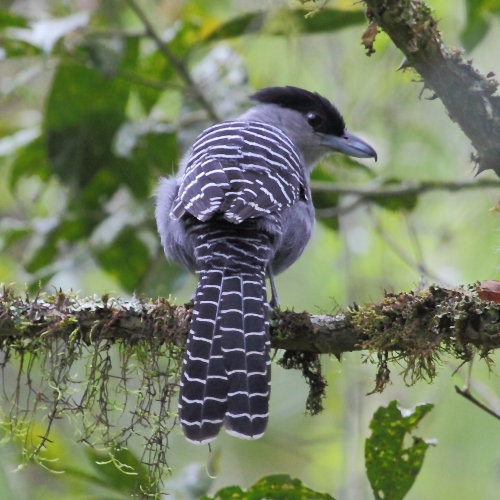
The Ochre-rumped Antbird is fairly small, measuring about 13 centimeters in length. It displays a distinctive plumage pattern characterized by dark gray upperparts and a prominent ochre-colored rump, which gives the bird its name. The underparts are lighter gray, with fine barring on the flanks and belly that enhances its subtly elegant appearance.
Males and females have similar plumage, though males often exhibit slightly more vibrant coloring, particularly on the rump and tail. Juveniles resemble adults but tend to have duller plumage and less pronounced barring on the underparts. This can make young birds harder to identify in the dense foliage where they reside.
The Ochre-rumped Antbird can be confused with other antbird species, such as the Ferruginous Antbird, due to similar habitats and overlapping ranges. However, the ochre rump and the specific barring pattern on the underparts are reliable identifiers. When perched, the Ochre-rumped Antbird maintains an upright posture, often flicking its tail as it forages.
Having trouble telling birds apart? Upload a photo to our bird identification tool for an instant species match.
Ochre-rumped Antbird Habitat and Range
Preferred Habitat
The Ochre-rumped Antbird is a forest specialist, inhabiting the moist, dense understory of the Atlantic Forest. It favors areas with abundant bamboo thickets and vine tangles, which provide cover and foraging opportunities. This bird is typically found at elevations ranging from 500 to 2000 meters, although it predominantly occupies the mid-elevation zones where conditions are ideal for its survival.
Unlike some other bird species, the Ochre-rumped Antbird does not exhibit significant seasonal habitat shifts, maintaining its presence in the forest throughout the year. Urbanization poses a threat to its habitat as the Atlantic Forest continues to shrink due to human activities. Conservation of these forests is critical to preserving the natural environment of this species.
Geographic Range
The Ochre-rumped Antbird is endemic to southeastern Brazil, with its range confined to the Atlantic Forest biome. It is primarily found in the states of São Paulo, Rio de Janeiro, and Espírito Santo, where it inhabits the dense, humid forests and bamboo thickets. Its range does not extend beyond these areas, making the bird a true resident of the Atlantic Forest.
There are no known migration patterns for this species, as it is a sedentary bird that remains in its preferred habitat year-round. Within its range, population densities can vary, with higher concentrations often found in regions where the understory is particularly dense and well-preserved.
Want to know which birds visit your area? Browse our backyard birds by location guides for region-specific species lists.
What Does the Ochre-rumped Antbird Eat?
The Ochre-rumped Antbird primarily feeds on insects and other small arthropods, making it an active and agile forager in its forest home. It employs a methodical foraging technique, carefully picking insects from leaves, twigs, and branches. The bird often follows mixed-species flocks, taking advantage of the disturbance caused by other birds to flush out hidden prey.
In terms of prey size, the Ochre-rumped Antbird targets small to medium-sized insects, including ants, beetles, and caterpillars. Its feeding schedule is influenced by the availability of prey, with peak foraging activity occurring during the cooler parts of the day, such as early morning and late afternoon. Seasonal changes in insect populations can affect the diet of this antbird, although it remains predominantly insectivorous throughout the year.
Ochre-rumped Antbird Behavior and Social Structure
The Ochre-rumped Antbird exhibits a territorial and solitary nature, especially during the breeding season when pairs aggressively defend their chosen territories. This period sees increased vocal activity from the males, who sing persistently to establish dominance and attract mates. Courtship displays are subtle, often involving mutual foraging and the sharing of food between paired birds.
Outside the breeding season, these antbirds may sometimes join mixed-species foraging flocks, benefiting from the collective vigilance and increased foraging efficiency. When faced with predators, the Ochre-rumped Antbird employs evasive maneuvers, using the dense understory to disappear from sight quickly. Its daily activity patterns are heavily influenced by the availability of light, with dawn and dusk being the most active periods.
Ochre-rumped Antbird Nesting and Reproduction
The Ochre-rumped Antbird builds its nest close to the ground, usually within dense foliage or between bamboo stems. The nest is an open cup structure constructed from twigs, leaves, and plant fibers, providing camouflage in its natural habitat. These birds prefer secluded areas to minimize the risk of predation on their eggs and young.
A typical clutch consists of two to three eggs, which are incubated by both parents for about 14 to 16 days. After hatching, the chicks remain in the nest for approximately 12 to 14 days before fledging. Parental care is shared, with both parents involved in feeding and protecting the young. The Ochre-rumped Antbird typically raises one brood per year, although favorable conditions may sometimes lead to a second brood.
Ochre-rumped Antbird Sounds and Vocalizations
The song of the Ochre-rumped Antbird is distinctive and rhythmically structured, consisting of a series of rapid, high-pitched notes that rise and fall in a melodic pattern. These vocalizations serve as both territorial calls and mating signals, particularly during the breeding season.
In addition to its primary song, this antbird emits sharp, quick call notes used in communication with its mate or to alert others to potential threats. Alarm calls are typically harsher and more urgent, designed to warn of approaching predators. The bird participates in dawn chorus behavior, contributing its voice to the rich symphony of the forest.
Interesting Facts About the Ochre-rumped Antbird
- 1The Ochre-rumped Antbird's distinct rump coloration aids in identification amidst dense foliage.
- 2This antbird relies on mixed-species flocks to increase foraging success and predator awareness.
- 3With a length of about 13 cm, the Ochre-rumped Antbird is a compact yet agile forest dweller.
- 4Its song, a rapid sequence of notes, is a key identifier and plays a crucial role in mating rituals.
- 5The Ochre-rumped Antbird's habitat, the Atlantic Forest, is one of the most biodiverse regions on Earth.
- 6Despite its limited range, this bird contributes significantly to insect population control in its habitat.
- 7Both male and female Ochre-rumped Antbirds share responsibilities in nesting and raising their young.
Ochre-rumped Antbird Conservation Status
The Ochre-rumped Antbird is currently classified as Near Threatened by the IUCN due to its restricted range and the ongoing threat of habitat loss. Deforestation and habitat fragmentation are the primary concerns, fueled by agricultural expansion and urban development in Brazil's Atlantic Forest. Conservation efforts are underway to preserve the remaining forest habitats, including the establishment of protected areas and reforestation projects. Despite these efforts, the population trend of the Ochre-rumped Antbird remains a concern, with continued monitoring necessary to ensure its survival.