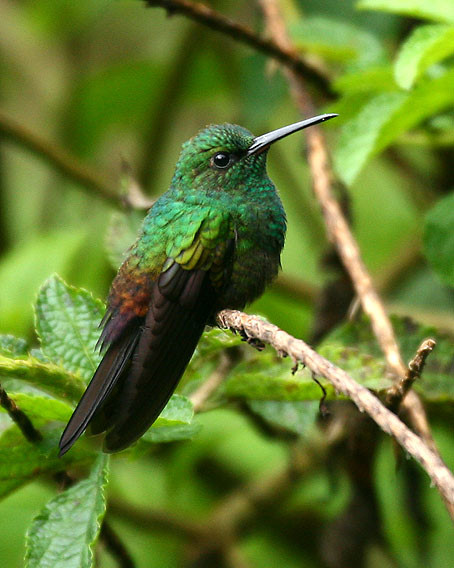
Olive-spotted Hummingbird
Talaphorus chlorocercus
Order: Apodiformes / Family: Trochilidae

Wikimedia Commons
About the Olive-spotted Hummingbird
The Olive-spotted Hummingbird, scientifically known as Talaphorus chlorocercus, is a fascinating member of the family Trochilidae. This small bird is predominantly found in the tropical regions of South America, particularly in countries such as Ecuador, Peru, and Colombia. These hummingbirds thrive in the lush, dense forests, often making their home in areas rich with flowering plants. Their role in the ecosystem is significant, as they are key pollinators for many plant species, contributing to the biodiversity of their habitat. During the rainy season, these birds are especially active, as the abundance of flowers provides ample nectar, their primary food source. The Olive-spotted Hummingbird is an important indicator of forest health, and its presence signifies a well-functioning ecosystem. These birds exhibit seasonal behaviors, adjusting their feeding and nesting practices according to the availability of resources. While primarily non-migratory, localized movements in search of food are common. The hummingbird's ecological role extends beyond pollination; they also serve as prey for larger avian species, maintaining a balance in the food chain. Observing the Olive-spotted Hummingbird offers insights into the complex interactions within tropical ecosystems, highlighting the intricate relationships between flora and fauna.
The Olive-spotted Hummingbird belongs to the family Trochilidae, within the order Apodiformes. These birds typically live average 4 years with max recorded 7 years.
How to Identify a Olive-spotted Hummingbird
The Olive-spotted Hummingbird is characterized by its iridescent green plumage that catches the light brilliantly, making it a dazzling sight amidst forest foliage. Adult males typically display a more vivid coloration compared to females, with a striking metallic sheen. Females, while also green, tend to have slightly duller plumage. Juveniles resemble females but with a more subdued color palette. The bird's name is derived from the distinctive olive spots that decorate its flanks, a feature that aids in quick identification. Its slender, elongated beak is perfectly adapted for nectar feeding, allowing it to reach deep into flowers. In flight, the Olive-spotted Hummingbird presents a silhouette typical of the species group, with rapid wing beats that create a blur to the human eye. When perched, this hummingbird sits upright, often on thin branches or twigs, where it can easily spot rivals or potential mates. It's important to distinguish this species from similar hummingbirds such as the Rufous-tailed Hummingbird; the Olive-spotted Hummingbird lacks the rufous tail and has a more uniform green body.
Having trouble telling birds apart? Upload a photo to our bird identification tool for an instant species match.
Olive-spotted Hummingbird Habitat and Range
Preferred Habitat
The Olive-spotted Hummingbird inhabits tropical rainforests, favoring areas with abundant flowering vegetation. It thrives at elevations ranging from sea level up to 1,500 meters. These birds are most frequently found in undisturbed forest environments but have also been observed in secondary growth and edge habitats. Unlike many birds, the Olive-spotted Hummingbird shows resilience in slightly altered landscapes, provided there is a sufficient supply of nectar-rich flowers. Despite their adaptability, they prefer rural over urban settings, where the natural flora is more prevalent. Seasonal changes in flower availability can prompt shifts in habitat use, with birds moving to higher elevations during dry periods to access blooming plants.
Geographic Range
The Olive-spotted Hummingbird is primarily found in the northwestern regions of South America. Its range includes countries such as Ecuador, Peru, and Colombia, where it occupies tropical and subtropical environments. These birds do not undertake long migrations, but they do exhibit localized movements in response to the flowering cycles of their preferred food sources. They are most commonly seen in the Amazon Basin and the eastern slopes of the Andes. In these regions, population densities can vary, with hotspots of abundance where floral resources are plentiful. Although generally not considered migratory, the Olive-spotted Hummingbird's movements are influenced by seasonal changes in nectar availability.
Want to know which birds visit your area? Browse our backyard birds by location guides for region-specific species lists.
What Does the Olive-spotted Hummingbird Eat?
The Olive-spotted Hummingbird primarily feeds on nectar, which it collects by inserting its long, slender bill into flowers. It prefers tubular flowers that match its bill shape, allowing efficient nectar extraction. While nectar constitutes the bulk of its diet, the hummingbird also consumes small insects and spiders, providing essential proteins and nutrients. Seasonal variations in flowering patterns can lead to shifts in diet, with a greater reliance on insects during periods of scarce floral resources. Foraging typically occurs during daylight hours, with peak activity in the early morning and late afternoon. The bird employs a hovering technique to access flowers, showcasing its remarkable agility and precision in flight.
Want to attract Olive-spotted Hummingbirds to your yard? See our recommended feeders and seed types for the best results.
Olive-spotted Hummingbird Behavior and Social Structure
Olive-spotted Hummingbirds exhibit solitary behavior, although they may be seen in loose aggregations around abundant food sources. These birds are highly territorial, with males fiercely defending their feeding and nesting territories against intruders. Courtship involves elaborate aerial displays, where males perform intricate maneuvers to attract females. Once paired, the female takes on the primary role of nest building and chick rearing. Despite their territorial nature, Olive-spotted Hummingbirds display a certain tolerance towards other nectar-feeding species, occasionally sharing feeding grounds. These hummingbirds maintain a strict daily routine, with periods of intense activity interspersed with rest and preening. Their small size and rapid flight make them challenging targets for predators, although they remain vigilant to threats.
Olive-spotted Hummingbird Nesting and Reproduction
The Olive-spotted Hummingbird constructs small, cup-shaped nests using plant fibers, spider silk, and moss, which provide camouflage and stability. Nests are typically located on thin branches, often well-concealed among leaves. The female lays two white eggs, which she incubates alone for about 15-18 days. After hatching, chicks remain in the nest for approximately 20-25 days, during which the female provides constant care and feeding. Both parents participate in defending the nest from potential threats, although the male's involvement diminishes after the eggs are laid. The Olive-spotted Hummingbird usually raises one to two broods per year, depending on environmental conditions and food availability.
Olive-spotted Hummingbird Sounds and Vocalizations
The Olive-spotted Hummingbird produces a distinctive series of high-pitched, rapid chirps, which serve both as territorial calls and communication between mates. These sounds, often described as a mix of whistles and clicks, are sharp and clear, cutting through the ambient noise of the forest. During courtship displays, males may emit more melodious, complex songs to attract females. Alarm calls are quick and repetitive, designed to alert others of potential danger. The dawn chorus, less prominent than in songbirds, nonetheless features these hummingbirds as they begin their daily activities.
Interesting Facts About the Olive-spotted Hummingbird
- 1The Olive-spotted Hummingbird can beat its wings up to 70 times per second, enabling its extraordinary hovering capability.
- 2Despite their small size, weighing around 4 grams, these hummingbirds consume up to twice their body weight in nectar daily.
- 3The hummingbird's heart beats over 1,200 times per minute during flight, showcasing its high-energy lifestyle.
- 4These birds can visit hundreds of flowers in a single day, playing a crucial role in pollination across vast areas.
- 5The Olive-spotted Hummingbird's iridescent plumage results from microscopic platelets, not pigments, reflecting light.
- 6Females are solely responsible for nest building and chick rearing, providing all care from egg to fledging.
- 7Hummingbirds have excellent spatial memory, remembering the locations of individual flowers and feeders.
Olive-spotted Hummingbird Conservation Status
Currently, the Olive-spotted Hummingbird holds a status of Least Concern on the IUCN Red List. Despite this, certain populations face threats from habitat loss due to deforestation and agricultural expansion. Conservation efforts focus on preserving critical habitats and promoting sustainable land-use practices. The species' adaptability to secondary growth areas offers a measure of resilience, but ongoing monitoring is essential to ensure its continued survival. Historical data indicates stable population trends, though localized declines in heavily disturbed areas have been noted.
Attracting Olive-spotted Hummingbirds to Your Feeder
The Olive-spotted Hummingbird is a regular visitor to backyard bird feeders across its range. At the Eye On The Fly feeding station, we observe Olive-spotted Hummingbirds regularly and capture footage with our feeder cameras.
Other Trochilidae Species


Birds Similar to the Olive-spotted Hummingbird
These species are often confused with the Olive-spotted Hummingbird due to similar appearance or overlapping range.