
Olive Warbler
Peucedramus taeniatus
Order: Passeriformes / Family: Peucedramidae
Wikimedia Commons
About the Olive Warbler
The Olive Warbler, scientifically known as Peucedramus taeniatus, is a fascinating songbird that occupies a unique position within the avian taxonomy. As the sole member of the family Peucedramidae, this bird is of particular interest to ornithologists. The Olive Warbler is endemic to the high-altitude pine and fir forests of North and Central America, where it plays a significant ecological role in insect control. It contributes to the health of coniferous forests by preying on various arthropods, thus assisting in maintaining the balance of these ecosystems. The Olive Warbler is distinctive not only because of its taxonomic singularity but also due to its striking plumage and vocalizations. Typically, it resides in forests dominated by pine, fir, and oak, ranging from southern Arizona and New Mexico down through the Sierra Madre Occidental and into Central America, reaching as far south as Nicaragua. During the breeding season, which occurs from late spring to early summer, the Olive Warbler becomes especially active, engaging in intricate courtship displays and vocal performances to attract mates. These activities are crucial for establishing territories and ensuring reproductive success. The bird's presence is often a reliable indicator of healthy high-altitude forest ecosystems, as its survival depends on the availability of mature trees and a rich supply of insects. The Olive Warbler's adaptability to various forest strata allows it to exploit different ecological niches within its habitat. In addition to its ecological importance, the Olive Warbler serves as an inspiration for conservation efforts focused on preserving the unique montane forests it inhabits. Researchers have noted that the preservation of these habitats is crucial for the Olive Warbler's continued survival, as deforestation and habitat degradation pose significant threats. Consequently, understanding the Olive Warbler's role and requirements is vital for developing effective conservation strategies that benefit not only this species but the entire forest community.
The Olive Warbler belongs to the family Peucedramidae, within the order Passeriformes. These birds typically live average 6 years, with a maximum recorded of 10 years..
How to Identify a Olive Warbler
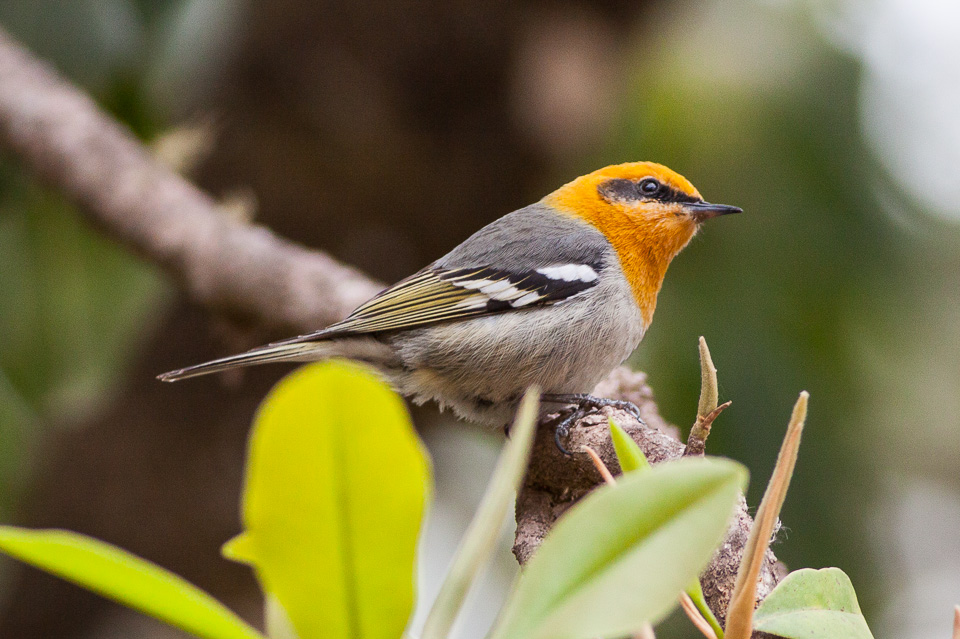
The Olive Warbler is readily identifiable by its unique coloration and structure. Adult males possess a striking orange head which contrasts sharply with their otherwise gray body and wings. The throat and upper chest are similarly orange, providing a vibrant splash of color. In contrast, females and juveniles display a more muted coloration. Females have a pale yellowish head and throat, with the rest of their plumage being primarily gray. Juveniles resemble females but are even duller, often with a slightly olive tinge on the head. Both sexes have two white wing bars, a distinguishing feature that aids in identification. The Olive Warbler is often mistaken for other small birds such as vireos or warblers, but its unique head coloration and family affiliation set it apart. In flight, the Olive Warbler presents a compact silhouette, with a short tail and rounded wings, typical of small passerines. When perched, it often assumes an upright posture, frequently flicking its wings and tail. This behavior, combined with its coloration and calls, helps birders pinpoint its presence in dense foliage. Observing these field marks and behaviors are essential for accurately identifying the Olive Warbler in its natural habitat.
Having trouble telling birds apart? Upload a photo to our bird identification tool for an instant species match.
Olive Warbler Habitat and Range
Preferred Habitat
The Olive Warbler thrives in high-altitude coniferous forests, particularly those dominated by pine, fir, and oak trees. These habitats are typically found at elevations ranging from 1,500 to 3,500 meters. The bird shows a preference for mature forests with a well-developed canopy, where it can forage for insects among the foliage. Seasonal habitat shifts occur as the bird seeks lower elevations during colder months, though it generally remains within montane forests. Unlike some species, the Olive Warbler is not commonly found in urban areas, preferring the tranquility and resources of remote mountain habitats. Its presence in forested areas indicates a preference for less disturbed environments, making it a species of interest for conservationists monitoring forest health.
Geographic Range
The Olive Warbler's range is relatively restricted compared to other North American songbirds. During the breeding season, it inhabits the mountain ranges of southern Arizona and New Mexico, extending southward through the Sierra Madre Occidental and Sierra Madre Oriental in Mexico. The species continues into Central America, reaching as far as Nicaragua. While the bird is primarily resident, there are altitudinal movements as it descends to lower elevations in winter, particularly in the northern parts of its range. Specific population density hotspots include the pine-oak forests of the Sierra Madre Occidental, where the Olive Warbler is considered locally common. However, its density decreases in more fragmented or degraded habitats, highlighting the importance of continuous forest tracts for its survival.
Want to know which birds visit your area? Browse our backyard birds by location guides for region-specific species lists.
What Does the Olive Warbler Eat?
The Olive Warbler primarily feeds on insects and other arthropods, which it gleans from the foliage of trees. Its diet consists mainly of caterpillars, beetles, and spiders. During the breeding season, the Olive Warbler's diet becomes even more insect-heavy as it requires additional nutrients to support nestlings. In the non-breeding season, its diet may also include small quantities of plant material such as seeds or berries, although this is less common. The Olive Warbler employs a methodical foraging technique, moving through the canopy in search of prey. It often hangs upside down from branches to reach insects on the undersides of leaves, displaying agility and resourcefulness in its pursuit of food. The bird's feeding schedule aligns with daylight hours, with peak activity occurring in the early morning and late afternoon when insect activity is highest.
Olive Warbler Behavior and Social Structure
The Olive Warbler exhibits a complex social structure, often maintaining small family groups during the breeding season. These groups typically consist of a mated pair and their offspring. The species displays territorial behavior, with males singing to defend their breeding territories from rivals. Courtship displays involve singing and intricate flight patterns designed to attract females. Outside the breeding season, the Olive Warbler may join mixed-species foraging flocks, taking advantage of the increased vigilance against predators. Its response to predators includes alarm calls and evasive flight maneuvers. The Olive Warbler is diurnal, primarily active during daylight hours. It follows a predictable daily pattern, with foraging activities dominating the morning and social interactions occurring throughout the day. The bird's behavior reflects its adaptation to the dynamic environment of montane forests, where resources and threats vary significantly.
Olive Warbler Nesting and Reproduction
Olive Warblers construct cup-shaped nests, typically placed in the outer branches of coniferous or oak trees, often at varying heights from the ground. The nest is composed of fine plant fibers, moss, and spider silk, providing a secure and camouflaged environment for the eggs. A typical clutch consists of 3 to 4 eggs, which the female incubates for about 12 to 14 days. Both parents participate in feeding the nestlings, which fledge approximately 14 to 16 days after hatching. The Olive Warbler may raise two broods per year, depending on environmental conditions and food availability. Parental roles are distinct, with the male primarily defending the territory while the female focuses on incubation and early chick care. This division of labor ensures the survival and development of the offspring in the demanding montane environment.
Olive Warbler Sounds and Vocalizations
The Olive Warbler's primary song is a series of high-pitched, musical notes, often described as a tinkling or jingling sound. This song serves as a territorial declaration and courtship signal. Call notes are soft and include a variety of sounds such as chips and trills. Alarm calls are more abrupt and sharp, alerting other birds to potential danger. The Olive Warbler participates in the dawn chorus, with males singing prominently at first light to reinforce territory boundaries. Its vocalizations, although not as complex as some other songbirds, are distinctive and carry well through the forested habitats it occupies, aiding in identification and adding to the acoustic landscape of its environment.
Interesting Facts About the Olive Warbler
- 1The Olive Warbler was once grouped with the New World warblers, but genetic studies revealed it as the sole member of its own family, Peucedramidae.
- 2Despite its name, the Olive Warbler's most distinctive feature is not its olive coloration but the vibrant orange head of the male.
- 3Unlike many warblers, the Olive Warbler has a more restricted range, being found only in high-altitude forests from the southwestern United States to Central America.
- 4The Olive Warbler's song, while simple, is effective in communicating territory boundaries and attracting mates in dense forest environments.
- 5Both male and female Olive Warblers participate in nest building, showcasing a cooperative breeding behavior uncommon in many bird species.
- 6The Olive Warbler's adaptability to different forest strata allows it to exploit a wide range of ecological niches within its mountain habitats.
- 7Its presence in a forest often indicates a healthy ecosystem, as it requires mature trees and abundant insect life for survival.
Olive Warbler Conservation Status
The Olive Warbler is currently listed as Least Concern by the IUCN. However, its population trend is uncertain due to habitat fragmentation and forest degradation in parts of its range. Primary threats include logging and land conversion for agriculture, which reduce available habitat. Conservation efforts focus on preserving high-altitude forests and promoting sustainable forestry practices. Historical population changes are not well-documented, but ongoing habitat loss emphasizes the need for continued monitoring. Protecting large tracts of montane forest is crucial for sustaining the Olive Warbler and maintaining the biodiversity of these unique ecosystems.
Other Peucedramidae Species
Birds Similar to the Olive Warbler
These species are often confused with the Olive Warbler due to similar appearance or overlapping range.

