
Peucedramus olivaceus
Peucedramus olivaceus
Order: Passeriformes / Family: Peucedramidae
About the Peucedramus olivaceus
The Olive Warbler, scientifically known as Peucedramus olivaceus, is a unique species that holds a singular position in ornithological taxonomy as the sole member of the family Peucedramidae. This species exhibits an unusual combination of characteristics that differentiates it from other warblers, highlighting its evolutionary distinctiveness. The Olive Warbler is primarily found in the mountainous regions of Central America and the southwestern United States, with its range extending from southern Arizona and New Mexico through Mexico and into El Salvador and Honduras. It thrives in coniferous forests, particularly those dominated by pines, at elevations ranging from 1,800 to 3,500 meters. The ecological role of the Olive Warbler is characterized by its insectivorous diet, which helps control insect populations, contributing to the balance of forest ecosystems. This bird's presence signals a healthy forest environment, as it requires specific habitat conditions to thrive. During the breeding season, the Olive Warbler engages in fascinating behaviors, including intricate courtship displays. Males put on vivid performances to attract females, showcasing their agility and vocal prowess. These displays are crucial for establishing territories and ensuring successful mating. Seasonal changes in behavior also occur, with the Olive Warbler exhibiting altitudinal migration patterns in response to climatic conditions. In winter, some populations may move to lower elevations or slightly different habitats, though they generally remain within their established range. The Olive Warbler's significance extends beyond its ecological role. It serves as an important indicator species for conservationists monitoring forest health in its range. Changes in its population or distribution can signal alterations in forest conditions, prompting conservation efforts. Protecting the habitats of the Olive Warbler not only preserves this unique species but also supports the broader ecological integrity of the regions it inhabits.
The Peucedramus olivaceus belongs to the family Peucedramidae, within the order Passeriformes. These birds typically live average 5 years, with a maximum recorded of 9 years..
How to Identify a Peucedramus olivaceus
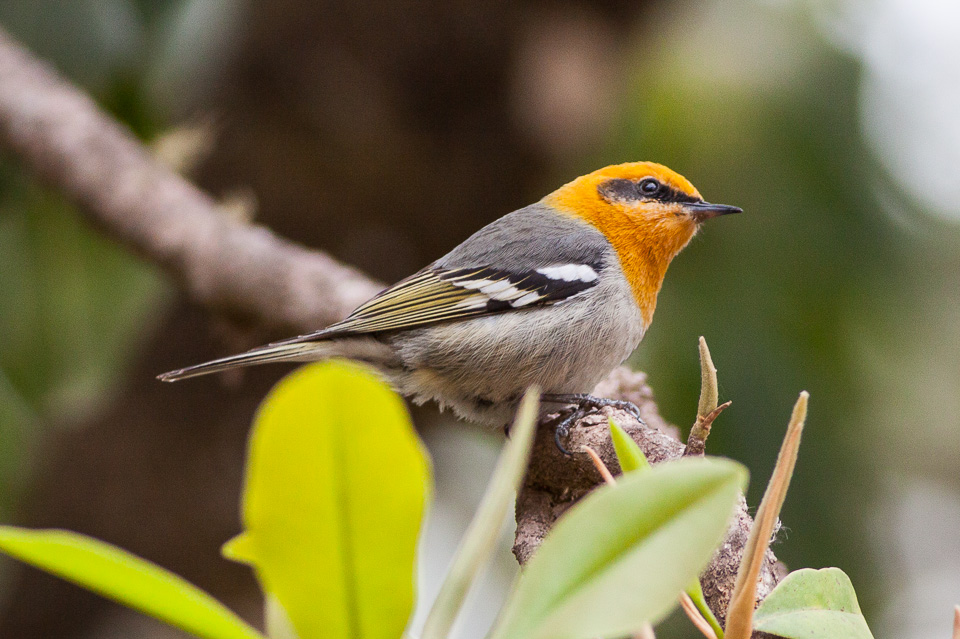
Identifying the Olive Warbler involves noting several distinct field marks. Adult males are particularly striking, with their olive-green plumage, contrasting with a black facial mask and bright orange forehead and throat. The wings and tail are primarily gray, offering a subtle but noticeable contrast to the vibrant body colors. Females and juveniles are more muted, exhibiting a duller olive tone with less pronounced black facial markings and a paler orange throat, making sex and age differentiation possible with careful observation. While the Olive Warbler's coloration sets it apart, its size, comparable to that of a small chickadee (about 12-14 cm in length), and its distinctive song further aid in identification. In flight, the Olive Warbler displays a characteristic undulating flight pattern, typical of many small passerines. When perched, it often holds a slightly upright posture, which, along with its unique coloration, assists birders in distinguishing it from other warblers. Confusion with similar species, like the Orange-crowned Warbler, can occur, but the Olive Warbler's contrasting facial patterns and unique song help prevent misidentification.
Having trouble telling birds apart? Upload a photo to our bird identification tool for an instant species match.
Peucedramus olivaceus Habitat and Range
Preferred Habitat
The Olive Warbler is predominantly associated with high-elevation coniferous forests, particularly those rich in pine species. It inhabits regions such as the Sierra Madre Occidental and the mountains of southeastern Arizona and southwestern New Mexico. These forests provide the dense canopy cover and abundant insect life necessary for its survival. The Olive Warbler shows a preference for habitats at elevations between 1,800 and 3,500 meters, often moving to different altitudes with seasonal temperature variations. While typically found in remote forested areas, it occasionally ventures into adjacent open woodlands and is less commonly seen in urban environments. Seasonal habitat shifts are observed, with some populations descending to lower elevations during colder months. However, the Olive Warbler remains a predominantly forest-dwelling species, rarely straying far from its preferred coniferous habitats.
Geographic Range
The Olive Warbler's range spans the southwestern United States through Central America. In the United States, it primarily breeds in the high-altitude forests of southern Arizona and southwestern New Mexico. Its range extends southward through the mountainous regions of Mexico, including the Sierra Madre Occidental and Oriental, and continues into Guatemala, El Salvador, and Honduras. During the breeding season, the Olive Warbler is most commonly found at higher elevations, taking advantage of cooler temperatures and abundant food resources. Some populations engage in altitudinal migration, moving to lower elevations or slightly different forest types during the winter months. Despite this seasonal movement, the Olive Warbler tends to stay within its general range, seldom venturing far from its traditional habitats. Population densities are highest in areas with extensive, undisturbed pine forests, where conditions are optimal for breeding and feeding.
Want to know which birds visit your area? Browse our backyard birds by location guides for region-specific species lists.
What Does the Peucedramus olivaceus Eat?
The Olive Warbler primarily feeds on insects, making it an integral part of its forest ecosystem. Its diet consists mainly of caterpillars, beetles, and other small arthropods, which it gleans from the needles and branches of pine trees. The Olive Warbler employs a variety of foraging techniques, including hover-gleaning and flycatching, to capture its prey. During the breeding season, its dietary needs increase, leading to more active and frequent foraging behaviors. Seasonal variations in diet occur as insect availability changes, with the Olive Warbler occasionally supplementing its diet with seeds or berries during colder months when insects are less abundant. This adaptability in diet helps the Olive Warbler maintain its energy requirements throughout the year, allowing it to thrive in its forested habitat.
Peucedramus olivaceus Behavior and Social Structure
The Olive Warbler exhibits a range of fascinating behaviors, particularly during the breeding season. Males are highly territorial, defending their chosen nesting sites with vigorous song and displays. Courtship involves elaborate aerial displays and vocalizations to attract females and establish pair bonds. Once paired, Olive Warblers maintain a monogamous bond throughout the breeding season. These birds are generally solitary or found in pairs during the breeding season, but they may form small mixed-species flocks outside of it. The Olive Warbler's response to predators includes alarm calls and evasive flight patterns. They are generally active during daylight hours, with peak activity occurring in the early morning and late afternoon when foraging is most productive. Their daily routine involves moving through the forest canopy in search of food, interspersed with periods of rest and preening.
Peucedramus olivaceus Nesting and Reproduction
Olive Warblers construct their nests high in the canopy of pine trees, often at heights exceeding 10 meters. The nest is a compact, cup-shaped structure made from a variety of materials, including twigs, grass, moss, and spider silk, providing both stability and camouflage. The female typically selects the nesting site and is primarily responsible for building the nest. Clutch sizes range from three to four eggs, which the female incubates for about 12 to 14 days. Both parents participate in feeding the chicks, which fledge approximately two weeks after hatching. The Olive Warbler may produce one to two broods per year, depending on environmental conditions and food availability. Parental care continues after fledging, with adults teaching the young essential survival skills.
Peucedramus olivaceus Sounds and Vocalizations
The Olive Warbler's song is a distinctive, melodic series of clear, whistled notes delivered in rapid succession. The rhythm is steady, with a sweet and flute-like quality that can be heard echoing through its forest habitat. In addition to its primary song, the Olive Warbler emits a variety of call notes, including soft chips and more urgent alarm calls when threatened by predators. During the dawn chorus, the Olive Warbler's song is especially prominent, contributing to the vibrant acoustic landscape of its environment. Birders often compare its song to that of the Pine Warbler, though the Olive Warbler's notes are generally clearer and more musical.
Interesting Facts About the Peucedramus olivaceus
- 1The Olive Warbler is the only member of its family, Peucedramidae, highlighting its unique evolutionary path.
- 2Despite its common name, the Olive Warbler is not a true warbler, distinguishing it taxonomically from others.
- 3Olive Warblers exhibit altitudinal migration, moving to different elevations with changing seasons.
- 4Their nests are often constructed more than 10 meters above the ground, providing safety from many predators.
- 5The Olive Warbler's song is often compared to that of a flute, making it a favorite among birdwatchers.
- 6Male Olive Warblers are known for their striking courtship displays, which involve both song and movement.
- 7These birds play a crucial role in controlling insect populations in their forest habitats.
Peucedramus olivaceus Conservation Status
The Olive Warbler is currently classified as Least Concern by the IUCN, with populations considered stable. However, habitat loss due to deforestation and climate change poses ongoing threats to its long-term survival. Conservation efforts focus on preserving and restoring coniferous forest habitats, particularly in regions with significant deforestation pressures. Historical population trends have shown some fluctuations, but the Olive Warbler has generally maintained stable numbers thanks to its adaptability and broad range. Continued monitoring and habitat protection are essential to ensure the species remains a vibrant part of its ecosystem.
Other Peucedramidae Species
Birds Similar to the Peucedramus olivaceus
These species are often confused with the Peucedramus olivaceus due to similar appearance or overlapping range.
