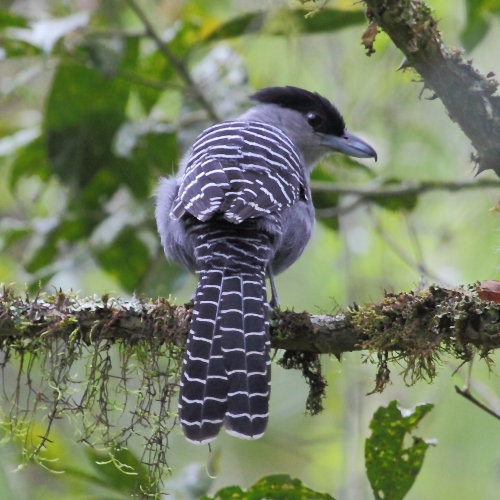
Pacific Antwren
Myrmotherula pacifica
Order: Passeriformes / Family: Thamnophilidae

Wikimedia Commons
About the Pacific Antwren
The Pacific Antwren, Myrmotherula pacifica, is a member of the Thamnophilidae family, characterized by its diminutive size and contrasting black-and-white plumage. This bird primarily inhabits the dense understory of tropical forests along the Pacific slope. Its presence is particularly noted in the Chocó region, which spans parts of western Colombia and northwestern Ecuador. The dense, humid forests of these regions offer the perfect environment for the Pacific Antwren, providing ample foraging opportunities and shelter. As a resident species, the Pacific Antwren does not migrate, maintaining its territory year-round. Its ecological role is significant, as it controls insect populations, serving as a natural pest deterrent. In addition, the Pacific Antwren contributes to the complex food web of the forest ecosystem by serving as prey to larger birds and mammals. This antwren is often observed participating in mixed-species flocks, a behavior that facilitates efficient foraging and provides protection against predators. Its ability to thrive in such biodiverse habitats underscores its adaptability and ecological importance. The Pacific Antwren's activity peaks during the early morning and late afternoon when it actively searches for food, emitting its distinctive calls. Its role extends beyond mere predation as it influences the reproductive success of various plant species by dispersing seeds and controlling insect herbivores. Despite facing threats from habitat destruction and deforestation, the Pacific Antwren remains a vital component of its ecosystem, emblematic of the fragile balance within tropical forests.
The Pacific Antwren belongs to the family Thamnophilidae, within the order Passeriformes. These birds typically live average 4-5 years, with a maximum recorded of 7 years..
How to Identify a Pacific Antwren
The Pacific Antwren is a small bird, measuring approximately 10 cm in length and weighing around 8 grams. Adult males display striking black-and-white plumage, with a predominantly black head and upperparts contrasted by white wing bars and underparts. Females, while also patterned, tend to exhibit more muted tones with grayish-brown rather than black. Juveniles resemble females but are often paler with less distinct markings. The Pacific Antwren can be confused with similar species such as the Checker-throated Antwren; however, its lack of a spotted throat and its unique vocalizations aid in distinguishing it. In flight, the Pacific Antwren's silhouette is compact with rapid wingbeats, while its perching posture is often upright and alert. Observers should note the bird's active movement through foliage, as it rarely remains still for long.
Having trouble telling birds apart? Upload a photo to our bird identification tool for an instant species match.
Pacific Antwren Habitat and Range
Preferred Habitat
The Pacific Antwren thrives in the dense, humid understory of tropical lowland forests. It is most commonly found in primary and mature secondary forests at elevations ranging from sea level to about 1,200 meters. This species favors areas with a closed canopy and thick leaf litter, which provide abundant insect prey. The Chocó region's forested landscapes offer the ideal habitat, though the Pacific Antwren can occasionally be found in forest edges and clearings. It tends to avoid urban areas, preferring the seclusion of dense vegetation. Seasonal changes in habitat use are minimal, as the species does not migrate and remains in its preferred environment year-round.
Geographic Range
The Pacific Antwren's range is primarily restricted to the Pacific slope of northwestern South America, specifically within Colombia and Ecuador. This bird inhabits the Chocó biogeographic region, known for its high biodiversity and endemism. Within this range, the Pacific Antwren is a year-round resident, with no significant migratory movements. Population densities are highest in areas of undisturbed forest, though local populations can be affected by deforestation and habitat fragmentation. Despite its limited range, the species is relatively common within suitable habitats, often observed in conjunction with mixed-species foraging flocks.
Want to know which birds visit your area? Browse our backyard birds by location guides for region-specific species lists.
What Does the Pacific Antwren Eat?
The Pacific Antwren primarily feeds on insects and other arthropods, which it gleans from leaves and branches in the forest understory. Its diet includes ants, beetles, spiders, and caterpillars. The antwren employs a foraging technique known as 'hover-gleaning,' where it hovers momentarily to pick prey off foliage. During the wet season, when insect abundance is high, the Pacific Antwren's diet is rich with a variety of prey. In drier periods, it may supplement its diet with small fruits or seeds. Foraging takes place throughout the day, with peak activity in the cool hours of morning and late afternoon.
Pacific Antwren Behavior and Social Structure
The Pacific Antwren exhibits social behavior, often joining mixed-species flocks. This strategy enhances foraging efficiency and provides safety in numbers against predators. While generally non-territorial, the Pacific Antwren may exhibit aggressive behavior towards intruders during the breeding season. Courtship displays are subtle, involving vocalizations and mutual preening. Though not strongly flocking, the Pacific Antwren benefits from the protection and collaborative foraging offered by multi-species associations. Its daily routine involves active foraging interspersed with periods of rest and preening. In response to predators, it relies on its cryptic plumage and quick, agile movements through dense vegetation.
Pacific Antwren Nesting and Reproduction
The Pacific Antwren constructs a small, cup-shaped nest made of plant fibers, leaves, and moss. Typically, these nests are located low in shrubs or small trees, often well-concealed in dense foliage. The female lays a clutch of two to three eggs, which both parents incubate for about 14 to 16 days. After hatching, the chicks are altricial and require constant care and feeding. Fledging occurs approximately 10 to 12 days after hatching, with both parents actively involved in feeding and protecting the young. The Pacific Antwren generally raises one brood per year, though favorable conditions may allow for a second.
Pacific Antwren Sounds and Vocalizations
The Pacific Antwren's primary song is a series of quick, high-pitched notes, delivered in a rapid, rhythmic sequence that resembles the sound of a bouncing ball. Its call notes are sharp and metallic, often used to maintain contact with flock members. In the presence of potential threats, the Pacific Antwren emits a distinctive alarm call, a sharp 'chip' note repeated in quick succession. During the dawn chorus, its song is most prominent, contributing to the cacophony of sounds in the forest understory.
Interesting Facts About the Pacific Antwren
- 1The Pacific Antwren is one of the many bird species endemic to the biodiversity-rich Chocó region, known for its high level of species endemism.
- 2Despite its small size, the Pacific Antwren plays a crucial role in controlling insect populations, effectively acting as a natural pest manager in its habitat.
- 3The Pacific Antwren's distinctive song and calls can be an important tool for birdwatchers to locate and identify it in the dense forest understory.
- 4This species forms part of the mixed-species flocks, which can include up to 40 different bird species, enhancing their collective foraging success.
- 5The Pacific Antwren's habitat is among the world's most humid areas, receiving up to 8 meters of rainfall annually, supporting lush vegetation.
- 6Although primarily insectivorous, the Pacific Antwren may occasionally consume small fruits, showcasing its dietary flexibility.
- 7The dense forests inhabited by the Pacific Antwren are also home to several critically endangered species, emphasizing the need for habitat conservation.
Pacific Antwren Conservation Status
The Pacific Antwren is currently listed as Least Concern by the IUCN. While its population is suspected to be decreasing due to habitat loss, particularly from deforestation and land conversion in the Chocó region, it remains relatively common within its limited range. Conservation efforts focus on preserving its habitat through the establishment of protected areas and sustainable land management practices. Historical population changes are not well-documented, but ongoing deforestation poses a significant threat to its continued survival.