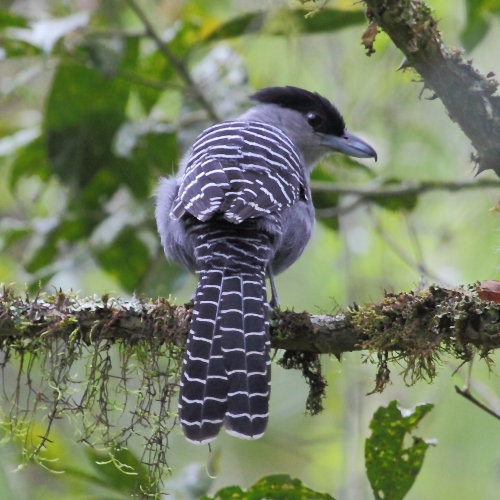
Pale-faced Bare-eye
Phlegopsis borbae
Order: Passeriformes / Family: Thamnophilidae

Wikimedia Commons
About the Pale-faced Bare-eye
The Pale-faced Bare-eye (Phlegopsis borbae) is a striking bird found in the dense forests of the Amazon Basin. This bird belongs to the Thamnophilidae family, a group of antbirds known for their specialized foraging behaviors. The Pale-faced Bare-eye has evolved to depend heavily on the intricate ecosystems of South America's lowland rainforests, where it plays a crucial role as both a predator and a participant in mixed-species flocks. This bird typically inhabits Brazil, specifically in the states of Amazonas and Pará, where vast tracts of rainforest provide the cover and resources it requires.
The significance of the Pale-faced Bare-eye extends beyond its beauty, as it contributes to the complex food web of the Amazon. Acting as an insectivore, it helps control the population of various arthropods, which in turn influences the health of plant life by controlling herbivorous insect populations. This balance highlights the interconnectedness of rainforest species and underlines the bird's ecological importance.
Within these forested habitats, the Pale-faced Bare-eye demonstrates seasonal behaviors that are closely tied to the breeding cycle and resource availability. During the breeding season, these birds exhibit increased territoriality, often becoming more vocal to ward off competitors and attract mates. Outside of this period, they join mixed-species flocks, enhancing their foraging success by reducing the risk of predation and increasing access to food resources. This seasonal flexibility showcases the bird's adaptability to the ever-changing conditions of its environment.
The Pale-faced Bare-eye's contribution to its ecosystem underscores the broader significance of protecting its habitat. Deforestation and habitat fragmentation pose significant threats to its survival, making conservation efforts critical. The bird's presence serves as an indicator of forest health, and its study can reveal much about the ecological dynamics within one of the world's most biodiverse regions.
The Pale-faced Bare-eye belongs to the family Thamnophilidae, within the order Passeriformes. These birds typically live average 6-8 years, with a maximum recorded of 12 years..
How to Identify a Pale-faced Bare-eye
The Pale-faced Bare-eye can be identified by its unique facial characteristics, most notably the bare skin around its eyes, which is a pale, almost translucent shade. The rest of its plumage is primarily deep brown with subtle differences between the sexes. Males tend to exhibit a slightly richer brown tone compared to females, who have a more muted appearance overall. Juveniles resemble adults but with a slightly duller coloration.
In the field, distinguishing the Pale-faced Bare-eye from similar species can be challenging due to its preference for dense undergrowth. However, its behavior of following army ant swarms and its distinctive call often aid in identification. The bird's silhouette is compact with a short tail, and it often adopts an upright, alert posture when perching, keeping an eye out for both prey and potential threats.
Confusion with other antbird species occurs primarily with those sharing its habitat, such as the White-plumed Antbird. However, the Pale-faced Bare-eye's distinct facial markings and vocalizations usually help differentiate it. Observers should pay close attention to the bird's eye region and listen for its calls to ensure accurate identification.
Having trouble telling birds apart? Upload a photo to our bird identification tool for an instant species match.
Pale-faced Bare-eye Habitat and Range
Preferred Habitat
The Pale-faced Bare-eye thrives in the Amazonian rainforest, favoring dense, humid undergrowth where army ant swarms are frequent. It is most commonly found in lowland tropical forests, with an elevation range primarily from sea level to about 500 meters. These birds prefer areas with a closed canopy, which provides the cover and microhabitats necessary for their survival.
Seasonal habitat shifts are minimal for the Pale-faced Bare-eye since it is a resident species, relying on the consistent climate and resources of the rainforest. Unlike some other bird species, it does not typically venture into urban areas, as it requires the specific ecological conditions only found in vast forested regions.
The bird's preference for undisturbed forest underscores the importance of preserving these environments. Habitat destruction through logging and agriculture poses significant threats, as these activities reduce the available habitat and disrupt the delicate balance of the ecosystem.
Geographic Range
The Pale-faced Bare-eye is endemic to the Amazon Basin, specifically within Brazil's states of Amazonas and Pará. It resides year-round in these lowland forests, relying on the rich biodiversity of the region to sustain its life cycle. This bird does not migrate, as its habitat provides the necessary resources throughout the year.
Within its range, the Pale-faced Bare-eye can be found in population density hotspots correlating with areas of high ant swarm activity. These swarms provide a critical food source, drawing the bird to regions where army ants are more prevalent. Consequently, the bird's distribution is closely tied to the availability and distribution of these swarms.
While widespread within its range, the Pale-faced Bare-eye's reliance on pristine forest environments makes it vulnerable to habitat loss. As deforestation continues to alter the landscape, suitable areas for the bird diminish, making conservation efforts vital to ensure the species' continued survival in its native range.
Want to know which birds visit your area? Browse our backyard birds by location guides for region-specific species lists.
What Does the Pale-faced Bare-eye Eat?
The Pale-faced Bare-eye primarily feeds on insects and other small arthropods, with a particular preference for those flushed out by army ant swarms. This bird's diet consists of a variety of prey, including beetles, spiders, and larvae, which it captures with precision using its short, sturdy bill.
Seasonally, the bird's diet may shift slightly depending on the availability of prey. During periods of lower ant activity, the Pale-faced Bare-eye relies more heavily on solitary foraging, picking insects from foliage or the forest floor. However, it thrives best in the presence of ant swarms, where it can partake in the abundance of prey disturbed by the ants' movements.
Foraging typically occurs during daylight hours, with peaks in activity during the early morning and late afternoon. The bird moves quickly through the underbrush, often following ant swarms to maximize its foraging success. Its reliance on this unique foraging strategy highlights the importance of army ants in its ecosystem and the bird's specialized adaptation to its environment.
Pale-faced Bare-eye Behavior and Social Structure
The Pale-faced Bare-eye exhibits intriguing social and territorial behaviors, particularly during the breeding season. While generally solitary or found in pairs, these birds display heightened territoriality during this period, vigorously defending their chosen area from rival pairs. Courtship involves vocal displays and synchronized movements, with pairs often engaging in duet singing to strengthen their bond.
Beyond the breeding season, the Pale-faced Bare-eye often joins mixed-species flocks, a strategy that enhances foraging efficiency and provides safety in numbers. These flocks typically form around ant swarms, with the Pale-faced Bare-eye taking advantage of the ants' ability to flush out prey from the forest floor.
The bird's response to predators includes remaining motionless or issuing alarm calls to alert others of danger. Its daily activity pattern revolves around foraging and territorial maintenance, with peak activity during cooler parts of the day, such as early morning and late afternoon. This routine ensures that the bird expends energy efficiently while avoiding the heat of midday.
Pale-faced Bare-eye Nesting and Reproduction
The Pale-faced Bare-eye constructs its nest in the dense undergrowth of the Amazon rainforest, choosing locations that provide both concealment and protection from predators. The nest itself is a cup-shaped structure made primarily of leaves, twigs, and other plant materials, meticulously woven together to create a secure environment for its eggs.
Clutch size typically ranges from two to three eggs, which both parents incubate over a period of about 14 to 16 days. During this time, the pair takes turns foraging and guarding the nest, showcasing a shared responsibility in rearing their young.
Once hatched, the chicks grow quickly, fledging approximately 11 to 13 days after hatching. Parental roles continue to be equally divided, with both adults providing food and protection to their offspring until they can fend for themselves. The Pale-faced Bare-eye usually raises one brood per year, with breeding timed to coincide with peak insect availability, ensuring sufficient resources for their young.
Pale-faced Bare-eye Sounds and Vocalizations
The Pale-faced Bare-eye's song is a distinctive series of sharp, rhythmic notes, often described as a high-pitched 'chip-chip-chip' sound that resonates through the dense forest undergrowth. This song serves as both a territorial declaration and a courtship display, with males particularly vocal during the breeding season.
In addition to its primary song, the Pale-faced Bare-eye also emits a variety of call notes, including softer 'tut-tut' sounds used for communication between mates or flock members. Alarm calls are harsher and more abrupt, designed to alert others to potential threats nearby. During the dawn chorus, the bird's song can be heard alongside those of other forest inhabitants, contributing to the rich tapestry of sound that defines the Amazon rainforest.
The bird's vocalizations are key identifiers, aiding in its detection in the often visually obscured environment it inhabits. Recognizing these sounds is invaluable for those studying or observing the species in its natural habitat.
Interesting Facts About the Pale-faced Bare-eye
- 1The Pale-faced Bare-eye's reliance on ant swarms is so strong that it often follows them for hours, picking off fleeing insects.
- 2Despite its name, the Pale-faced Bare-eye's face isn't entirely bare but features unique feather arrangements that make it appear so.
- 3The bird's vocalizations are not only a means of communication but also play a critical role in establishing and maintaining territories.
- 4Unlike many bird species, both male and female Pale-faced Bare-eyes participate equally in nest building and chick rearing.
- 5The Pale-faced Bare-eye's habitat preference for dense undergrowth makes it a challenging subject for photographers and birdwatchers.
- 6Research suggests that Pale-faced Bare-eyes can recognize individual ant swarms, following specific ones that yield better foraging success.
- 7Even within the dense Amazon rainforest, the Pale-faced Bare-eye's distinctive calls can carry long distances, aiding in locating mates.
Pale-faced Bare-eye Conservation Status
The Pale-faced Bare-eye is currently listed as Least Concern by the IUCN, but its population trend is decreasing due to ongoing habitat loss. Deforestation, driven by logging and agricultural expansion, poses the greatest threat to this species, as it reduces the availability of suitable habitats. Conservation efforts focus on preserving large tracts of intact rainforest, which are vital for the survival of the Pale-faced Bare-eye and countless other species. Protecting these areas from development and promoting sustainable land-use practices are crucial steps in mitigating habitat loss. Historically, the Pale-faced Bare-eye has remained relatively stable within its range, but the accelerating pace of environmental change poses new challenges. Continued research and monitoring are essential to understand the full impact of these changes and to inform effective conservation strategies.