
Pallid Honeyguide
Indicator meliphilus
Order: Piciformes / Family: Indicatoridae

Wikimedia Commons
About the Pallid Honeyguide
The Pallid Honeyguide, or Indicator meliphilus, holds a fascinating position within avian communities of sub-Saharan Africa. Part of the family Indicatoridae, this bird is one of the few that practice brood parasitism, a reproductive strategy that involves laying eggs in the nests of other bird species. Found primarily in Eastern Africa, particularly in countries like Kenya, Tanzania, and Uganda, the Pallid Honeyguide inhabits diverse ecosystems ranging from dry savannas to montane forests. Its presence is often an indicator of healthy ecosystems due to its reliance on beeswax and insects, which thrive in biodiverse areas. The bird's interactions with other species, such as its reliance on bee colonies for food, underscore its ecological significance. Unlike many parasitic birds, the Pallid Honeyguide does not target a single species for its parasitism. Instead, it chooses a variety of hosts, including barbets and woodpeckers, which can adapt to its parasitic presence. Seasonal behaviors of the Pallid Honeyguide are most evident during breeding seasons when it actively searches for host nests. Its cryptic plumage allows it to remain inconspicuous as it discreetly deposits its eggs. The bird's role extends beyond its parasitic habits. By consuming beeswax, it indirectly assists in controlling bee populations, thus maintaining a balance within its habitat. Furthermore, the Pallid Honeyguide's presence often signals the availability of bee colonies, which are crucial for the pollination of numerous plant species within its range. Its unique dietary habits and parasitic strategy contribute to the complex tapestry of interdependent relationships in its environment, highlighting the interconnectedness of life in these regions.
The Pallid Honeyguide belongs to the family Indicatoridae, within the order Piciformes. These birds typically live average 5-7 years, with scant data on maximum longevity..
How to Identify a Pallid Honeyguide
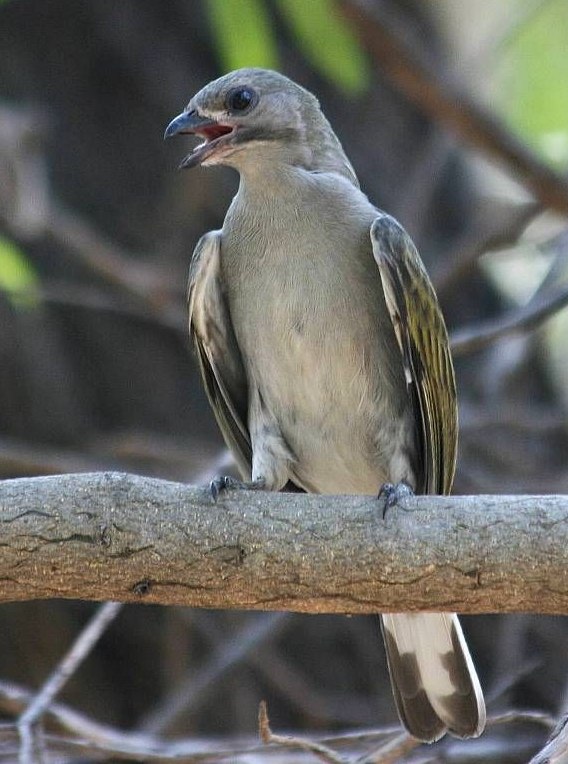
Identifying the Pallid Honeyguide requires careful observation of its subtle field marks. Adult birds exhibit a predominantly grayish-brown plumage, which aids in their stealthy nature. The underparts are paler, often described as a soft buff or cream color. A key identifying feature is the slight yellowish tinge on the flanks and under the wings, more pronounced in males. Females tend to be slightly duller, lacking the faint yellow hues seen in males. Juveniles resemble adults but may display a more mottled appearance, offering added camouflage. In flight, the Pallid Honeyguide presents a distinct silhouette characterized by short, rounded wings and a relatively short tail, aiding in agile maneuvers through dense foliage. When perched, the bird maintains a slightly upright posture, often observed on branches near bee colonies or potential host nests. Confusion with similar species like the Lesser Honeyguide (Indicator minor) can occur, yet the Pallid Honeyguide's paler overall coloration and preference for different habitats provide crucial differentiation cues.
Having trouble telling birds apart? Upload a photo to our bird identification tool for an instant species match.
Pallid Honeyguide Habitat and Range
Preferred Habitat
The Pallid Honeyguide thrives in a variety of habitats, including dry acacia savannas, miombo woodlands, and montane forests. It is commonly found at elevations ranging from sea level up to 2000 meters, depending on the geographic region. In the arid savannas of Kenya and northern Tanzania, it frequents areas with abundant bee activity, which aligns with its dietary needs. Unlike some honeyguides that may venture into rural or semi-urban areas, the Pallid Honeyguide typically avoids heavily populated regions, preferring the tranquility of natural habitats. Seasonal shifts in habitat use are minimal, as the bird remains relatively sedentary, following the availability of bee colonies and suitable host nests throughout the year.
Geographic Range
The Pallid Honeyguide is a resident species within Eastern Africa, with its range extending from southern Ethiopia through Kenya and Tanzania, reaching as far south as northern Malawi. Its presence is notably consistent within these regions, with no significant migratory behavior observed. Population densities vary, with higher concentrations found in areas where bee colonies are abundant. For instance, the woodlands of central Tanzania offer a thriving environment, supporting larger numbers of this species. While its range overlaps with other honeyguide species, the Pallid Honeyguide maintains distinct ecological niches, ensuring minimal competition for resources.
Want to know which birds visit your area? Browse our backyard birds by location guides for region-specific species lists.
What Does the Pallid Honeyguide Eat?
The diet of the Pallid Honeyguide primarily consists of beeswax and the larvae of bees and wasps, showcasing its specialized feeding habits. This reliance on beeswax sets it apart from many other bird species. The bird employs a unique foraging technique, often following honeybee colonies to locate potential food sources. It uses its sharp beak to access hives and extract wax and larvae, demonstrating a remarkable adaptation to its environment. During certain seasons, when beeswax is less abundant, the Pallid Honeyguide may supplement its diet with small insects and occasionally fruit, ensuring a balanced intake of nutrients. Its feeding schedule aligns with the activity patterns of bee colonies, often peaking during warmer months when bees are most active.
Pallid Honeyguide Behavior and Social Structure
The social structure of the Pallid Honeyguide is relatively solitary, with individuals maintaining distinct territories that they defend vigorously from rivals. Territorial behavior becomes particularly evident during the breeding season, as males actively patrol their domains to safeguard access to host nests. Courtship displays are subtle, involving quiet calls and modest posturing to attract mates. Unlike many bird species, the Pallid Honeyguide does not form large flocks, preferring to operate independently or in pairs. Its response to predators is typically cautious, relying on its cryptic plumage to remain undetected. Daily activity patterns revolve around foraging and locating suitable host nests, with peak activity occurring during early morning and late afternoon.
Pallid Honeyguide Nesting and Reproduction
The Pallid Honeyguide, as a brood parasite, does not build its own nest. Instead, it lays its eggs in the nests of other bird species such as barbets and woodpeckers. The female typically lays a single egg per host nest, ensuring minimal competition within the host's clutch. Once the host incubates and raises the honeyguide chick, the young bird exhibits aggressive behavior, often outcompeting or ejecting host chicks to secure available resources. The incubation period aligns with that of the host species, generally lasting around two weeks. After hatching, the Pallid Honeyguide chick remains in the host nest until fledging, which occurs approximately three to four weeks later. Despite its parasitic strategy, this bird successfully raises multiple broods per year by targeting different hosts across its range.
Pallid Honeyguide Sounds and Vocalizations
The primary song of the Pallid Honeyguide is a series of soft, melodious whistles that are often delivered in short sequences. These whistles have a gentle, flute-like quality, making them pleasant to the ear. Call notes are more abrupt, often used for communication between mates or signaling to host species. Alarm calls, though rare, consist of sharp, agitated notes that alert nearby birds to potential threats. During the dawn chorus, the Pallid Honeyguide's song blends subtly with the calls of other woodland species, contributing to the rich tapestry of early morning sounds.
Interesting Facts About the Pallid Honeyguide
- 1The Pallid Honeyguide is one of only a few bird species that primarily consume beeswax, a highly unusual dietary preference.
- 2Unlike cuckoos, the Pallid Honeyguide does not mimic the eggs of its host species, yet its chicks often dominate the nest.
- 3Pallid Honeyguides have been known to forage alongside honey badgers, benefiting from the mammals' hive-breaking skills.
- 4This bird's cryptic plumage allows it to stealthily approach host nests without alarming potential hosts.
- 5The Pallid Honeyguide can detect wax-based substances from significant distances, showcasing an exceptional sense of smell.
Pallid Honeyguide Conservation Status
The Pallid Honeyguide currently holds a status of Least Concern according to the IUCN Red List, with populations considered stable across its native range. However, habitat degradation and the loss of bee colonies due to agricultural practices and pesticide use pose potential threats. Conservation efforts focus on preserving natural habitats and promoting sustainable land management practices to protect both the bird and its food sources. Historically, the Pallid Honeyguide has maintained a consistent population size, thanks in part to its adaptability and the relative abundance of suitable host species.
Other Indicatoridae Species



Birds Similar to the Pallid Honeyguide
These species are often confused with the Pallid Honeyguide due to similar appearance or overlapping range.
