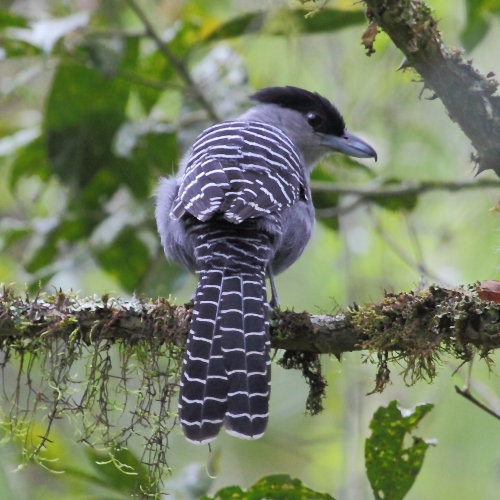
Pectoral Antwren
Herpsilochmus pectoralis
Order: Passeriformes / Family: Thamnophilidae

Wikimedia Commons
About the Pectoral Antwren
The Pectoral Antwren, scientifically known as Herpsilochmus pectoralis, is a small bird endemic to the Neotropical region, primarily found in the northeastern parts of Brazil. This bird belongs to the family Thamnophilidae, which is renowned for its ant-following behavior. The Pectoral Antwren is of particular interest to ornithologists due to its restricted range and specialized habitat preferences. Typically, it inhabits semi-deciduous forests and dense thickets, where it plays a pivotal role in the ecosystem by participating in the control of insect populations. The Pectoral Antwren displays a strong preference for lowland tropical forests, often found at elevations from sea level up to 800 meters. Due to its preference for dense undergrowth and relatively shy nature, it is more often heard than seen, making it a challenging yet rewarding species for birdwatchers to observe. Seasonal behaviors of the Pectoral Antwren vary slightly, with breeding coinciding with the rainy season, which provides abundant food resources for raising young. During this period, the antwren becomes more vocal and active, engaging in courtship displays that are crucial for pair formation. The significance of the Pectoral Antwren extends beyond its ecological role. As a species with a limited range, it serves as an indicator of habitat health in its region, especially in the face of deforestation and habitat fragmentation. Conservationists often prioritize the protection of the Pectoral Antwren's habitat as part of broader efforts to conserve the rich biodiversity of Brazil’s northeastern forests. Furthermore, the bird's specialized diet, primarily consisting of insects, underscores its role in maintaining the delicate balance of its ecosystem.
The Pectoral Antwren belongs to the family Thamnophilidae, within the order Passeriformes. These birds typically live average 3-4 years, with a max recorded of 5 years.
How to Identify a Pectoral Antwren
Identifying the Pectoral Antwren involves noting several key features. Adult males typically display a striking plumage with a black crown, nape, and mantle, contrasted by a white supercilium and throat. The most distinctive feature is the pair of prominent white wing bars set against dark wings, which are often visible even in the dense foliage they inhabit. Females, on the other hand, tend to have a more subdued color palette, with a brownish crown and less pronounced wing bars. Juveniles resemble females but may have even duller plumage. The Pectoral Antwren’s small size and subtle, quick movements can make field identification challenging. However, its distinctive vocalizations often give away its presence before it is seen. The species may be confused with other small antwrens, such as the Black-capped Antwren, but the Pectoral Antwren's unique combination of wing markings and head pattern helps distinguish it. In flight, the Pectoral Antwren shows a short, rounded wing silhouette, and when perching, it tends to hold its body upright, often flicking its wings and tail.
Having trouble telling birds apart? Upload a photo to our bird identification tool for an instant species match.
Pectoral Antwren Habitat and Range
Preferred Habitat
The Pectoral Antwren primarily inhabits lowland tropical forests, favoring areas with dense undergrowth and tangled vegetation. These habitats provide the cover necessary for foraging and nesting. It is most commonly found in semi-deciduous forests in northeastern Brazil, particularly within the states of Pernambuco and Alagoas. The bird typically occupies elevations ranging from sea level to about 800 meters, although it is most frequently observed in lower elevations where the forest canopy is dense. Unlike some other antbirds, the Pectoral Antwren does not typically adapt to urban environments, largely due to its dependence on well-preserved forest habitats. Seasonal habitat shifts are minimal, as the species remains closely tied to its preferred forest settings throughout the year.
Geographic Range
The Pectoral Antwren is endemic to a relatively small area within northeastern Brazil, with its range primarily concentrated in the states of Pernambuco and Alagoas. This limited distribution makes it a species of particular conservation concern. The bird's range does not include any significant migratory corridors, as it is a resident species, maintaining a year-round presence within its preferred habitats. Within this region, population density hotspots correspond to areas with remaining patches of semi-deciduous forest. Due to habitat fragmentation, the Pectoral Antwren's range has become increasingly patchy, with pockets of suitable habitat becoming isolated. Conservation efforts focus on protecting these key areas to ensure the species' survival.
Want to know which birds visit your area? Browse our backyard birds by location guides for region-specific species lists.
What Does the Pectoral Antwren Eat?
The diet of the Pectoral Antwren primarily consists of small arthropods, including insects and spiders. It forages actively in the dense foliage, often gleaning prey from leaves and branches. This bird exhibits a methodical approach to foraging, using its sharp bill to probe and pick insects from crevices. During the rainy season, when insect abundance peaks, the Pectoral Antwren takes advantage of the increased food supply to support its breeding activities. While its diet remains consistent throughout the year, slight variations may occur as it opportunistically consumes available prey. The Pectoral Antwren's feeding schedule aligns with its diurnal activity patterns, with peaks in foraging occurring during the early morning and late afternoon when temperatures are cooler.
Pectoral Antwren Behavior and Social Structure
The Pectoral Antwren exhibits intriguing behaviors that reflect its adaptation to life in dense forest habitats. Socially, it is generally seen alone or in pairs, rarely forming larger flocks. This bird is territorial, with pairs maintaining and defending their territories through vocalizations and displays. During the breeding season, courtship involves a series of vocal and visual displays, where males may sing persistently and display their striking wing patterns to attract females. The Pectoral Antwren's response to predators involves a combination of cryptic behavior and alarm calls. When threatened, it often freezes or flits to the safety of dense foliage. Daily activity patterns are diurnal, with the bird being most active during the cooler parts of the day. It spends considerable time foraging in the lower to mid-levels of the forest, navigating through the undergrowth with agility.
Pectoral Antwren Nesting and Reproduction
The nesting habits of the Pectoral Antwren reflect its adaptation to forest environments. Its nest is typically a small cup-like structure, woven from plant fibers and spider silk, and concealed within dense foliage or shrubs. Preferred nesting sites are usually low to the ground, often less than two meters in elevation, providing camouflage and protection from predators. The clutch size of the Pectoral Antwren generally consists of two eggs, which both parents incubate. The incubation period lasts approximately 14-16 days, followed by a fledging period of about 12-14 days. Parental roles are shared, with both male and female feeding and caring for the chicks. The Pectoral Antwren usually raises one brood per year, although favorable conditions may occasionally allow for two.
Pectoral Antwren Sounds and Vocalizations
The vocalizations of the Pectoral Antwren are diverse and integral to its communication. The primary song is a series of high-pitched, rapid whistles that rise and fall in pitch, often described as a 'ti-ti-ti-ti-tiu'. This song serves both to establish territory and to attract mates. Call notes are sharp and piercing, used in contact between pairs and as alarm signals when predators are near. The bird's dawn chorus is particularly notable, with males often singing vigorously at first light. Compared to other antbirds, the Pectoral Antwren's song is distinct yet may be confused with other species in its range, requiring careful listening to differentiate.
Interesting Facts About the Pectoral Antwren
- 1Despite its small size, the Pectoral Antwren plays a crucial role in controlling insect populations in its habitat.
- 2The species was first described in the mid-19th century, showcasing its historical presence in ornithological studies.
- 3Observations indicate that the Pectoral Antwren can be quite elusive, often heard more than seen due to its preference for dense undergrowth.
- 4Researchers have noted its territorial song can be heard from distances of up to 100 meters, aiding in its detection.
- 5The Pectoral Antwren's habitat is part of the renowned Atlantic Forest, one of the world's most diverse and endangered ecosystems.
- 6It has a relatively small global range, restricted to northeastern Brazil, making it a focal point of regional conservation efforts.
- 7The Pectoral Antwren's plumage is adapted for camouflage, allowing it to blend seamlessly into its forest environment.
Pectoral Antwren Conservation Status
The Pectoral Antwren is currently listed as Near Threatened by the IUCN, with its population trend considered to be decreasing. The primary threats to this species include habitat loss and fragmentation due to deforestation for agriculture and urban development. Conservation efforts focus on protecting and restoring its natural habitat, particularly in the Atlantic Forest region. These efforts include the establishment of protected areas and initiatives to promote sustainable land use practices. Historical population changes indicate a decline correlating with increased human activity in its range, highlighting the need for ongoing conservation attention.