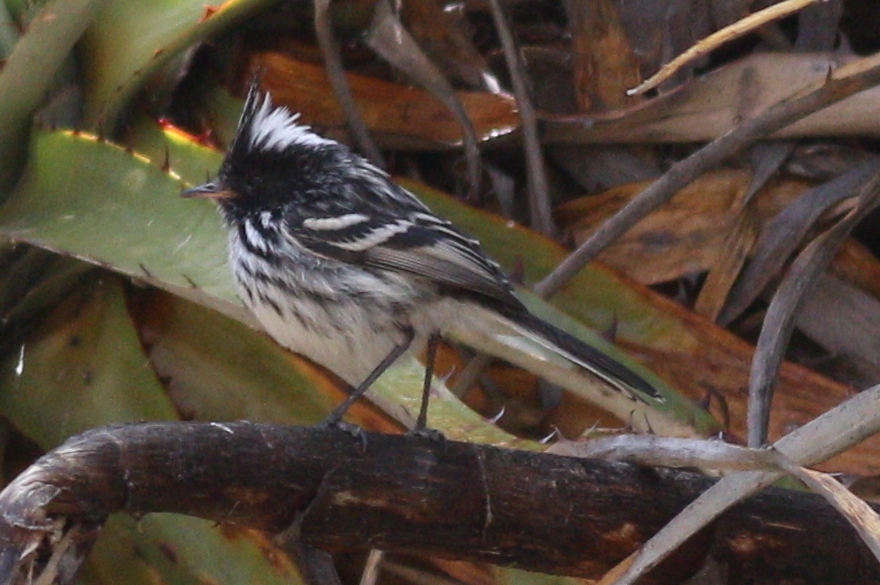
Pied-crested Tit-Tyrant
Anairetes reguloides
Order: Passeriformes / Family: Tyrannidae

Wikimedia Commons
About the Pied-crested Tit-Tyrant
The Pied-crested Tit-Tyrant, scientifically known as Anairetes reguloides, is a small passerine bird belonging to the Tyrannidae family. It is primarily found in the Andean regions of South America, specifically thriving in Peru and Bolivia. This species is known for its striking appearance, characterized by a black and white plumage that assists in camouflaging within its natural habitat. The Pied-crested Tit-Tyrant is an integral part of the montane ecosystems, contributing to insect population control through its feeding habits. Often seen flitting energetically through shrubby areas, this bird plays a crucial role in maintaining the ecological balance. During its breeding season, typically from September to February, the Pied-crested Tit-Tyrant becomes particularly territorial, showcasing complex courtship displays to attract mates. This behavior is vital for the continuation of its lineage. Seasonal migrations are not largely observed in this species, as it tends to remain within its native range throughout the year, although some altitudinal movements may occur in response to climatic variations. The Pied-crested Tit-Tyrant also serves as an indicator species for habitat health, as its presence suggests a well-balanced ecosystem. Its adaptability to various shrubland environments highlights its ecological significance, especially in areas undergoing environmental changes. Ornithologists and bird enthusiasts alike value the Pied-crested Tit-Tyrant for its unique behaviors and its role in the biodiversity of the Andean montane regions.
The Pied-crested Tit-Tyrant belongs to the family Tyrannidae, within the order Passeriformes. These birds typically live generally 5-7 years in the wild..
How to Identify a Pied-crested Tit-Tyrant
The Pied-crested Tit-Tyrant is easily identifiable by its bold black and white plumage. Adults exhibit a distinctive pattern with a black head and crest contrasted by white cheeks and throat. The underparts are primarily white with some subtle gray streaking. The wings and tail are black, accented with white edges. Juveniles resemble adults but tend to have a more muted coloration, lacking the stark contrast of the mature birds. Sexual dimorphism is not prominent in this species, with males and females appearing similar in plumage and size. Compared to other species in the Anairetes genus, the Pied-crested Tit-Tyrant is smaller and more agile, often causing confusion with the Tufted Tit-Tyrant. However, the latter lacks the striking white throat and has more pronounced streaking on the underparts. In flight, the Pied-crested Tit-Tyrant demonstrates rapid wingbeats and short, swift movements, often perching with a slightly cocked tail and upright posture. This posture, combined with its unique plumage, makes it relatively easy to identify in the field.
Having trouble telling birds apart? Upload a photo to our bird identification tool for an instant species match.
Pied-crested Tit-Tyrant Habitat and Range
Preferred Habitat
The Pied-crested Tit-Tyrant predominantly inhabits montane shrublands and open woodlands, particularly favoring areas with dense shrubbery and low trees. It thrives at elevations ranging from 2,000 to 4,000 meters above sea level. This bird adapts well to a variety of habitats within this range, including semi-arid regions and areas adjacent to agricultural lands. While it is more commonly found in rural settings, it can occasionally be seen in urban parks and gardens, especially those located near its natural habitats. Seasonal habitat shifts are minimal, with the Pied-crested Tit-Tyrant showing a preference for consistency in its living environment. However, during colder months, it may descend to lower elevations in search of food and warmth.
Geographic Range
The Pied-crested Tit-Tyrant's range is largely confined to the Andean regions of Peru and Bolivia, where it is considered common within its preferred habitats. Its breeding range is concentrated in these areas, with no significant long-distance migrations observed. However, altitudinal movements are noted, particularly when birds adjust their elevation in response to seasonal temperature fluctuations. Within its range, population density hotspots include the central Andean slopes, where shrublands and open woodlands provide ample resources. Despite its limited geographic range, the Pied-crested Tit-Tyrant maintains a stable population, supported by the relatively undisturbed nature of its habitat.
Want to know which birds visit your area? Browse our backyard birds by location guides for region-specific species lists.
What Does the Pied-crested Tit-Tyrant Eat?
Primarily insectivorous, the Pied-crested Tit-Tyrant's diet consists of small insects and arthropods. It actively forages by gleaning insects from foliage and occasionally catching prey mid-air with agile flights. During the breeding season, its diet may also include spiders and small invertebrates, providing essential protein for its young. Seasonal diet changes are minimal, although availability of certain prey species may vary. The bird's foraging techniques involve rapid movements through shrubs and trees, often seen flitting from branch to branch. It typically feeds during daylight hours, with peak activity observed in the early morning and late afternoon.
Pied-crested Tit-Tyrant Behavior and Social Structure
The Pied-crested Tit-Tyrant exhibits a lively and energetic behavior, often seen actively flitting through its habitat. It is generally solitary or found in pairs, especially during the breeding season when it becomes highly territorial. Courtship displays involve both vocalizations and visual signals, with males performing acrobatic flights to attract females. Socially, the Pied-crested Tit-Tyrant tends to maintain loose territories, with boundaries often overlapping with those of neighboring pairs. Flocking behavior is uncommon, although small groups may form during non-breeding periods when foraging. In response to predators, this bird relies on its agility and camouflage, often freezing in place or retreating to dense cover. Daily activity patterns include periods of intense foraging interspersed with rest, particularly during the hottest parts of the day.
Pied-crested Tit-Tyrant Nesting and Reproduction
The Pied-crested Tit-Tyrant constructs its nest in dense shrubs or low trees. The nest is a small cup made of twigs, grass, and feathers, intricately woven to provide stability and insulation. Preferred nesting sites are typically well-hidden within foliage, offering protection from predators. The typical clutch size consists of 2 to 3 eggs, with an incubation period of approximately 14 to 16 days. Both parents participate in feeding and caring for the chicks, which fledge after about 18 to 20 days. The species usually raises one brood per year, although favorable conditions may occasionally allow for a second.
Pied-crested Tit-Tyrant Sounds and Vocalizations
The Pied-crested Tit-Tyrant's song is a series of high-pitched, rapid notes delivered in a cheerful, repetitive pattern. These vocalizations serve both territorial and courtship purposes, often heard at dawn and during peak breeding times. Call notes are sharp and distinct, often described as 'chit-chit' sounds. Alarm calls are more abrupt and harsh, used to alert conspecifics of potential threats. This bird's vocalizations are a key aspect of its territorial behavior, with frequent song bursts marking its presence.
Interesting Facts About the Pied-crested Tit-Tyrant
- 1The Pied-crested Tit-Tyrant is one of the smallest members of the Tyrannidae family, measuring just 11 cm in length.
- 2Unlike many other tyrant flycatchers, the Pied-crested Tit-Tyrant exhibits minimal sexual dimorphism, making males and females difficult to distinguish.
- 3The bird's crest is not only for display; it also aids in communication during courtship and territorial disputes.
- 4Despite its small size, the Pied-crested Tit-Tyrant has a large, melodious song that carries well in its montane environment.
- 5Its ability to thrive in both shrubby areas and low woodlands makes it a versatile indicator species for habitat health.
- 6This species is known to occasionally join mixed-species foraging flocks, benefiting from the increased vigilance against predators.
- 7The Pied-crested Tit-Tyrant plays a crucial role in controlling insect populations, contributing to the ecological balance of its habitat.
Pied-crested Tit-Tyrant Conservation Status
The Pied-crested Tit-Tyrant is currently listed as Least Concern by the IUCN, with a stable population trend. Its primary threats include habitat loss due to agricultural expansion and deforestation. However, its adaptability to various montane environments helps mitigate some of these impacts. Conservation efforts focus on protecting its natural habitats through sustainable land management practices. Historically, the population has remained relatively stable, with no significant declines recorded.
Other Tyrannidae Species


Birds Similar to the Pied-crested Tit-Tyrant
These species are often confused with the Pied-crested Tit-Tyrant due to similar appearance or overlapping range.