Pithys leucops
Pithys leucops
Order: Passeriformes / Family: Thamnophilidae
About the Pithys leucops
The White-masked Antbird, known scientifically as Pithys leucops, is a striking member of the Thamnophilidae family. Endemic to the dense tropical rainforests of the Amazon Basin, this bird plays a vital ecological role as part of the intricate understory avian community. Predominantly found in the countries of Brazil, Peru, and Colombia, the White-masked Antbird exhibits an affinity for humid, lowland forests rich in biodiversity. It thrives in primary forests but can also adapt to secondary growth areas, provided these habitats offer thick foliage and ample insect prey. The bird's behaviors are closely tied to the seasonal rhythms of the rainforest. During the wet season, when insect populations peak, the White-masked Antbird becomes more vocal and active, diligently foraging and defending its territory. As the dry season takes hold, the bird may reduce its vocal activity, focusing instead on conserving energy and maintaining its territory amidst increased competition for resources. This species is integral to the ecosystem, helping control insect populations and participating in mutualistic relationships with other fauna. By following swarms of army ants, the White-masked Antbird capitalizes on the insects disturbed by these predators, showcasing a remarkable example of niche specialization in the avian world.
The Pithys leucops belongs to the family Thamnophilidae, within the order Passeriformes. These birds typically live average 5-6 years, with a maximum recorded of 8 years..
How to Identify a Pithys leucops
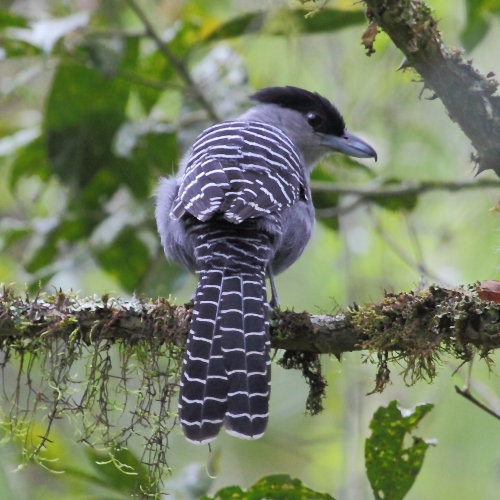
Adult White-masked Antbirds are unmistakable due to their striking white facial mask, which contrasts sharply with their otherwise dark plumage. Their bodies are predominantly black with subtle hints of brown on the wings and tail feathers. Males and females share similar coloration, making gender differentiation challenging in the field. However, males tend to have a slightly more pronounced white mask. Juveniles display a more muted coloration, with a less defined mask and a brownish tinge to their plumage, allowing them to blend more seamlessly into the forest undergrowth. The White-masked Antbird's silhouette in flight is compact, with rounded wings and a short tail, typical of birds adapted to darting through dense foliage. When perched, it often adopts a horizontal posture, making use of its strong legs and feet to navigate branches and vines with ease. Observers may confuse this species with other antbirds; however, the distinct facial markings of Pithys leucops provide a reliable field mark that sets it apart.
Having trouble telling birds apart? Upload a photo to our bird identification tool for an instant species match.
Pithys leucops Habitat and Range
Preferred Habitat
The White-masked Antbird inhabits lowland tropical rainforests, thriving in humid environments that offer dense canopy coverage and rich understory vegetation. Typical elevations range from sea level up to 1,000 meters, though the bird is most commonly found below 500 meters. This species favors regions with high insect activity, often near water bodies that support diverse insect populations. Seasonal shifts in habitat use are minimal; however, the bird may venture into slightly higher elevations or secondary growth areas during periods of increased environmental pressure or habitat disturbance. Urban presence is negligible, as the species prefers remote forested areas far from human development.
Geographic Range
The breeding range of the White-masked Antbird spans across the Amazon Basin, predominantly within the countries of Brazil, Peru, and Colombia. The bird is considered non-migratory, maintaining year-round residency in its preferred habitats. However, localized movements occur in response to seasonal changes in food availability and habitat conditions. Population density is highest in undisturbed forested regions, where the complex structure of the rainforest provides ample foraging opportunities and nesting sites. Despite its relatively wide range, the bird's presence is often patchy and localized due to habitat specificity and fragmentation.
Want to know which birds visit your area? Browse our backyard birds by location guides for region-specific species lists.
What Does the Pithys leucops Eat?
The diet of the White-masked Antbird primarily consists of insects and other small arthropods. It exhibits a preference for ants, beetles, and spiders, which it gleans from leaf litter and low vegetation. During the wet season, when insect abundance peaks, the bird becomes an active forager, utilizing rapid, precise movements to capture prey. The antbird employs a unique foraging technique, following swarms of army ants to catch insects flushed out by these predators. This behavior not only maximizes feeding efficiency but also minimizes energy expenditure. While ants remain a staple food source year-round, seasonal variations may lead the bird to supplement its diet with other available insects or small invertebrates during periods of scarcity.
Pithys leucops Behavior and Social Structure
Socially, the White-masked Antbird is typically solitary or found in pairs, maintaining well-defined territories that it actively defends from intruders. Territorial disputes often involve vocal displays and aggressive posturing, with physical confrontations being rare. During the breeding season, courtship displays become more pronounced, with males using their distinctive calls and postures to attract females. The species does not form large flocks, preferring instead to maintain solitary vigilance over its territory. Its response to predators involves remaining motionless and relying on its cryptic plumage for concealment. Daily activity peaks during the early morning and late afternoon, aligning with periods of increased insect activity in the forest.
Pithys leucops Nesting and Reproduction
The White-masked Antbird constructs cup-shaped nests using leaves, twigs, and other plant materials, typically situating them in dense undergrowth or shrubbery to ensure concealment. Nests are usually placed at heights between 1 to 3 meters above ground. The breeding season corresponds with the wet season, providing optimal conditions for raising young. Clutch size generally consists of two eggs, with both parents sharing incubation duties over a period of approximately 14 to 16 days. After hatching, chicks remain in the nest for about 10 to 12 days before fledging. Both parents participate in feeding and caring for the young, ensuring their survival in the challenging forest environment. The species may raise one or two broods per year, depending on environmental conditions and food availability.
Pithys leucops Sounds and Vocalizations
The primary song of the White-masked Antbird is a series of melodious whistles, with a rhythm that starts slow and accelerates toward the end. Each note is clear and flute-like, often repeated in a sequence that can carry through the dense forest understory. Call notes are sharp and staccato, serving as communication between mates or warnings to intruders. In the presence of threats, alarm calls become more rapid and harsh, effectively alerting other birds in the vicinity. During the dawn chorus, the bird's song is most prominent, marking its territory and signaling readiness for mating. The sound is distinctive and can be compared to a series of descending musical notes, both soothing and assertive.
Interesting Facts About the Pithys leucops
- 1The White-masked Antbird gets its name from the distinctive white feathers around its eyes and face, resembling a mask.
- 2This species is a professional antbird, often found following army ant swarms to catch fleeing insects.
- 3Despite its striking appearance, the White-masked Antbird is often heard before it is seen, thanks to its melodious song.
- 4The bird's reliance on army ants is so strong that it rarely strays far from known ant foraging trails.
- 5Its unique foraging strategy places it among the specialized guilds of birds that rely on interspecies cooperation for food.
- 6The White-masked Antbird's habitat preference for dense, humid rainforests makes it an indicator species for ecosystem health.
- 7Though primarily insectivorous, this bird displays remarkable adaptability, altering its diet based on seasonal prey availability.
Pithys leucops Conservation Status
The White-masked Antbird is currently classified as Least Concern by the IUCN, with populations considered stable across most of its range. However, primary threats include habitat loss due to deforestation and land conversion for agriculture and logging. Conservation efforts focus on preserving intact rainforest habitats and promoting sustainable land-use practices. Historical population changes are closely linked to the extent of forest cover, with declines noted in areas experiencing significant environmental degradation. Continued monitoring and habitat protection are essential to ensuring the long-term survival of this species.