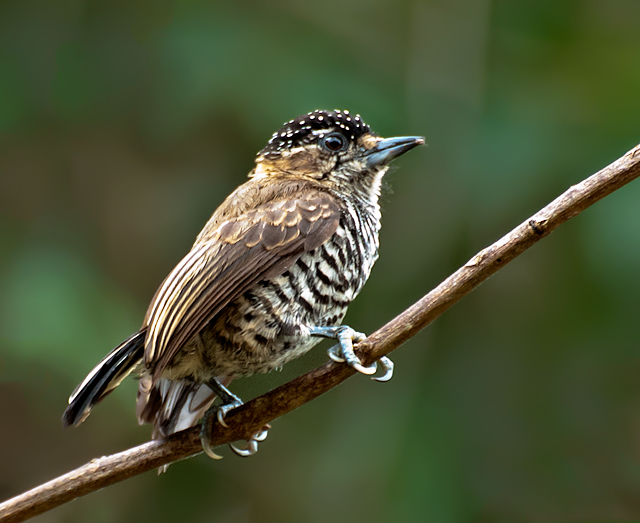
Plain-breasted Piculet
Picumnus castelnau
Order: Piciformes / Family: Picidae

Wikimedia Commons
About the Plain-breasted Piculet
The Plain-breasted Piculet, scientific name Picumnus castelnau, is a small bird that belongs to the family Picidae. It is primarily found in tropical and subtropical forests of South America, notably in countries like Brazil, Peru, and Colombia. As a member of the piculet group, it shares many characteristics with woodpeckers, yet it exhibits distinct behaviors adapted for its unique ecological niche. These birds are particularly significant for their role as insectivores within their ecosystems. By feeding on insects, they help control pest populations and contribute to the health of forest ecosystems. Their presence is often indicative of a healthy, biodiverse environment. The Plain-breasted Piculet can be found in a variety of forested habitats, from lowland rainforests to subtropical woodlands, often preferring areas with dense foliage where they can forage for insects and larvae. During the breeding season, these birds become more vocal and active, as males engage in displays to attract females. Outside of the breeding season, they remain relatively quiet and solitary, blending into their surroundings. In addition to their ecological role, Plain-breasted Piculets are of interest to birdwatchers due to their elusive nature and specialized habitats. Observing these birds requires patience and a keen eye, as they can be easily overlooked due to their size and understated plumage. Conservationists also pay close attention to their populations, as changes in their numbers can signal shifts in forest health and biodiversity. While not currently considered endangered, the Plain-breasted Piculet faces threats from habitat loss and degradation due to deforestation and land conversion for agriculture. Efforts to preserve their natural habitats are essential to ensuring their continued presence in South America's forests.
The Plain-breasted Piculet belongs to the family Picidae, within the order Piciformes. These birds typically live average 5 years with a maximum recorded of 8 years..
How to Identify a Plain-breasted Piculet
Field identification of the Plain-breasted Piculet involves noting its small size, approximately 9 to 10 cm in length, and its relatively short tail. Adult plumage is characterized by a subtle grayish-brown coloration on the upper body and a paler, almost white underbelly, which gives the bird its 'plain-breasted' descriptor. Males and females are similar in appearance, but males may exhibit a slight reddish or rusty tinge on the crown, although this can be difficult to discern in the field. Juveniles resemble adults but may have more muted colors and a lack of distinct crown markings. The Plain-breasted Piculet can be confused with other piculet species, especially those within the same geographic range, such as the White-barred Piculet or the Speckle-chested Piculet. However, careful observation of the plumage and the lack of distinct markings can help in accurate identification. In flight, this bird displays a rapid, undulating pattern typical of many woodpeckers. When perched, its posture is upright, often clinging to small branches or vines with its strong feet. Observers can differentiate it from similar species by noting the absence of prominent markings or vibrant colors, which are common in other piculet species.
Having trouble telling birds apart? Upload a photo to our bird identification tool for an instant species match.
Plain-breasted Piculet Habitat and Range
Preferred Habitat
The Plain-breasted Piculet inhabits a range of forested environments within South America. It primarily resides in tropical and subtropical forests, favoring areas with dense foliage that provide ample foraging opportunities. These birds are often found at elevations ranging from sea level up to 1,500 meters, with a preference for lowland rainforests and subtropical woodlands. The presence of mature trees and a rich understory is crucial for their feeding and nesting habits. While they are primarily forest dwellers, they can occasionally be found in secondary forests or areas of regrowth, provided that there is sufficient canopy cover. There is little evidence of significant habitat shifts with seasons, as the Plain-breasted Piculet tends to remain in forested areas year-round. Urban presence is rare, as they prefer natural settings that offer the structural complexity needed for foraging and nesting.
Geographic Range
The geographic range of the Plain-breasted Piculet extends across several South American countries, including Brazil, Peru, Colombia, and Bolivia. This bird is a resident species, meaning it does not engage in long-distance migrations but may exhibit local movements in response to resource availability. Its breeding range overlaps significantly with its overall distribution, as it tends to remain within dense forest habitats throughout the year. While population densities vary across its range, certain regions, such as the Amazon basin in Brazil and the Andean foothills in Peru, serve as population density hotspots due to the availability of optimal habitat conditions. Despite inhabiting a relatively wide range, the Plain-breasted Piculet's distribution is closely tied to forest cover, limiting its presence in areas subjected to extensive deforestation.
Want to know which birds visit your area? Browse our backyard birds by location guides for region-specific species lists.
What Does the Plain-breasted Piculet Eat?
The diet of the Plain-breasted Piculet predominantly consists of insects and their larvae, making it a vital insectivore within its forest ecosystem. Its feeding strategy involves gleaning insects from tree bark, leaves, and twigs, using its small, chisel-like bill to probe crevices and dislodge prey. Ants, beetles, and caterpillars are among the primary food sources, but the piculet may also consume spiders and other small arthropods. During the wet season, when insect abundance is high, the piculet's diet is rich and varied, allowing it to meet the nutritional demands of breeding and raising young. In contrast, the dry season may see a slight shift in diet, with increased reliance on available insect larvae. The Plain-breasted Piculet typically forages alone or in pairs, often in the mid-story or canopy layers of the forest. Its methodical and deliberate foraging technique involves careful inspection of potential feeding sites, resulting in a relatively slow feeding schedule compared to other more gregarious bird species.
Plain-breasted Piculet Behavior and Social Structure
The behavior of the Plain-breasted Piculet reflects its adaptations to a life in dense forest environments. It is generally a solitary bird, although pairs may be observed during the breeding season. Territoriality is evident, with individuals or pairs defending their feeding and nesting areas from intruders. Courtship displays include subtle movements and vocalizations designed to attract a mate while maintaining a low profile within the forest canopy. Flocking behavior is uncommon, as these birds tend to prioritize territorial defense and resource availability. However, they may join mixed-species foraging flocks, which can enhance feeding efficiency and provide protection from predators. In response to threats, the Plain-breasted Piculet will often remain motionless, relying on its cryptic plumage for camouflage. Its daily activity pattern includes active foraging during the cooler morning and late afternoon hours, with periods of rest or minimal activity during the heat of midday.
Plain-breasted Piculet Nesting and Reproduction
Nesting for the Plain-breasted Piculet involves the excavation of small cavities in tree branches or trunks. These cavities serve as nesting sites, where the female lays a clutch typically consisting of two to four eggs. Nest construction requires considerable effort, as both male and female participate in the excavation process. The incubation period lasts approximately two weeks, with both parents sharing the responsibility of keeping the eggs warm. After hatching, the young remain in the nest for another two to three weeks, during which time they are fed and cared for by both parents. The fledgling timeline is relatively short, as the young birds must quickly learn to forage and survive independently in the dense forest environment. Depending on environmental conditions and food availability, the Plain-breasted Piculet may raise one to two broods per year.
Plain-breasted Piculet Sounds and Vocalizations
The vocal repertoire of the Plain-breasted Piculet includes a primary song characterized by a series of rapid, high-pitched notes delivered in a steady rhythm. This song serves as both a territorial marker and a courtship signal, often heard during the early morning hours as part of the dawn chorus. Call notes are typically short and sharp, used for communication between mates or to alert potential threats. Alarm calls, while less frequent, consist of a series of quick, ascending notes designed to deter predators or signal danger to nearby conspecifics. Compared to other birds in its habitat, the Plain-breasted Piculet's vocalizations are relatively subtle, allowing it to maintain a low profile in its forested environment.
Interesting Facts About the Plain-breasted Piculet
- 1The Plain-breasted Piculet is one of the smallest members of the woodpecker family, measuring only about 9 to 10 centimeters in length.
- 2Unlike many woodpecker species, the Plain-breasted Piculet does not drum on trees, relying instead on vocalizations for communication.
- 3The bird's small size and subtle plumage make it a challenging yet rewarding find for birdwatchers exploring South America's forests.
- 4Plain-breasted Piculets are skilled at foraging for insects in the dense foliage of the forest canopy, often using precise movements to extract prey.
- 5Despite their small size, they play an important ecological role in controlling insect populations in their habitats.
- 6The Plain-breasted Piculet's ability to excavate nest cavities in trees is a testament to its strong bill and specialized adaptation to forest life.
- 7This species is often found in mixed-species flocks, benefiting from increased foraging success and predator avoidance.
Plain-breasted Piculet Conservation Status
The Plain-breasted Piculet is currently listed as Least Concern by the IUCN, indicating a stable population trend. However, the primary threat to its continued wellbeing is habitat loss due to deforestation and land conversion for agriculture. As forest habitats are cleared or fragmented, the piculet faces increased pressure from reduced nesting sites and food resources. Conservation efforts focus on preserving large tracts of forest and promoting sustainable land-use practices to mitigate habitat degradation. Historical population changes have generally been linked to the intensity of logging and agricultural expansion, underscoring the importance of effective conservation strategies. Continued monitoring and habitat protection remain crucial to ensuring the survival of this species in its natural environment.
Other Picidae Species


Birds Similar to the Plain-breasted Piculet
These species are often confused with the Plain-breasted Piculet due to similar appearance or overlapping range.