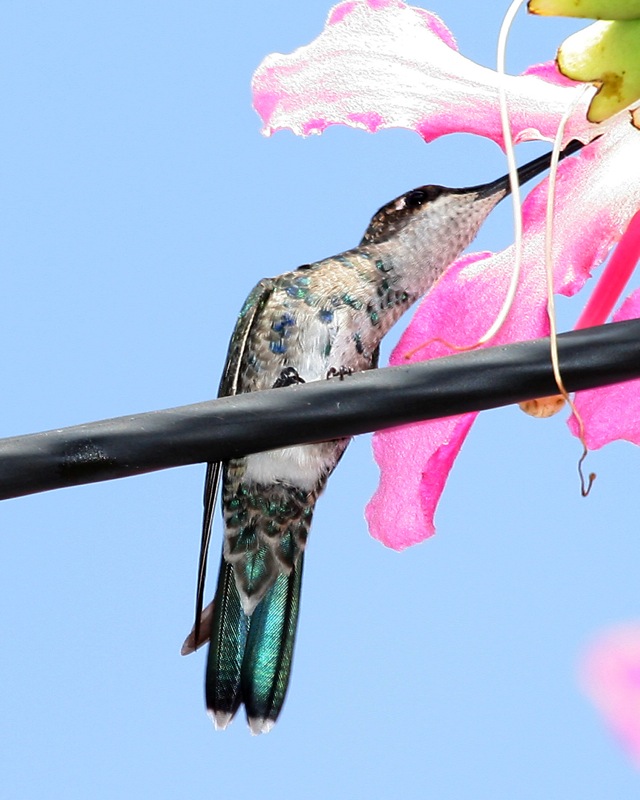
Plain-capped Starthroat
Heliomaster constantii
Order: Apodiformes / Family: Trochilidae

Wikimedia Commons
About the Plain-capped Starthroat
The Plain-capped Starthroat (Heliomaster constantii) is a remarkable hummingbird species renowned for its eye-catching appearance and ecological adaptability. This bird inhabits arid and semi-arid regions across Central America, extending its range into the southern United States, particularly in Arizona, New Mexico, and Texas. Its presence in these regions highlights its adaptability to diverse environments, including thorn scrub, dry forests, and desert habitats. During the breeding season, the Plain-capped Starthroat becomes an integral part of its ecosystem, playing a crucial role in pollination. As a nectarivorous bird, it pollinates a variety of flowering plants, contributing to the biodiversity and health of its habitat. Its long, straight bill and agile flight enable it to access nectar from deep within flowers, facilitating cross-pollination. In addition to its ecological role, the Plain-capped Starthroat's behavior and adaptations offer insights into the evolutionary processes that shape species in arid environments. The bird's seasonal behaviors are equally fascinating. During the breeding season, which varies depending on geographic location, the Plain-capped Starthroat engages in elaborate courtship displays. Males perform aerial acrobatics to impress potential mates, and their presence becomes more pronounced as they establish territories to attract females. In the non-breeding season, these hummingbirds may undertake local movements in search of food resources, although they are generally non-migratory. Observing the Plain-capped Starthroat in its natural habitat provides birdwatchers and nature enthusiasts with a glimpse into the complex interplay of behavior, ecology, and environment that defines this species. Its presence in both urban and rural settings underscores its adaptability, making it a fascinating subject of study for ornithologists and conservationists alike.
The Plain-capped Starthroat belongs to the family Trochilidae, within the order Apodiformes. These birds typically live average 3-5 years, with a maximum recorded of 7 years..
How to Identify a Plain-capped Starthroat
Identifying the Plain-capped Starthroat in the field requires attention to several distinctive features. Adult birds exhibit a prominent white cap on their heads, which contrasts with their otherwise dark head and back. Their throat displays a vibrant iridescent purple, which can appear black in some lighting conditions. The underparts are predominantly white, providing a stark contrast to the darker upperparts and contributing to their striking appearance. Males and females are similar in plumage, though males tend to have more intense coloration on the throat. Juveniles resemble adults but with less pronounced iridescence. In flight, the Plain-capped Starthroat's silhouette is unique due to its long, slender bill and elongated tail, which is often slightly forked. Perched, they maintain an upright posture, often on exposed branches or utility wires. While similar in size to other hummingbirds, they can be confused with the closely related Magnificent Hummingbird. However, the Plain-capped Starthroat's distinctive white cap and specific throat coloration help differentiate it. Understanding these key identification markers is essential for birders hoping to accurately identify this species in the field.
Having trouble telling birds apart? Upload a photo to our bird identification tool for an instant species match.
Plain-capped Starthroat Habitat and Range
Preferred Habitat
The Plain-capped Starthroat thrives in arid and semi-arid habitats, where it can be found in thorn scrub, dry forests, and deserts. In the United States, its range includes parts of Arizona, New Mexico, and Texas, where it occupies elevations from sea level up to 2,000 meters. It demonstrates a remarkable ability to adapt to changing environments, often inhabiting areas where other hummingbirds may not be present. The bird's presence in urban and suburban areas indicates its flexibility, though it primarily favors natural habitats that offer abundant flowering plants. Seasonal shifts in habitat use are not prominent, but local movements may occur as birds seek food resources during different times of the year.
Geographic Range
The range of the Plain-capped Starthroat extends from the southwestern United States to Central America. In the U.S., it is predominantly found in southern Arizona, New Mexico, and Texas, where it is considered a seasonal visitor. Breeding populations are more concentrated in Central America, particularly in countries like Mexico, Guatemala, and Honduras. The bird is largely sedentary, with limited migration patterns, though it may undertake localized movements in response to food availability. Population density tends to be higher in regions with abundant flowering plants, and the species is often found in hotspots such as desert oases and areas with rich floral diversity. Understanding the specific range and distribution of this species aids in conservation efforts and ecological studies.
Want to know which birds visit your area? Browse our backyard birds by location guides for region-specific species lists.
What Does the Plain-capped Starthroat Eat?
The diet of the Plain-capped Starthroat primarily consists of nectar from a variety of flowering plants. It exhibits a preference for tubular flowers, which are ideally suited to its long bill and specialized feeding technique. In addition to nectar, the bird supplements its diet with small insects and spiders, providing essential protein. Seasonal variations in diet are influenced by the availability of flowering plants, with the bird adjusting its foraging behavior to match resource abundance. Typical foraging involves hovering before flowers, inserting its bill to extract nectar, and capturing insects in mid-air. The bird's feeding schedule is largely diurnal, with peak activity during early morning and late afternoon when flowers produce the most nectar.
Want to attract Plain-capped Starthroats to your yard? See our recommended feeders and seed types for the best results.
Plain-capped Starthroat Behavior and Social Structure
The Plain-capped Starthroat exhibits a variety of behaviors that reflect its ecological niche and social structure. It is generally solitary, although males become territorial during the breeding season, aggressively defending their territories from rivals. Courtship displays involve dramatic aerial maneuvers, with males showcasing their flight prowess to attract females. While not typically a flocking species, the bird may congregate in areas with abundant food resources. In response to predators, the Plain-capped Starthroat relies on rapid flight and evasive maneuvers to escape threats. Its daily activity patterns are shaped by temperature and resource availability, with high activity during cooler parts of the day.
Plain-capped Starthroat Nesting and Reproduction
Nesting for the Plain-capped Starthroat involves constructing a small, cup-shaped nest made of plant fibers, spider silk, and lichen. These nests are typically situated on horizontal branches or in sheltered locations that provide protection from the elements. The female is primarily responsible for nest building, incubation, and caring for the young. Clutch size usually consists of two eggs, which the female incubates for approximately 14-19 days. After hatching, the chicks remain in the nest for about 20-26 days before fledging. Parental roles are largely maternal, with the female providing all necessary care. The species typically raises one to two broods per year, depending on environmental conditions.
Plain-capped Starthroat Sounds and Vocalizations
The vocalizations of the Plain-capped Starthroat include a series of high-pitched chirps and whistles. Its primary song consists of rapid, repetitive notes that serve to establish territory and attract mates. Call notes are sharp and distinct, often used in communication between individuals. Alarm calls are more urgent, with a harsher quality that warns of potential threats. During the dawn chorus, the bird's vocal activity peaks, contributing to the acoustic landscape of its habitat. These sounds, while not melodious, serve important functions in the bird's social and territorial interactions.
Interesting Facts About the Plain-capped Starthroat
- 1The Plain-capped Starthroat is one of the few hummingbirds that can be found in both urban and desert environments, showcasing its adaptability.
- 2Despite its vibrant throat, the Plain-capped Starthroat often blends into its surroundings due to its predominantly gray and white plumage.
- 3This species' long bill allows it to feed on flowers that are inaccessible to other hummingbirds, reducing competition for resources.
- 4The Plain-capped Starthroat can flap its wings over 50 times per second, allowing for incredible maneuverability in flight.
- 5It is capable of entering torpor, a state of reduced metabolic rate, to conserve energy during cool nights when food is scarce.
- 6The Plain-capped Starthroat's courtship display includes a series of rapid dives and loops, showcasing its aerial agility to potential mates.
- 7Despite its size, the Plain-capped Starthroat plays a critical role in pollinating a wide variety of flowering plants, supporting ecosystem biodiversity.
Plain-capped Starthroat Conservation Status
Currently, the IUCN lists the Plain-capped Starthroat as a species of Least Concern, indicating a stable population trend. However, habitat loss due to agricultural expansion and urbanization poses ongoing threats to its natural habitats. Conservation efforts focus on preserving key habitats and promoting habitat restoration initiatives. Historical population data suggest stability, but continued monitoring is essential to ensure long-term viability. Education and awareness campaigns can aid in mitigating threats, emphasizing the importance of preserving arid and semi-arid ecosystems that support this species.
Attracting Plain-capped Starthroats to Your Feeder
The Plain-capped Starthroat is a regular visitor to backyard bird feeders across its range. At the Eye On The Fly feeding station, we observe Plain-capped Starthroats regularly and capture footage with our feeder cameras.
Other Trochilidae Species


Birds Similar to the Plain-capped Starthroat
These species are often confused with the Plain-capped Starthroat due to similar appearance or overlapping range.