
Plain-winged Antshrike
Thamnophilus schistaceus
Order: Passeriformes / Family: Thamnophilidae

Wikimedia Commons
About the Plain-winged Antshrike
The Plain-winged Antshrike, scientifically known as Thamnophilus schistaceus, is a remarkable member of the Thamnophilidae family. This bird thrives in the lush and dense understory of lowland tropical forests across the Amazon Basin. Found primarily in countries like Brazil, Peru, Ecuador, and Colombia, its presence is vital to the ecological balance of these biodiverse regions. The bird's significance lies in its role as both predator and prey within its ecosystem, aiding in the control of insect populations and serving as a food source for larger predators.
An avian icon of the Amazon, the Plain-winged Antshrike usually inhabits forests at elevations ranging from sea level up to 1200 meters, although it predominantly dwells below 1000 meters. This bird is adept at navigating through the thick foliage of terra firme and seasonally flooded várzea forests. Its preference for understory habitats makes it somewhat elusive, often heard more than seen.
The Plain-winged Antshrike plays a crucial role in the intricate web of life within the Amazon rainforest. Feeding primarily on insects, it helps manage insect populations, thus contributing to the health of plant life and maintaining the ecological balance. During the breeding season, these antshrikes exhibit fascinating behaviors, forming monogamous pairs that communicate through a series of melodious calls and coordinated movements. As a result of its ecological importance, the Plain-winged Antshrike's presence is a positive indicator of forest health and biodiversity.
The Plain-winged Antshrike belongs to the family Thamnophilidae, within the order Passeriformes. These birds typically live average 5 years, with a maximum recorded of 7 years..
How to Identify a Plain-winged Antshrike
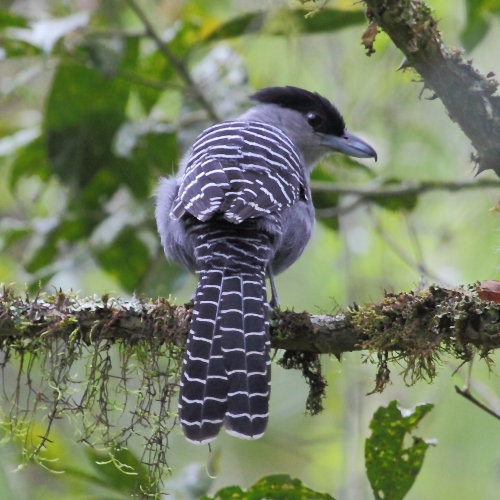
The Plain-winged Antshrike is a medium-sized bird characterized by its mostly gray plumage, which provides excellent camouflage in its forested habitat. Adult males exhibit a sleek gray color on their upperparts, with a slightly paler gray on the underparts. They have a subtle but distinct blackish face mask and a robust, hooked bill adapted for insectivory.
Females differ from males by showcasing a more brownish hue on their wings and back, which blends seamlessly with the forest surroundings. Juvenile birds resemble females but may exhibit more mottled patterns as their plumage matures. The lack of prominent wing bars, a trait common in many ant shrikes, gives the Plain-winged Antshrike its common name.
In flight, this bird displays a relatively short and rounded silhouette with rapid, direct movements. The Plain-winged Antshrike is often confused with similar species like the Spot-winged Antshrike; however, the latter has more pronounced wing markings. The Plain-winged Antshrike's habit of perching quietly in dense foliage, coupled with its unique vocalizations, aids in its identification.
Having trouble telling birds apart? Upload a photo to our bird identification tool for an instant species match.
Plain-winged Antshrike Habitat and Range
Preferred Habitat
The Plain-winged Antshrike inhabits the dense understory of tropical lowland forests, favoring terra firme and seasonally inundated várzea forests. These habitats are typically found in the Amazon Basin, where vegetation is luxuriant and diverse. The bird is rarely found in open areas, as it relies heavily on thick cover for foraging and nesting.
Its elevation range spans from sea level to approximately 1200 meters, although it predominantly resides at elevations below 1000 meters. Despite its preference for undisturbed forest habitats, the Plain-winged Antshrike can sometimes be found in secondary growth areas. However, it generally avoids urban environments, emphasizing the importance of pristine forest habitats for its survival.
Seasonal habitat shifts are minimal for this species, as it is a year-round resident of its chosen territories. The bird's reliance on dense foliage underscores the need for conservation efforts aimed at preserving these critical ecosystems.
Geographic Range
The Plain-winged Antshrike primarily inhabits the vast lowland forests of the Amazon Basin, with its range extending across several South American countries. In Brazil, it is found in the expansive Amazon region, while in Peru, it occupies the lush forests of the eastern lowlands. Ecuador and Colombia also host populations of this bird, particularly in their respective Amazonian territories.
This species is non-migratory, maintaining a year-round presence within its preferred habitats. Population density is notably higher in areas with rich, diverse insect life and abundant dense vegetation, which provides both sustenance and shelter.
The bird's range does not extend to higher elevations or cooler climates, as it is adapted to the warm, humid conditions typical of tropical forests. Conservation of these habitats is vital to maintaining the stability of the Plain-winged Antshrike populations, given their confined geographic distribution.
Want to know which birds visit your area? Browse our backyard birds by location guides for region-specific species lists.
What Does the Plain-winged Antshrike Eat?
The diet of the Plain-winged Antshrike consists primarily of insects and other small arthropods. This bird is an expert forager, utilizing its strong, hooked bill to extract prey from bark, leaves, and other surfaces within the dense understory. Beetles, ants, caterpillars, and spiders are among its preferred food sources, which it captures through meticulous searching and quick, precise movements.
While insects dominate its diet, the Plain-winged Antshrike may occasionally consume small fruits or seeds, particularly when insect abundance is low. This dietary flexibility aids in its survival during periods of scarcity.
Foraging occurs throughout the day, with peak activity during the cooler early morning and late afternoon hours. The bird often forages in pairs or small family groups, employing a cooperative approach to disturb and flush out hidden prey. This behavior not only increases foraging efficiency but also strengthens social bonds within the group.
Plain-winged Antshrike Behavior and Social Structure
The Plain-winged Antshrike exhibits a complex social structure, often forming monogamous pairs that remain together throughout the year. These pairs establish and defend territories within the dense forest understory, using vocalizations to communicate with each other and deter potential intruders.
During courtship, males perform elaborate displays, which include spreading their wings and tails, puffing out their chests, and singing melodious songs to attract females. Once paired, both males and females contribute to territorial defense and care of their offspring.
This bird is generally solitary outside of the breeding season, though it may join mixed-species flocks for increased foraging efficiency and protection against predators. The Plain-winged Antshrike remains vigilant against threats, using alarm calls to warn other birds of potential dangers. Its daily activity pattern involves active foraging in the early morning and late afternoon, with rest periods during the hottest part of the day.
Plain-winged Antshrike Nesting and Reproduction
The Plain-winged Antshrike constructs a cup-shaped nest using twigs, leaves, and fibers. These nests are typically located in dense foliage at heights ranging from 1 to 5 meters above the ground, providing concealment from predators.
The breeding season occurs primarily during the rainy months when food is abundant. Females lay clutches of 2 to 3 eggs, which both parents incubate over a period of about 14 to 16 days. During this time, one parent remains at the nest while the other forages for food.
After hatching, the chicks are altricial and require constant care and feeding by both parents. The fledging period lasts approximately 12 to 15 days, during which the young birds develop the strength and skills necessary for survival. The Plain-winged Antshrike typically produces one brood per year, although conditions may occasionally allow for a second.
Plain-winged Antshrike Sounds and Vocalizations
The Plain-winged Antshrike's primary song is a series of melodious whistles, often described as a clear and repetitive 'whee-whee-whee.' These vocalizations serve to establish territory and communicate between mates. The pitch is relatively high, and the quality is smooth and flowing, making it distinct among the forest sounds.
In addition to its primary song, the bird produces a variety of call notes, including short, sharp 'chip' sounds used for contact between individuals. Alarm calls are more abrupt and harsh, designed to alert conspecifics to potential threats.
This species participates in the dawn chorus, contributing its song to the early morning symphony of the rainforest. The Plain-winged Antshrike's vocalizations are crucial for maintaining social bonds and ensuring the security of its territory.
Interesting Facts About the Plain-winged Antshrike
- 1The Plain-winged Antshrike is known for its exceptional camouflage, often blending seamlessly into the forest understory, making it difficult to spot.
- 2Despite being primarily insectivorous, the Plain-winged Antshrike occasionally supplements its diet with small fruits, showcasing its adaptability.
- 3During the breeding season, both male and female Plain-winged Antshrikes participate in nest building and rearing of the young, highlighting their cooperative parenting.
- 4The Plain-winged Antshrike's song can be heard up to 100 meters away in dense forest, serving as an effective territorial marker.
- 5This species' preference for dense, undisturbed habitats makes it an important indicator of forest health and biodiversity in the Amazon Basin.
- 6The Plain-winged Antshrike often participates in mixed-species flocks, benefiting from the increased foraging success and protection these groups provide.
- 7The bird's scientific name, Thamnophilus schistaceus, reflects its grayish coloration, with 'schistaceus' indicating a slate-like hue.
Plain-winged Antshrike Conservation Status
The Plain-winged Antshrike is currently classified as a species of Least Concern by the IUCN, although population trends indicate potential threats from habitat destruction. Deforestation, primarily driven by agricultural expansion and logging, poses the most significant threat to its habitat in the Amazon Basin. Despite these challenges, conservation efforts focused on protecting large tracts of tropical forest are critical for maintaining stable populations of this species. Establishing and enforcing protected areas, along with sustainable land-use practices, can help mitigate the impacts of habitat loss. Historically, the Plain-winged Antshrike has maintained stable population levels, but ongoing environmental changes necessitate vigilant conservation efforts to ensure its continued survival. Monitoring population trends and habitat integrity remains essential for proactive conservation management.
Other Thamnophilidae Species



Birds Similar to the Plain-winged Antshrike
These species are often confused with the Plain-winged Antshrike due to similar appearance or overlapping range.