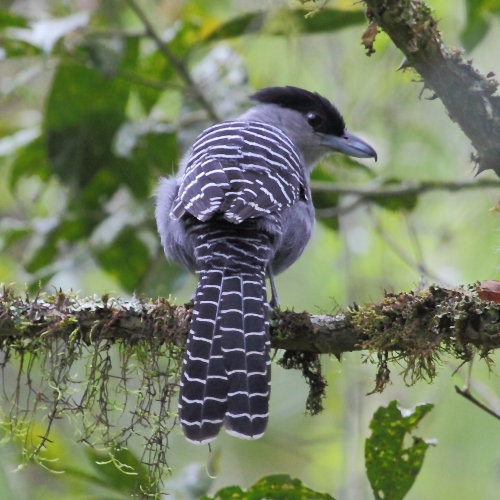
Planalto Slaty-Antshrike
Thamnophilus pelzelni
Order: Passeriformes / Family: Thamnophilidae

Wikimedia Commons
About the Planalto Slaty-Antshrike
The Planalto Slaty-Antshrike (Thamnophilus pelzelni) is a captivating bird endemic to the high-altitude forests of central and southeastern Brazil. This bird plays a significant role in the ecosystem as an insectivore, helping control insect populations within its habitat. Notably, the Planalto Slaty-Antshrike thrives in regions such as the Cerrado and the Mata Atlântica, which are known for their rich biodiversity and complex ecological interactions. Its presence highlights the health and stability of these forested environments, as it relies heavily on the dense underbrush for foraging and nesting.
The Planalto Slaty-Antshrike holds particular significance as an indicator species for the health of its native forests. As it primarily occupies areas of undisturbed habitat, its population trends can provide insights into the effects of deforestation and habitat fragmentation, both pressing issues in Brazil. During the breeding season, which typically spans from September to January, the bird's activities become more conspicuous, as males engage in vocal displays to establish territories and attract mates. Outside of the breeding season, its behavior becomes more subdued, with individuals often found silently foraging in pairs or small family groups.
Ecologically, the Planalto Slaty-Antshrike contributes to the intricate web of life within its forest home. By feeding on insects and other small invertebrates, it helps maintain a balance in the population of these creatures, which in turn affects plant health and distribution. The bird's foraging behavior, characterized by methodical movements through foliage and the occasional hover-gleaning, ensures that it impacts a variety of microhabitats within its range. This antshrike's presence thus underscores the interconnectedness of the tropical forest ecosystem, demonstrating the importance of preserving such environments for the myriad species that depend upon them.
The Planalto Slaty-Antshrike belongs to the family Thamnophilidae, within the order Passeriformes. These birds typically live 4-7 years with a maximum recorded of 9 years.
How to Identify a Planalto Slaty-Antshrike
Adult Planalto Slaty-Antshrikes exhibit a distinctive slate-gray coloration, with males having a slightly darker and more uniform plumage compared to females. The males also display a subtle blackish hood, which becomes visible in optimal lighting conditions. Females, on the other hand, have a slightly paler belly, which provides a useful field mark for differentiation between the sexes.
Juvenile Planalto Slaty-Antshrikes tend to have a more mottled appearance, with brownish tones interspersed within their gray feathers. This coloration gradually shifts to the adult pattern as they mature. When observing these birds in the field, one may also note the bird's relatively long tail and upright posture, which can aid in identification.
The Planalto Slaty-Antshrike can be confused with other members of the Thamnophilidae family, particularly the closely related Variable Antshrike. However, the latter species typically exhibits more pronounced sexual dimorphism and variability in plumage. Observers should pay close attention to the bird's silhouette when in flight, as its rounded wings and short, direct flight pattern are characteristic of the species.
Having trouble telling birds apart? Upload a photo to our bird identification tool for an instant species match.
Planalto Slaty-Antshrike Habitat and Range
Preferred Habitat
The Planalto Slaty-Antshrike primarily inhabits the dense, humid forests of central and southeastern Brazil. This bird is most commonly found in the understory and mid-level strata of these forests, where it can easily navigate through the thick vegetation. It thrives in both primary and secondary forests, with a notable presence in regions such as the Cerrado and Mata Atlântica.
Elevation plays a significant role in its distribution, as it predominantly occupies areas ranging from 500 to 1,200 meters above sea level. During different seasons, the bird may exhibit slight altitudinal movements, particularly in response to food availability and climatic conditions.
While generally associated with rural and forested areas, the Planalto Slaty-Antshrike can also adapt to human-altered landscapes, provided that sufficient vegetative cover remains. However, it is rarely found in highly urbanized settings, preferring instead the relative tranquility and resource richness of less disturbed habitats.
Geographic Range
The Planalto Slaty-Antshrike is a non-migratory species, with its range confined to Brazil. It is predominantly found in the central and southeastern regions of the country, with particular density in the states of Minas Gerais, São Paulo, and Paraná.
Within these regions, the bird's population is concentrated in areas with dense forest cover, often overlapping with protected areas and national parks. This geographic distribution helps buffer the species from some of the more severe impacts of habitat loss, though it remains vulnerable to ongoing deforestation and land conversion.
While the Planalto Slaty-Antshrike does not undertake long-distance migrations, it may engage in localized movements to exploit seasonal food resources. These movements are typically altitudinal, allowing the bird to remain within its preferred habitat type year-round.
Want to know which birds visit your area? Browse our backyard birds by location guides for region-specific species lists.
What Does the Planalto Slaty-Antshrike Eat?
The diet of the Planalto Slaty-Antshrike consists primarily of insects and small invertebrates, which it gleans from foliage and bark in the understory of its forest habitat. This bird employs a variety of foraging techniques, including gleaning and hover-gleaning, to capture prey such as beetles, spiders, and caterpillars.
Seasonal variations in food availability can lead to shifts in diet composition, with the bird occasionally consuming small fruits or seeds when insect populations dwindle. However, its strong preference for animal prey remains consistent throughout the year.
The Planalto Slaty-Antshrike typically forages during the cooler parts of the day, such as early morning and late afternoon, to maximize its hunting efficiency. Its methodical approach to foraging, combined with its keen eyesight and agility, allows it to exploit a wide range of microhabitats within its forest environment.
Planalto Slaty-Antshrike Behavior and Social Structure
The Planalto Slaty-Antshrike exhibits a largely solitary or paired social structure, particularly during the breeding season when territorial behavior becomes pronounced. Males establish and defend territories through vocalizations and displays, often engaging in duet singing with their mates to strengthen pair bonds and deter rivals.
Courtship displays involve a combination of vocal and physical displays, with males showcasing their plumage and engaging in short flights to attract females. During the non-breeding season, the bird's social structure becomes more flexible, with small groups occasionally forming to exploit abundant food resources.
In response to predators, the Planalto Slaty-Antshrike employs a combination of alarm calls and evasive maneuvers. Its daily activity patterns are influenced by environmental conditions, with peak activity occurring during cooler periods when foraging is most efficient.
Planalto Slaty-Antshrike Nesting and Reproduction
The Planalto Slaty-Antshrike constructs its nest within the dense undergrowth of its forest habitat. The nest is typically a cup-shaped structure made from twigs, leaves, and plant fibers, carefully woven to provide camouflage and protection from predators.
Nests are usually located at heights of 1-3 meters above the ground, often concealed within shrubbery or dense foliage. The typical clutch size consists of two to three eggs, which both parents incubate for a period of approximately 14-16 days.
After hatching, the nestlings remain in the nest for about 12-15 days before fledging. Both parents share in feeding and protecting the young, ensuring their survival in the critical early stages of life. The Planalto Slaty-Antshrike typically raises one brood per year, although favorable conditions may occasionally allow for a second.
Planalto Slaty-Antshrike Sounds and Vocalizations
The primary song of the Planalto Slaty-Antshrike is a series of clear, melodious whistles, often described as a descending series of notes that create a haunting yet musical quality. This song serves as a territorial call and is most frequently heard during the breeding season.
Call notes consist of sharp 'chip' sounds, used for communication between mates and alerting others to potential threats. Alarm calls are more urgent and harsh, designed to warn of imminent danger and coordinate evasive actions.
During the dawn chorus, the Planalto Slaty-Antshrike's song can be heard resonating through the forest, contributing to the complex auditory landscape of its habitat.
Interesting Facts About the Planalto Slaty-Antshrike
- 1The Planalto Slaty-Antshrike was first described in the late 19th century, highlighting the rich avian diversity of Brazil's highlands.
- 2Despite its name, the Planalto Slaty-Antshrike does not primarily feed on ants but rather a variety of insects and small invertebrates.
- 3The bird's duet singing is a fascinating behavior that strengthens pair bonds and helps defend territories against intruders.
- 4The Planalto Slaty-Antshrike's preference for dense undergrowth makes it a challenging species to observe in its natural habitat.
- 5This antshrike's presence is often an indicator of healthy forest ecosystems, underscoring its ecological importance.
- 6The Planalto Slaty-Antshrike's plumage provides excellent camouflage against the forest's shaded understory.
- 7Research on the Planalto Slaty-Antshrike contributes to our understanding of the impacts of habitat fragmentation in tropical forests.
Planalto Slaty-Antshrike Conservation Status
The Planalto Slaty-Antshrike is currently listed as Least Concern by the IUCN, with its population considered stable. However, ongoing deforestation and habitat fragmentation pose significant threats, particularly in the rapidly changing landscapes of Brazil. Conservation efforts focus on the preservation and restoration of critical habitats, such as the Cerrado and Mata Atlântica, which harbor rich biodiversity. Protected areas and national parks play a vital role in safeguarding the habitats of the Planalto Slaty-Antshrike, though continued vigilance and sustainable land management practices are essential. Historical population changes have been influenced by varying degrees of habitat alteration, making current conservation strategies crucial for ensuring the species' long-term survival.