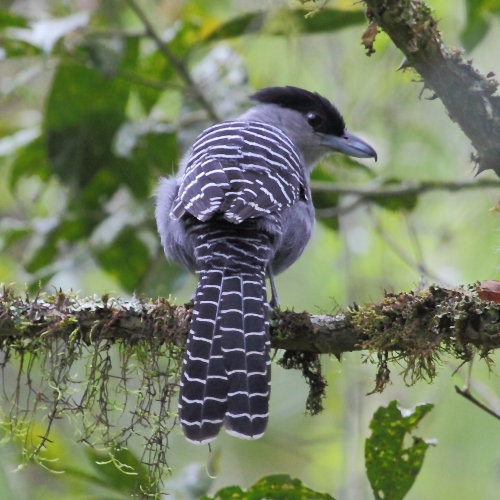
Plumbeous Antbird
Myrmeciza hyperythra
Order: Passeriformes / Family: Thamnophilidae

Wikimedia Commons
About the Plumbeous Antbird
The Plumbeous Antbird, scientifically known as Myrmeciza hyperythra, is an engaging species within the Thamnophilidae family, predominantly found in the tropical rainforests of South America. This bird thrives in the dense understories of lowland forests, often in regions like the Amazon Basin, extending from eastern Colombia and Venezuela, through Ecuador and Peru, to northern Brazil. Its ecological role is significant, primarily because it plays an integral part in the forest's avian community.
The Plumbeous Antbird is adapted to a life of skulking in the shadows of the forest, where it forages among leaf litter and dense vegetation. Its presence is often detected by its distinctive vocalizations rather than by sight. The bird's reliance on army ant swarms for foraging highlights its ecological niche, as it captures insects and other small prey fleeing from the advancing ants. This behavior underscores its role in the ecosystem as both a predator and a participant in mutualistic relationships.
Seasonally, the Plumbeous Antbird exhibits slight variations in behavior. During the breeding season, which typically aligns with the wet season, it becomes more vocal and territorial, engaging in loud duets with its mate. These vocalizations serve to establish territory boundaries and strengthen pair bonds. In contrast, during the non-breeding season, its activities are less conspicuous, and it may join mixed-species flocks, a behavior that enhances foraging efficiency and predator avoidance.
Understanding the Plumbeous Antbird's role in the ecosystem provides insights into the complex interactions within tropical forest habitats. As a species that relies heavily on specific environmental conditions, its presence can serve as an indicator of forest health. Conservation efforts to protect these habitats are crucial, not only for the Plumbeous Antbird but also for the myriad of species that share its habitat.
The Plumbeous Antbird belongs to the family Thamnophilidae, within the order Passeriformes. These birds typically live average 5-8 years, with a maximum recorded of 12 years..
How to Identify a Plumbeous Antbird
The Plumbeous Antbird is best identified by its slate-gray plumage, which gives it a distinctive appearance among the dense forest vegetation. Adult males typically exhibit a uniform gray coloration, with a slightly darker tone on the head and upper parts. Females, on the other hand, present a more muted gray with subtle brownish undertones, particularly on the underparts, setting them apart from their male counterparts. Juvenile Plumbeous Antbirds resemble females but often have a browner hue and less distinct markings.
One of the key features of the Plumbeous Antbird is its strikingly dark eyes set against its lighter plumage, which can be a useful field mark for observers. This feature, combined with its behavior of remaining close to the ground or within the middle understory, aids in its identification. In flight, the bird's silhouette is compact, with rounded wings and a short tail, a profile typical of antbirds that rely on quick, agile movements through dense foliage.
Confusion with similar species is possible but can be mitigated by noting the Plumbeous Antbird's habitat preferences and vocalizations. Its calls, a series of sharp, metallic notes, differ from those of other antbird species, providing additional clues for accurate identification. The bird's perching posture is often upright, with a slight forward lean, as it scans the ground for prey, another behavioral trait that aids in distinguishing it from other forest inhabitants.
Having trouble telling birds apart? Upload a photo to our bird identification tool for an instant species match.
Plumbeous Antbird Habitat and Range
Preferred Habitat
The Plumbeous Antbird inhabits the dense, humid lowland rainforests of the Amazon Basin, a region characterized by its biodiversity and complex ecosystems. These forests provide the ideal environment for the bird, with abundant undergrowth and a rich supply of insects. The antbird shows a marked preference for areas near watercourses or regions with high humidity, supporting its need for a consistent insect prey base.
Typically found at elevations ranging from sea level to about 1,000 meters, the bird rarely ventures into higher altitudes, which lack the dense understory it requires for foraging. While the Plumbeous Antbird is primarily associated with untouched, pristine forests, it can occasionally be found in secondary growth areas, provided they offer sufficient cover and food resources.
Seasonal habitat shifts are minimal for the Plumbeous Antbird, as it maintains a year-round presence within its range. Unlike some tropical species, it does not migrate or exhibit significant movement outside its core habitat areas. Urban presence for this species is virtually nonexistent, given its reliance on dense forest environments and specific ecological niches.
Geographic Range
The Plumbeous Antbird has a well-defined range within the northern and central regions of South America. Its distribution encompasses the vast Amazon Basin, where it is a common resident in countries such as Brazil, Peru, Ecuador, Colombia, and Venezuela. This range reflects its adaptation to the extensive lowland rainforests that characterize these countries.
Within its range, the Plumbeous Antbird exhibits a relatively sedentary lifestyle, with little evidence of long-distance migration. Instead, its movements are more localized, often confined to foraging territories within the dense forest understory. Population density hotspots include the Amazonian lowlands, particularly in areas with high ant swarm activity, which supports its foraging strategy.
Although its range is largely continuous across the Amazon Basin, localized populations may vary in density based on habitat quality and availability. Protected areas and national parks within these countries often support stable populations, offering a refuge from habitat degradation and deforestation, which pose significant threats to its natural environment.
Want to know which birds visit your area? Browse our backyard birds by location guides for region-specific species lists.
What Does the Plumbeous Antbird Eat?
The diet of the Plumbeous Antbird primarily consists of insects and other small arthropods, which it skillfully captures by following army ant swarms. This specialized foraging strategy involves picking off insects that flee the advancing ants, making the bird a quintessential example of a 'follower' species in these swarms.
During the wet season, when insect availability peaks, the Plumbeous Antbird's diet expands to include a wider variety of prey, such as spiders and small invertebrates. Its foraging technique is characterized by quick, agile movements through the understory, as it snatches prey from the ground and from low vegetation.
This bird typically forages during the early morning and late afternoon, aligning its activity with peak insect movements. Prey size varies but generally includes small to medium-sized insects, ensuring that the bird meets its nutritional requirements without venturing far from its preferred habitat. Seasonal changes in diet are minimal, as the bird remains within its tropical forest environment year-round, where food resources are relatively stable.
Plumbeous Antbird Behavior and Social Structure
The Plumbeous Antbird exhibits a range of fascinating behaviors that emphasize its adaptation to life in the dense tropical forests. Socially, this bird is monogamous, often seen in pairs, particularly during the breeding season. Territorial behavior is pronounced, with both sexes participating in vocal displays to defend their territory from intruders.
Courtship displays involve synchronized vocal duets, where both members of a pair sing in unison, strengthening their bond and clearly marking their territory. Flocking behavior is uncommon, although the bird occasionally joins mixed-species flocks, especially outside the breeding season, to increase foraging efficiency and reduce predation risk.
In response to predators, the Plumbeous Antbird employs a strategy of concealment, utilizing the dense understory to evade detection. It remains vigilant, often freezing in place when a threat is perceived. Daily activity patterns show peak activity during dawn and dusk, when the bird forages actively, while it remains relatively inactive during the hottest parts of the day.
Plumbeous Antbird Nesting and Reproduction
Nest construction for the Plumbeous Antbird involves creating a simple, cup-shaped nest, typically composed of leaves, twigs, and other forest debris. These nests are strategically placed close to the ground, often in dense thickets or among low branches and vines, providing camouflage and protection from predators.
The typical clutch size for this species is two eggs, which are incubated by both parents. The incubation period lasts approximately 14 days, with both members of the pair sharing responsibilities, including feeding and guarding the nest. After hatching, the young are altricial, requiring constant care and feeding by the parents.
Fledging occurs around 12-14 days post-hatching, when the chicks are ready to explore their surroundings, albeit still under parental supervision. The Plumbeous Antbird generally raises one brood per year, although in favorable conditions, a second brood might be attempted. Parental roles are well defined, with both sexes equally contributing to the nurturing of their young.
Plumbeous Antbird Sounds and Vocalizations
The vocalizations of the Plumbeous Antbird are distinctive, characterized by a series of sharp, metallic notes that resonate through the dense forest. Its primary song consists of rapid, evenly spaced syllables often described as 'chip, chip, chip,' which serve both to defend territory and to communicate with mates.
In addition to its song, the Plumbeous Antbird employs various call notes, including soft whistles and harsher scolding calls used in alarm situations. These vocalizations play a crucial role in coordinating movements with a mate or signaling the presence of potential threats.
During the dawn chorus, the Plumbeous Antbird's song contributes to the rich tapestry of forest sounds, often holding its own against the calls of other antbird species. Its vocal repertoire, while not as varied as some songbirds, is an effective tool for maintaining territory and social bonds.
Interesting Facts About the Plumbeous Antbird
- 1The Plumbeous Antbird's diet heavily relies on army ant swarms, making it a prime example of an ant-following species.
- 2Despite its secretive nature, the Plumbeous Antbird can be located by its distinct metallic calls, which carry through dense forest understories.
- 3The species remains monogamous, with both male and female engaging in vocal duets to establish and defend their territory.
- 4Females are slightly smaller than males and feature subtle brownish tones, distinguishing them from the uniformly gray males.
- 5The Plumbeous Antbird's habitat spans the Amazon Basin, providing a critical indicator of rainforest health and biodiversity.
- 6These birds are known for their agile movements, adeptly navigating through dense foliage to capture fleeing insects.
- 7The bird's reliance on dense, humid forests underscores the importance of preserving its natural habitat from deforestation.
Plumbeous Antbird Conservation Status
The Plumbeous Antbird is currently listed as Least Concern by the IUCN, reflecting its relatively stable population within its extensive range. However, its dependence on intact rainforest habitats makes it vulnerable to deforestation and habitat fragmentation, which are significant threats in its native regions. While population trends remain stable in protected areas, ongoing habitat loss in unprotected regions poses a long-term risk. Conservation efforts focus on preserving large tracts of tropical forest, critical not just for the Plumbeous Antbird but for countless other species that share its habitat. Historical population changes are difficult to ascertain due to the bird's secretive nature and the challenges of conducting comprehensive population surveys in dense forests. Nonetheless, maintaining the health of Amazonian ecosystems is essential for ensuring the continued survival of the Plumbeous Antbird.