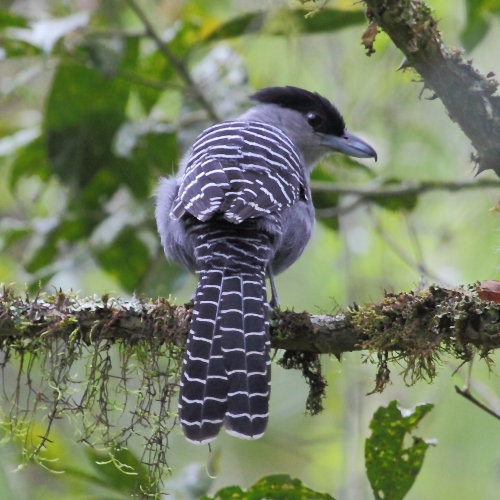
Predicted Antwren
Herpsilochmus praedictus
Order: Passeriformes / Family: Thamnophilidae

Wikimedia Commons
About the Predicted Antwren
The Predicted Antwren, scientifically known as Herpsilochmus praedictus, is a fascinating member of the Thamnophilidae family. This small passerine bird calls the lush forests of northeastern Peru its home, where it plays a crucial role in the ecosystem as an insectivore. Discovered relatively recently in ornithological terms, this species has garnered significant attention due to its limited geographic range and specialized habitat requirements. As a resident of the Amazon, the Predicted Antwren is found at elevations ranging from 200 to 600 meters, predominantly within the regions of Loreto and Ucayali. These birds thrive in the dense understory of terra firme and seasonally flooded forests, where they engage in their primary activity-gleaning insects from foliage. Their role in controlling insect populations underscores their ecological importance, helping maintain the delicate balance within these biodiverse rainforest systems. The Predicted Antwren exhibits seasonal behaviors typical of many Amazonian bird species. During the breeding season, which aligns with the rainy period from November to March, these birds become more vocal and conspicuous. Pairs engage in synchronized duets, a fascinating behavior that strengthens pair bonds and reinforces territorial claims. Outside of the breeding season, the Predicted Antwren remains relatively quiet, focusing on foraging and avoiding the attention of predators. This bird's presence in the Amazon stands as a testament to the rich biodiversity of the region, offering researchers and bird enthusiasts alike a glimpse into the intricate web of life within these forests. As such, the conservation of the Predicted Antwren and its habitat is of paramount importance, necessitating ongoing efforts to protect the unique avian diversity of the Amazon.
The Predicted Antwren belongs to the family Thamnophilidae, within the order Passeriformes. These birds typically live estimated average 3-4 years, with limited data on maximum age.
How to Identify a Predicted Antwren
Identifying the Predicted Antwren involves noting several key features. Adult males boast a striking contrast of black and white plumage, with black on the head and back, while the underparts are predominantly white. A distinguishing feature includes the white supercilium, or eyebrow stripe, which stands out against the dark head. Females, on the other hand, have a more subdued coloration with grayish tones replacing the stark black found in males, though they still retain the conspicuous white supercilium. Juvenile Predicted Antwrens may appear duller with mottled patterns, lacking the crisp contrast seen in adults. This species can be confused with similar antwrens within its range, such as the Long-winged Antwren. However, the Predicted Antwren's smaller size and distinctive vocalizations aid in differentiation. In flight, the bird's short, rounded wings and swift, direct flight pattern are notable, typical of the antwren family. When perching, these birds often adopt a horizontal posture, frequently twitching their tails-a behavior characteristic of many antbirds. Observers should also note their habit of remaining in the lower and mid-strata of the forest, which is consistent with their foraging style.
Having trouble telling birds apart? Upload a photo to our bird identification tool for an instant species match.
Predicted Antwren Habitat and Range
Preferred Habitat
The Predicted Antwren is a specialist of Amazonian terra firme forests, particularly favoring regions in northeastern Peru. These forests, characterized by their well-drained soils and dense canopy cover, provide the perfect setting for the antwren's foraging activities. Within these habitats, the bird is often found in the understory and mid-levels, where it can maximize its insect-hunting efficiency. The species shows a preference for areas with dense foliage, which offers both abundant prey and protection from predators. While the Predicted Antwren is largely confined to forest interiors, it occasionally ventures into seasonally flooded areas, particularly during the wet season when food availability peaks. Unlike some other bird species, it does not frequently venture into urban or highly disturbed areas, underscoring its reliance on intact forest ecosystems for survival. This habitat specificity makes it particularly vulnerable to deforestation and habitat fragmentation.
Geographic Range
The Predicted Antwren's range is restricted to the northeastern part of Peru, primarily in the Loreto and Ucayali regions. This endemic species does not undertake long migrations, residing year-round within its established territory. Its distribution is closely tied to the availability of suitable forest habitat, limiting the bird to areas where terra firme forests remain relatively undisturbed. Population densities are highest in these core areas, where the combination of abundant food resources and suitable nesting sites supports a stable population. Although the Predicted Antwren is not known to migrate over large distances, local movements may occur in response to seasonal changes in food supply, such as during periods of extended flooding or drought. It is essential for conservation efforts to focus on preserving large, contiguous tracts of forest to ensure the long-term survival of this species.
Want to know which birds visit your area? Browse our backyard birds by location guides for region-specific species lists.
What Does the Predicted Antwren Eat?
The diet of the Predicted Antwren consists primarily of insects and other small arthropods. This bird employs a foraging technique known as 'gleaning,' where it picks insects off leaves, branches, and other substrates within the forest understory. The antwren's small size and agile movements make it well-suited for this method, allowing it to exploit a variety of prey, including beetles, caterpillars, and spiders. Seasonal variations in food availability influence its diet composition, with a broader range of prey types consumed during the wet season when insects are most abundant. Foraging predominantly occurs during the cooler parts of the day, such as early morning and late afternoon, aligning with peak insect activity. The Predicted Antwren's role as an insectivore contributes to controlling insect populations, emphasizing its ecological importance within the forest ecosystem.
Predicted Antwren Behavior and Social Structure
The Predicted Antwren displays a range of fascinating behaviors that provide insight into its social structure and ecological niche. As a largely monogamous species, pairs establish and maintain territories that they defend vigorously against intruders. Territorial disputes often involve vocal duets, where pairs sing in harmony to assert dominance and strengthen pair bonds. These vocalizations play a crucial role in mate attraction and territorial maintenance, especially during the breeding season. The Predicted Antwren exhibits a degree of sociality, occasionally joining mixed-species flocks to enhance foraging efficiency and reduce predation risk. Within these flocks, they often associate with other insectivorous birds, benefiting from the collective vigilance against predators. Despite their social tendencies, Predicted Antwrens remain cautious and secretive, retreating into dense foliage at the first sign of danger. Their daily activity patterns revolve around foraging, with periods of rest during the hottest parts of the day.
Predicted Antwren Nesting and Reproduction
Nesting in the Predicted Antwren involves meticulous construction and site selection, reflecting their adaptation to the forest environment. Nests are typically built in the understory, well concealed among dense foliage to protect against predators. The nest structure is a small cup made of fine plant fibers, leaves, and spider silk, which provides both strength and camouflage. The typical clutch size consists of two to three eggs, which the female incubates over a period of approximately 14 to 16 days. Once hatched, both parents engage in feeding and caring for the chicks. The fledging period lasts around 10 to 12 days, after which the young begin to explore their surroundings, gradually gaining independence. The pair may raise one or two broods per year, depending on food availability and environmental conditions. Parental roles are well-defined, with both sexes contributing to incubation and chick-rearing, ensuring high survival rates for their offspring.
Predicted Antwren Sounds and Vocalizations
The Predicted Antwren's vocal repertoire includes a distinctive primary song, characterized by a rapid series of high-pitched notes delivered in a rhythmic sequence. This song serves both territorial and mate attraction purposes, often heard at dawn and dusk. Call notes are sharp and metallic, effective for communication between mates and signaling alarm in the presence of predators. During the dawn chorus, the antwren's vocalizations contribute to the rich tapestry of sounds in the Amazon rainforest, competing with other bird species for acoustic space. The alarm calls are particularly loud and piercing, alerting other birds to potential threats and enhancing the collective vigilance of mixed-species flocks. These vocalizations, while unique, can be compared to the rapid trills of a cricket, aiding in field identification for birders.
Interesting Facts About the Predicted Antwren
- 1The Predicted Antwren was only described scientifically in 2013, highlighting the continuous discovery of new species in the Amazon.
- 2Despite its name, the Predicted Antwren's existence was not anticipated by scientists, making its discovery a pleasant surprise.
- 3The species engages in duets, where mated pairs sing together, a behavior that is rare among small passerines.
- 4Its name, 'praedictus,' reflects the prediction of new species yet to be discovered in the rich Amazonian biodiversity.
- 5Mixed-species flocking, involving the Predicted Antwren, can include up to 30 different bird species, enhancing foraging success.
- 6Studies show that the Predicted Antwren can reduce leaf-eating insect populations by up to 30%, crucial for forest health.
- 7The bird's preference for dense understory makes it particularly challenging to observe, adding to its mystique among birders.
Predicted Antwren Conservation Status
The Predicted Antwren currently holds a status of Least Concern on the IUCN Red List, but its limited range and habitat specialization make it vulnerable to environmental changes. The primary threat to this species is habitat destruction, particularly from deforestation for agriculture and logging. Conservation efforts focus on protecting critical habitats within its range, including the establishment of protected areas and sustainable land-use practices. Population trends appear stable at present, but ongoing monitoring is necessary to detect any negative impacts from habitat loss or climate change. Historical population changes are not well-documented, given the species' recent discovery, yet the need for habitat conservation remains a priority to safeguard its future.