
Purple Martin
Progne subis
Order: Passeriformes / Family: Hirundinidae
Wikimedia Commons
About the Purple Martin
The Purple Martin, or Progne subis, is a remarkable species within the swallow family. As North America's largest swallow, it holds a unique place in both ecological and cultural contexts. Historically, Native Americans attracted Purple Martins by hanging hollow gourds, a practice that continues today with modern birdhouses. These birds are highly social and are often seen in large colonies. Their presence is most prominent in the eastern United States during the breeding season, where they inhabit a variety of open areas ranging from urban parks to rural farmlands.
Purple Martins play a vital ecological role as insectivores. They consume large quantities of flying insects, including beetles, dragonflies, and moths, thus serving as natural pest control agents. During the breeding season, they forage over open water and fields, often at high altitudes. This aerial feeding behavior is not only fascinating to observe but also essential for maintaining a balanced insect population.
Seasonal migration is another compelling aspect of Purple Martins' lives. These birds undertake long-distance journeys from their breeding grounds in North America to wintering sites in South America, specifically in the Amazon Basin. This migration, which covers thousands of miles, showcases their incredible endurance and navigational abilities. Their arrival in North America heralds the beginning of spring, while their departure in late summer signifies the onset of autumn.
Purple Martins are also a species of interest in conservation efforts. While their populations are stable in certain areas, they face challenges from habitat loss and competition with invasive species like the European Starling. Conservationists advocate for the provision of nesting sites and the management of these invasive species to ensure the long-term survival of these captivating birds.
The Purple Martin belongs to the family Hirundinidae, within the order Passeriformes. These birds typically live average lifespan is about 5-7 years, with a maximum recorded age of 13 years..
How to Identify a Purple Martin
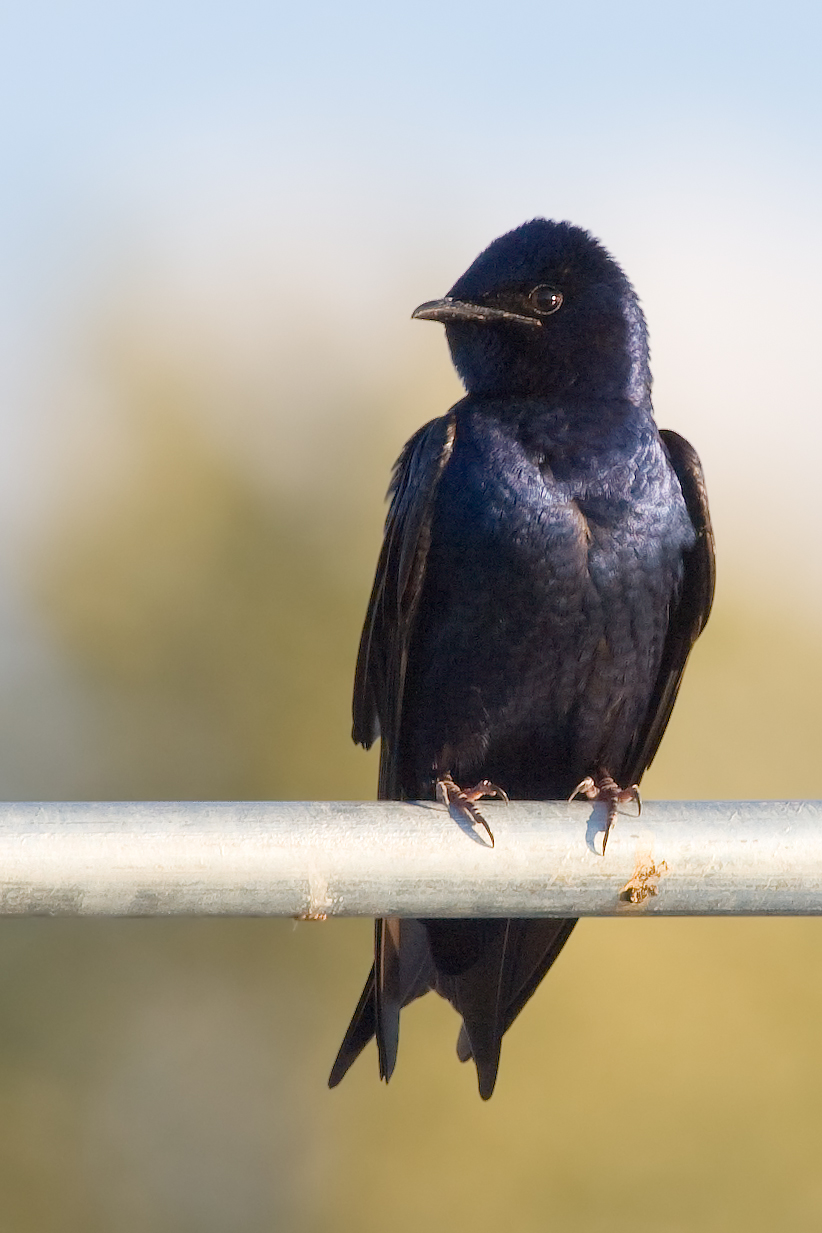
Adult Purple Martins are easily identifiable by their glossy, dark purple-blue plumage, which appears almost black in certain lighting conditions. Males display this iridescent coloration over their entire body, while females and juveniles exhibit more subdued coloring, with lighter underparts and grayish tones on the breast and forehead. The males' vibrant plumage is most pronounced during the breeding season, making them particularly striking against the sky.
Juvenile Purple Martins can be distinguished from adults by their brownish feather edges and paler belly, which gradually darken as they mature. Both sexes have a slightly forked tail, although it is less pronounced than in some other swallow species.
In flight, Purple Martins exhibit long, pointed wings and a streamlined body, which contribute to their agile and graceful flight patterns. They often soar and glide in wide circles, occasionally performing dramatic swoops and dives, showcasing their mastery of the air.
When perched, Purple Martins maintain an upright posture, often clustering together on telephone wires or the edges of their communal nesting sites. This behavior, coupled with their distinct vocalizations, aids in their identification even when not in flight.
Having trouble telling birds apart? Upload a photo to our bird identification tool for an instant species match.
Purple Martin Habitat and Range
Preferred Habitat
Purple Martins are adaptable birds that thrive in open areas with ample flying space for foraging. They frequently inhabit urban and suburban environments, especially where human-provided nesting sites are available. They are commonly found in parks, golf courses, and residential areas with open lawns.
In rural settings, these birds favor farmlands and meadows, often near bodies of water, which support abundant insect populations. They require proximity to water for both drinking and feeding purposes. During migration, they may be observed in a wider range of habitats as they make their way to their wintering grounds.
Elevation does not significantly restrict their habitat choice, as they are found from sea level to moderate altitudes. However, they are absent from densely forested regions where open flight paths are limited. Their affinity for human-altered landscapes makes them frequent visitors to areas where other bird species might not venture.
Geographic Range
The breeding range of the Purple Martin extends across much of North America, from the southern parts of Canada through the United States and into parts of northern Mexico. They are most abundant in the eastern and central regions of the U.S., where they benefit from widespread human-provided nesting sites.
During the non-breeding season, these birds migrate to South America, with a significant concentration in the Amazon Basin. They have been recorded in countries such as Brazil, Bolivia, and Peru, where they spend the winter months.
Migration corridors typically follow a north-south route across the Americas, with major stopover sites located in the southeastern United States. Population density is highest in areas with abundant nesting options, such as the Great Lakes region and the Mississippi River Valley, where large colonies can be observed.
Want to know which birds visit your area? Browse our backyard birds by location guides for region-specific species lists.
What Does the Purple Martin Eat?
Purple Martins primarily feed on a diet of flying insects, which they catch in mid-air using their adept aerial skills. Their diet includes beetles, dragonflies, moths, mosquitoes, and other winged insects, which they capture while performing acrobatic flight maneuvers.
During the breeding season, they focus on larger insects that provide more energy and nutrients for raising their young. In contrast, their winter diet in South America may include a broader range of insect species, depending on availability.
Foraging typically occurs during daylight hours, with peak activity in the early morning and late afternoon. These birds often hunt over open water or fields, where insect abundance is high. They can travel significant distances from their nesting sites in search of food, sometimes flying several miles to locate optimal feeding grounds.
Purple Martins employ a dynamic foraging technique, using their impressive speed and agility to outmaneuver prey. This method not only ensures a consistent food supply but also highlights their role as effective insect predators in their ecosystem.
Purple Martin Behavior and Social Structure
Purple Martins are highly social birds, often forming large colonies during the breeding season. These colonies can consist of dozens to hundreds of pairs, all utilizing communal nesting sites. Social interactions within the colony include vocalizations, mutual preening, and synchronized flights, which reinforce group cohesion.
Territorial behavior is evident during the breeding season, with males defending nesting sites against intruders. Courtship displays involve aerial chases and vocalizations, with males showcasing their plumage and flight skills to attract females. Once paired, both sexes cooperate in nest building and rearing young.
Flocking behavior is particularly pronounced during migration and on the wintering grounds, where massive roosts can form. These gatherings offer protection from predators and facilitate information exchange about food sources.
In response to predators, Purple Martins exhibit a variety of behaviors, including alarm calls and mobbing. They are vigilant in protecting their nests from avian and mammalian threats, often relying on the strength of their colony for defense. Daily activity patterns are influenced by weather conditions, with feeding and socializing occurring primarily in favorable weather.
Purple Martin Nesting and Reproduction
Purple Martins primarily nest in cavities, often using man-made birdhouses provided by enthusiasts. These structures typically consist of multiple compartments, accommodating the colony's communal nesting preferences. Natural cavities, such as those in dead trees, are also used, though they are less common.
The nesting season begins in late spring, with clutch sizes ranging from 3 to 7 eggs. Incubation lasts about 15 to 18 days, with both parents sharing responsibilities. After hatching, the young remain in the nest for approximately 26 to 32 days, receiving regular feedings from both parents.
Parental roles are well-defined, with both males and females participating in incubation, feeding, and defense of the nest. Purple Martins typically raise one brood per year, although in favorable conditions, a second brood is possible.
Nest materials include grass, twigs, and mud, with the interior lined with feathers for insulation. Nest site fidelity is strong, with birds often returning to the same location year after year, provided it remains suitable and safe.
Purple Martin Sounds and Vocalizations
The vocal repertoire of the Purple Martin is both varied and distinctive. The primary song consists of a series of rich, melodious chirps and gurgling notes, delivered in a rhythmic sequence. This song is often heard during courtship and territorial displays, serving to establish presence and attract mates.
Purple Martins also produce a range of call notes, including a distinctive 'tchew' sound used for contact between individuals. Alarm calls are sharp and insistent, alerting the colony to potential threats.
During the dawn chorus, males are particularly vocal, their songs filling the air as the sun rises. This behavior underscores their role in marking territory and maintaining social bonds within the colony. Compared to other swallows, the Purple Martin's vocalizations are richer and more complex, reflecting their social and communicative nature.
Interesting Facts About the Purple Martin
- 1Purple Martins can consume up to 2,000 insects per day, making them effective natural pest controllers.
- 2These birds are known to travel over 5,000 miles during their migration from North America to South America.
- 3Purple Martins have been nesting in human-provided structures for over 100 years, a unique relationship among wild birds.
- 4They are one of the few bird species that rely almost exclusively on humans for nesting sites in some regions.
- 5Purple Martins are capable of drinking and bathing mid-flight by skimming the surface of water bodies.
- 6The average lifespan of a Purple Martin in the wild is about 5 to 7 years, although some have been recorded living up to 13 years.
- 7They are known for their synchronized aerial displays, which can involve complex group maneuvers during feeding and social interactions.
Purple Martin Conservation Status
The Purple Martin is currently classified as Least Concern by the IUCN, although regional populations face significant challenges. The primary threats include habitat loss, competition with invasive species like European Starlings and House Sparrows, and pesticide use that reduces insect prey availability. Conservation efforts focus on providing artificial nesting structures, managing invasive species, and promoting awareness of their ecological importance. Historical population trends show fluctuations correlating with changes in land use and availability of nesting sites. Despite these challenges, Purple Martins have benefited from dedicated conservation projects, which have helped stabilize certain populations. Continued efforts are essential to ensure their future, particularly in areas where natural habitats are under pressure from urban and agricultural development.
Other Hirundinidae Species


Birds Similar to the Purple Martin
These species are often confused with the Purple Martin due to similar appearance or overlapping range.
