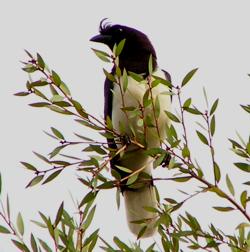
Purplish Jay
Cyanocorax cyanomelas
Order: Passeriformes / Family: Corvidae

Wikimedia Commons
About the Purplish Jay
The Purplish Jay (Cyanocorax cyanomelas) is a captivating bird found primarily in the subtropical and tropical forests of South America. This striking member of the Corvidae family is renowned for its vibrant plumage, which exhibits a mixture of deep purples and blues, providing a visual feast for any birdwatcher lucky enough to spot one. The Purplish Jay thrives in a variety of habitats, including the Amazon rainforest, the chaco woodlands, and the cerrado regions, adapting well to the varying conditions and resources these areas offer.
Ecologically, the Purplish Jay plays a critical role as both a predator and a seed disperser. Its diet consists primarily of insects, fruits, and small vertebrates, which helps control pest populations and facilitate plant reproduction. This bird’s social behavior and complex vocalizations make it a key species for studying avian communication and intelligence. Observations indicate that the Purplish Jay is active throughout the year, with seasonal behaviors influenced by the availability of food resources and climatic conditions.
In the eastern parts of Brazil and Paraguay, populations of the Purplish Jay are particularly dense, showcasing their adaptability to both primary and secondary forests. The bird's presence often correlates with the health of the forest ecosystem, as it requires large tracts of suitable habitat to maintain its social structures and foraging territories. Researchers continue to monitor the species to understand the broader impacts of environmental changes, such as deforestation and climate shifts, which can alter the Purplish Jay's distribution and abundance.
The Purplish Jay belongs to the family Corvidae, within the order Passeriformes. These birds typically live average 8 years; max recorded 11 years.
How to Identify a Purplish Jay
The Purplish Jay is a medium-sized bird with a length ranging from 33 to 36 cm. Its most distinctive feature is its iridescent plumage, which appears purplish-blue under certain lighting conditions. The head, nape, and upperparts are predominantly dark blue, while the wings and tail exhibit a more pronounced purple hue. This bird has a robust bill and strong legs, typical of the Corvidae family.
Juveniles differ slightly in coloration, with a duller appearance and more brownish tones compared to the adults. Male and female Purplish Jays are similar in plumage, making it challenging to distinguish between the sexes in the field. The bird's flight silhouette is characterized by broad, rounded wings and a slightly rounded tail, which contribute to its agile flying style.
The Purplish Jay's posture when perched is upright and alert, often accompanied by a curious tilt of the head as it surveys its surroundings. In comparison to other jays, such as the Azure Jay, the Purplish Jay is less vividly colored and lacks any white markings, which aids in its identification.
Having trouble telling birds apart? Upload a photo to our bird identification tool for an instant species match.
Purplish Jay Habitat and Range
Preferred Habitat
The Purplish Jay inhabits a range of forested environments in South America, predominantly in Brazil, Paraguay, and northern Argentina. These birds thrive in subtropical and tropical forests, including the dense Amazon rainforest and the dry chaco woodlands. They are also found in the cerrado, a vast tropical savanna region in Brazil characterized by its unique flora and fauna.
The Purplish Jay shows a preference for forest edges and secondary growth areas, where food resources are abundant. While primarily forest dwellers, they can occasionally be found in more open, semi-urban areas when suitable tree cover is available. These birds are not altitudinal migrants and typically reside below 1000 meters but have been observed adapting to a range of elevations within their habitat.
Geographic Range
The Purplish Jay's range extends across much of central South America, from the eastern Amazon basin to the southern edges of Paraguay and northern Argentina. They inhabit regions with diverse ecological characteristics, including the Brazilian states of Mato Grosso, Goiás, and São Paulo. In Paraguay, they are found in both eastern and western habitats, showcasing their adaptability.
As a non-migratory species, Purplish Jays maintain relatively stable territories throughout the year. However, they may shift slightly within their range in response to seasonal food availability. Population density is highest in areas with abundant forest cover, particularly in the Amazon and the Atlantic Forest regions, where the combination of climate and habitat provides optimal conditions.
Want to know which birds visit your area? Browse our backyard birds by location guides for region-specific species lists.
What Does the Purplish Jay Eat?
The diet of the Purplish Jay is varied and opportunistic, primarily consisting of insects, fruits, and small vertebrates. This bird plays a significant role in controlling insect populations, preying on a variety of species, including beetles and caterpillars. The Purplish Jay also consumes a wide range of fruits, contributing to seed dispersal in its habitat.
Seasonal changes affect their diet, with an increase in fruit consumption during the wet season when many forest plants bear fruit. Foraging techniques are diverse, including gleaning insects from foliage and catching prey mid-flight. The jay's strong bill aids in accessing a variety of food sources, from hard-shelled nuts to elusive invertebrates.
Purplish Jay Behavior and Social Structure
Purplish Jays are highly social birds, often forming small, cohesive flocks that exhibit complex social structures. They are known for their cooperative behaviors, such as mobbing predators and communal roosting, which enhance their survival in the wild. During the breeding season, these jays become more territorial, with pairs defending nesting sites against intruders.
Courtship displays are observed prior to nesting, involving mutual preening and food sharing between potential mates. The Purplish Jay is diurnal, spending its days actively foraging, socializing, and engaging in playful activities. Their response to predators is vigorous; they will mob larger birds of prey and emit alarm calls to alert other members of the flock. This behavior underscores their intelligence and adaptability in responding to threats.
Purplish Jay Nesting and Reproduction
The nesting habits of the Purplish Jay involve constructing open cup nests made of twigs, leaves, and other plant material. These nests are typically situated in trees or tall shrubs, well hidden within dense foliage to protect against predators. The typical clutch size ranges from three to five eggs, with both parents participating in incubation and feeding the chicks.
The incubation period lasts approximately 18 to 20 days, followed by a fledging period of around 25 days. During this time, the chicks are reliant on their parents for food and protection. The Purplish Jay may produce one to two broods per year, depending on environmental conditions and food availability.
Purplish Jay Sounds and Vocalizations
The vocalizations of the Purplish Jay are varied and complex, characterized by a range of melodious calls and harsh scolding notes. Their primary song consists of a series of clear, ringing whistles interspersed with chattering sounds. These vocalizations serve multiple purposes, from attracting mates to coordinating group activities.
Alarm calls are sharp and piercing, used to alert other jays of potential danger. During the dawn chorus, the Purplish Jay's calls are particularly prominent, as they communicate with one another across the forest canopy. This vocal diversity reflects their intelligence and social nature.
Interesting Facts About the Purplish Jay
- 1The Purplish Jay's iridescent feathers can appear different colors depending on the light, ranging from deep blue to rich purple.
- 2Purplish Jays have been observed using tools, such as sticks, to extract insects from tree bark, showcasing their problem-solving skills.
- 3Unlike many birds, Purplish Jays are known to engage in cooperative breeding, where non-breeding individuals help care for the young.
- 4These jays are monogamous, forming long-term pair bonds that involve mutual preening and shared parenting duties.
- 5The Purplish Jay's strong territorial instincts mean they often engage in noisy disputes with neighboring flocks.
- 6In addition to their natural habitats, Purplish Jays have adapted to living in cultivated areas, including coffee plantations.
- 7Despite their striking appearance, Purplish Jays are adept at camouflage, blending into the forest canopy when threatened.
Purplish Jay Conservation Status
The Purplish Jay is currently listed as Least Concern by the IUCN, with stable population trends across its range. However, habitat loss due to deforestation and land conversion poses ongoing threats to their natural habitats. Conservation efforts focus on preserving large tracts of forest and promoting sustainable land-use practices. Historical data suggest that while the population remains stable, regional declines have occurred in areas where forests have been heavily fragmented. Ongoing research and conservation initiatives aim to mitigate these impacts and ensure the long-term survival of the species.
Other Corvidae Species


Birds Similar to the Purplish Jay
These species are often confused with the Purplish Jay due to similar appearance or overlapping range.