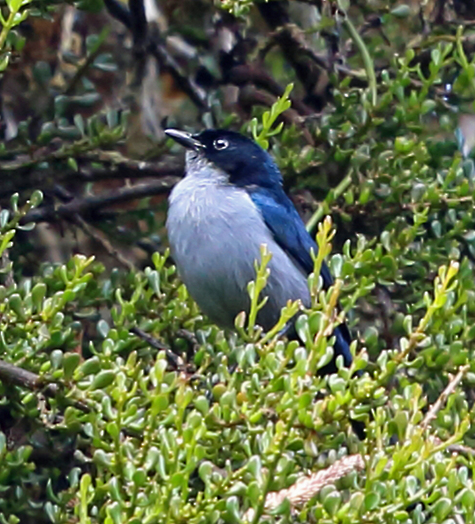
Pygmy Longbill
Oedistoma pygmaeum
Order: Passeriformes / Family: Melanocharitidae

Wikimedia Commons
About the Pygmy Longbill
The Pygmy Longbill (Oedistoma pygmaeum) is an intriguing member of the family Melanocharitidae, found predominantly in the dense tropical forests of New Guinea. This small passerine bird plays a crucial role in its ecosystem as both a pollinator and an insectivore. Its presence in the lush understories highlights the intricate web of life found in these biodiverse regions.
New Guinea's montane and lowland rainforests provide the primary habitat for the Pygmy Longbill. The bird's significance extends beyond its ecological role, as it is an indicator species for the health of these forests. The Pygmy Longbill relies heavily on intact forest canopies, where it can forage for nectar and small insects. This dependence makes it particularly vulnerable to deforestation and habitat fragmentation.
Throughout the year, the Pygmy Longbill engages in a range of behaviors that reflect its adaptation to the tropical environment. During the breeding season, its activity increases, with males exhibiting territorial behavior to secure prime feeding and nesting sites. The bird does not migrate, which underscores its reliance on stable environmental conditions. This non-migratory behavior means that any changes in its habitat can have immediate effects on its population. In the complex tapestry of New Guinea's avian life, the Pygmy Longbill serves as a vital thread, weaving together plant and insect communities through its feeding and breeding activities.
The Pygmy Longbill belongs to the family Melanocharitidae, within the order Passeriformes. These birds typically live average 3-5 years, with a maximum recorded of 6 years..
How to Identify a Pygmy Longbill
The Pygmy Longbill is a small bird, measuring approximately 9 to 10 cm in length. Its plumage is primarily a muted mix of browns and grays, providing effective camouflage against the forest backdrop. Adult males and females appear similar, though subtle differences may be observed in their feather brightness, with males sometimes displaying a slightly richer hue, particularly during the breeding season.
Juveniles resemble adults but often exhibit duller coloration, lacking the subtle luster that develops with maturity. The bird's most distinguishing feature is its long, slender bill, adapted for nectar feeding. This specialized beak sets it apart from other sympatric species, minimizing the potential for misidentification.
In flight, the Pygmy Longbill shows a rapid, direct flight pattern, aided by its compact wings. When perched, it maintains an upright posture, often seen clinging to thin branches or foliage in search of food. This perching behavior, combined with its distinctive bill, serves as a useful field mark for identification.
Having trouble telling birds apart? Upload a photo to our bird identification tool for an instant species match.
Pygmy Longbill Habitat and Range
Preferred Habitat
The Pygmy Longbill inhabits the tropical rainforests of New Guinea, thriving particularly in the dense understory of both lowland and montane forests. It favors areas with abundant floral resources, where it can exploit nectar from a variety of plants. The bird's altitudinal range extends from sea level up to 2,400 meters, but it is most commonly found between 500 and 1,800 meters.
While primarily a forest-dwelling species, the Pygmy Longbill may occasionally venture into forest edges, though it rarely appears in urban or heavily disturbed areas. Its preference for intact forest environments underscores the importance of conserving these habitats. Seasonal shifts in habitat use are minimal, as the bird remains within the forest throughout the year, relying on the consistent availability of food resources.
Geographic Range
The Pygmy Longbill's range is restricted to the island of New Guinea, encompassing both Papua New Guinea and the Indonesian province of Papua. Within this range, it occupies suitable forest habitats across the island, from the Vogelkop Peninsula in the west to the Owen Stanley Range in the east.
While the bird does not engage in long-distance migration, local movements may occur in response to food availability, particularly during the flowering of key nectar plants. The species exhibits patchy distribution, with population densities varying according to local habitat quality and food resource abundance. In regions where conditions are optimal, the Pygmy Longbill can be relatively common, forming small, loose aggregations around abundant nectar sources.
Want to know which birds visit your area? Browse our backyard birds by location guides for region-specific species lists.
What Does the Pygmy Longbill Eat?
The Pygmy Longbill primarily feeds on nectar, utilizing its specialized bill to access flowers that other birds cannot. Its diet is supplemented by small insects and arachnids, which provide essential proteins and nutrients. The bird's foraging behavior is agile and acrobatic, often involving hovering or clinging at awkward angles to reach flowers and foliage.
Dietary preferences may shift with the seasons, as the availability of nectar sources fluctuates. During periods of low floral abundance, the Pygmy Longbill increases its intake of insects, demonstrating dietary flexibility. Its feeding schedule extends throughout the day, with peaks in the morning and late afternoon when nectar concentrations are highest.
Pygmy Longbill Behavior and Social Structure
The Pygmy Longbill exhibits solitary or small-group behavior, rarely forming large flocks. It is territorial, with males defending feeding and nesting areas, especially during the breeding season. Territorial disputes involve vocalizations and displays, with males posturing and chasing rivals to assert dominance.
Courtship involves intricate aerial displays, where males showcase their agility and plumage. The bird's response to predators is to remain inconspicuous, relying on its cryptic coloration and quick flight to escape danger. Daily activities include foraging, preening, and resting, with periods of increased activity during dawn and dusk.
The Pygmy Longbill's social interactions are generally harmonious, though competition for resources can lead to brief skirmishes. Its behavior underscores the delicate balance of coexistence in the diverse avian community of New Guinea's forests.
Pygmy Longbill Nesting and Reproduction
The Pygmy Longbill constructs its nest in dense foliage, often choosing a site well-concealed by leaves and vines. The nest itself is a delicate cup made of plant fibers, moss, and spider silk, providing a secure environment for the eggs and nestlings.
Clutch size typically consists of two eggs, with both parents sharing incubation duties over a period of approximately 14 to 16 days. Once hatched, the nestlings remain in the nest for about 18 to 21 days before fledging. Parental roles are shared, with both the male and female involved in feeding and protecting the young.
The Pygmy Longbill usually raises one brood per year, though favorable conditions may allow for a second. This reproductive strategy aligns with the stable environmental conditions of its tropical habitat, minimizing the need for multiple breeding attempts.
Pygmy Longbill Sounds and Vocalizations
The primary song of the Pygmy Longbill is a series of high-pitched whistles, often described as thin and reedy. These calls serve both territorial and communicative functions, with variations in rhythm and pitch conveying different messages.
Alarm calls are sharper and more abrupt, designed to alert others to potential threats. During the dawn chorus, the Pygmy Longbill's song blends into the forest's symphony, contributing to the rich acoustic landscape. Its vocalizations, while not as elaborate as those of some other songbirds, are integral to its social interactions and territory defense.
Interesting Facts About the Pygmy Longbill
- 1The Pygmy Longbill's specialized bill allows it to access nectar from flowers that are inaccessible to many other bird species.
- 2Despite its small size, the Pygmy Longbill plays a crucial role in pollinating numerous plant species throughout New Guinea.
- 3The Pygmy Longbill's agile foraging techniques include hovering, similar to a hummingbird, when accessing hard-to-reach nectar.
- 4This bird's reliance on nectar makes it a key species for studying the ecological dynamics of New Guinea's forest ecosystems.
- 5Pygmy Longbills are known to adapt their diet based on seasonal availability, showcasing their resilience in a changing environment.
Pygmy Longbill Conservation Status
Currently, the Pygmy Longbill is classified as Least Concern by the IUCN. However, its populations face pressures from deforestation and habitat fragmentation, particularly in lowland areas where logging and agricultural expansion are prevalent. Conservation efforts focus on preserving the integrity of New Guinea's forests, with several regions designated as protected areas. Monitoring population trends remains crucial, as habitat loss could rapidly alter the bird's conservation status. Historical population data suggests stability, but ongoing habitat changes necessitate vigilant conservation measures to ensure the Pygmy Longbill's continued survival.
Other Melanocharitidae Species


Birds Similar to the Pygmy Longbill
These species are often confused with the Pygmy Longbill due to similar appearance or overlapping range.