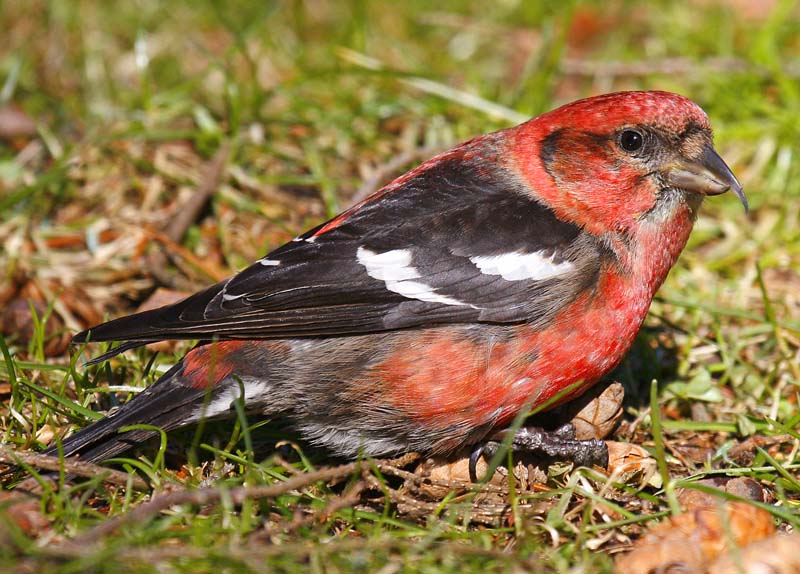
Red Crossbill
Loxia curvirostra
Order: Passeriformes / Family: Fringillidae

Wikimedia Commons
About the Red Crossbill
The Red Crossbill (Loxia curvirostra) is a fascinating songbird, easily recognized by its distinctive crossed bill. This specialized adaptation allows the bird to efficiently extract seeds from conifer cones, which form the bulk of its diet. Red Crossbills inhabit boreal and montane forests across North America and Eurasia, often found in stands of pine, spruce, and fir. These birds show a remarkable degree of ecological flexibility, as they are capable of breeding at any time of the year, provided food resources are abundant. This adaptability is particularly significant in regions like the Pacific Northwest of the United States and the boreal forests of Canada, where the availability of cones fluctuates seasonally. While primarily associated with coniferous forests, Red Crossbills occasionally venture into mixed forests, especially during irruption years when they may wander widely in search of food. Their ecological role is crucial in the seed dispersal and regeneration of coniferous forests. By feeding on seeds and inadvertently dropping them, these birds contribute to the spread of coniferous species, enhancing forest diversity and resilience. Throughout the year, the Red Crossbill displays an intriguing array of behaviors that reflect its strong dependence on conifer seeds. During the breeding season, which can occur at any time depending on seed availability, males perform a series of courtship displays to attract females. These displays include complex songs and flight patterns, showcasing the male's vitality and fitness. Red Crossbills are also known for their social behavior, often forming flocks that range from small family groups to larger congregations, particularly during the non-breeding season. While generally non-migratory, some populations engage in irruptive movements, traveling significant distances in search of better foraging grounds. Such movements are notably observed in years of poor cone crops in their usual habitats. Observing a Red Crossbill feeding is a testament to the marvels of avian adaptation. The bird uses its crossed bill to pry open the scales of a cone, then deftly extracts and consumes the seeds within. This feeding method is unique among birds and highlights the evolutionary pressures that have shaped the Red Crossbill's morphology. In addition to their ecological importance, Red Crossbills hold a special place in ornithology due to their vocalizations. These birds exhibit a range of call types, which vary geographically and have been the subject of extensive research. Understanding the variations in calls can provide insights into the population structure and movement patterns of these enigmatic birds. Overall, the Red Crossbill is a testament to the adaptability and specialization found within the avian world, serving as both a crucial component of forest ecosystems and a subject of scientific intrigue.
The Red Crossbill belongs to the family Fringillidae, within the order Passeriformes. These birds typically live average lifespan is 2-5 years, with a maximum recorded of 8 years..
How to Identify a Red Crossbill
Adult Red Crossbills exhibit a robust body with a length of about 15-17 cm and a wingspan of 27-30 cm. Males are typically a striking brick red, while females display more subdued olive or yellowish hues. Both sexes possess the characteristic crossed bill, essential for their seed-extraction technique. Juveniles tend to be streaked with brown and lack the vibrant coloration of adults, but their crossed bills are already evident. The difference between males and females is most apparent in their plumage, with males showing brighter colors. In flight, Red Crossbills have a distinctive silhouette, with pointed wings and a slightly forked tail. When perching, their posture is often upright, and they are usually found clinging to conifer branches. Differentiating Red Crossbills from similar species, such as the White-winged Crossbill, involves noting the absence of white wing bars, which are present in the latter. Additionally, Red Crossbills have a distinctive flight call that can aid in identification. Observers should note the bird's overall size and coloration, which help distinguish it from other finches and small passerines.
Having trouble telling birds apart? Upload a photo to our bird identification tool for an instant species match.
Red Crossbill Habitat and Range
Preferred Habitat
Red Crossbills inhabit a range of coniferous forest types, primarily favoring pine, spruce, and fir stands. They are commonly found at elevations ranging from 300 to 3000 meters, depending on latitude. In North America, they thrive in the vast boreal forests of Canada and the mountainous regions of the western United States, such as the Rockies and the Cascades. In Europe, they inhabit the coniferous forests of Scandinavia and the Alps. Seasonal habitat shifts occur in response to cone availability, with birds sometimes moving to lower elevations or mixed forests during food shortages. Although primarily forest dwellers, Red Crossbills occasionally visit urban parks and gardens, especially during irruptive years when natural food sources are scarce.
Geographic Range
The Red Crossbill has a broad range spanning North America, Europe, and parts of Asia. In North America, their breeding range extends from Alaska through Canada into the northern United States, including the Appalachian Mountains and the Pacific Northwest. During irruption events, they can appear as far south as the southern United States and even northern Mexico. In Europe, Red Crossbills breed from the British Isles across Scandinavia and into Russia. Their range in Asia includes parts of the Siberian taiga and the mountainous regions of Japan. While generally considered sedentary, these birds are known for their unpredictable movements, driven by the search for food. Population densities are highest in regions with abundant coniferous forests, such as the Canadian boreal zone and the Scandinavian forests.
Want to know which birds visit your area? Browse our backyard birds by location guides for region-specific species lists.
What Does the Red Crossbill Eat?
The diet of the Red Crossbill primarily consists of seeds from conifer cones, such as those of pine, spruce, and fir trees. This specialized diet requires the bird to use its crossed bill to pry open cone scales and extract the seeds with its tongue. During the breeding season, they may supplement their diet with insects to provide additional protein for growing chicks. In winter, when cone availability declines, Red Crossbills may expand their diet to include seeds from deciduous trees and shrubs. They typically feed in the morning and late afternoon, when cones are more accessible. Their foraging technique is highly efficient, allowing them to extract seeds quickly and move rapidly between cones.
Red Crossbill Behavior and Social Structure
Red Crossbills exhibit a range of social behaviors, often forming flocks outside of the breeding season. These flocks, which can number from a few individuals to several dozen, move nomadically in search of food. During the breeding season, pairs form and become more territorial, with males defending nesting sites through song and aerial displays. Courtship involves males performing flight songs and offering food to females. Red Crossbills display a strong flocking instinct, which provides protection against predators like hawks and owls. They communicate through a series of calls and songs, which serve to maintain group cohesion and signal alarm. Daily activity patterns include bouts of feeding interspersed with periods of rest and preening.
Red Crossbill Nesting and Reproduction
Red Crossbills typically nest in coniferous trees, selecting sites that offer both concealment and proximity to food sources. Nests are compact structures built from twigs, grasses, and lichens, lined with softer materials such as feathers and moss. The female usually lays 2-4 eggs, which she incubates for about 12-16 days. The male supports by providing food during incubation. Once hatched, chicks fledge after 18-22 days, receiving care from both parents. Red Crossbills may raise multiple broods in a year if conditions allow, taking advantage of abundant food supplies.
Red Crossbill Sounds and Vocalizations
The primary song of the Red Crossbill is a series of jumbled, musical notes with a rhythmic cadence. Their call notes, often heard in flight, are sharp and metallic, aiding in flock cohesion. Alarm calls are more rapid and higher-pitched, signaling potential danger. During the dawn chorus, males sing to establish territory and attract mates. The vocalizations of Red Crossbills are complex and vary geographically, which has led to the identification of different call types associated with specific populations.
Interesting Facts About the Red Crossbill
- 1Red Crossbills can breed at any time of year if food is plentiful, a rare trait among birds.
- 2The unique crossed bill of the Red Crossbill is an adaptation for prying open conifer cones.
- 3Red Crossbills exhibit geographic vocal variation, with eight distinct call types identified.
- 4During irruption years, Red Crossbills can travel hundreds of kilometers beyond their usual range.
- 5Red Crossbills can consume over 3000 seeds per day, highlighting their role in forest ecology.
- 6The species' ability to breed opportunistically makes it resilient to environmental changes.
- 7Red Crossbills have been observed using their bills to break ice to access water in winter.
Red Crossbill Conservation Status
The Red Crossbill is currently listed as Least Concern by the IUCN, with populations considered stable. However, habitat loss and climate change pose ongoing threats. Conservation efforts focus on preserving coniferous forest habitats and monitoring population trends. Historically, the species has shown resilience to environmental changes due to its adaptability, but continued habitat protection is essential to safeguard future populations.
Other Fringillidae Species


Birds Similar to the Red Crossbill
These species are often confused with the Red Crossbill due to similar appearance or overlapping range.