
White-winged Crossbill
Loxia leucoptera
Order: Passeriformes / Family: Fringillidae
Wikimedia Commons
About the White-winged Crossbill
The White-winged Crossbill (Loxia leucoptera) is a fascinating bird of the northern boreal forests, renowned for its remarkable crossed bill, which is uniquely adapted to extract seeds from conifer cones. This finch thrives in coniferous woodlands, where it plays a vital role in the ecosystem by controlling seed populations and facilitating forest regeneration through its feeding habits. The species is a year-round resident in regions like Alaska, Canada, and the northern United States, although it sometimes irrupts southward during winters when cone crops fail. These irruptions bring them into areas like the northeastern United States, providing birders with occasional opportunities to observe their distinctive feeding behaviors.
White-winged Crossbills are integral to the health of boreal forests. By feeding on a variety of conifer seeds, including spruce, pine, and fir, they help maintain the balance of these tree populations. Their foraging activities often disperse seeds, aiding in forest regeneration. During summer, these birds primarily inhabit dense stands of conifers, such as spruce and tamarack, where they contribute to the ecosystem by consuming insects as well as seeds. This dietary flexibility allows them to thrive even when cone availability fluctuates.
Seasonally, the White-winged Crossbill adjusts its behavior to take advantage of fluctuating food resources. In the breeding season, males showcase vibrant songs to attract mates, and their courtship displays are a spectacle in the dense northern forests. During winter, when food becomes scarce, they exhibit nomadic behaviors, forming flocks to search for abundant cone resources. This opportunistic feeding strategy enables them to survive in the challenging conditions of boreal winters, showcasing their adaptability and resilience in harsh environments.
The White-winged Crossbill belongs to the family Fringillidae, within the order Passeriformes. These birds typically live 3-4 years on average, with a maximum recorded of 8 years.
How to Identify a White-winged Crossbill
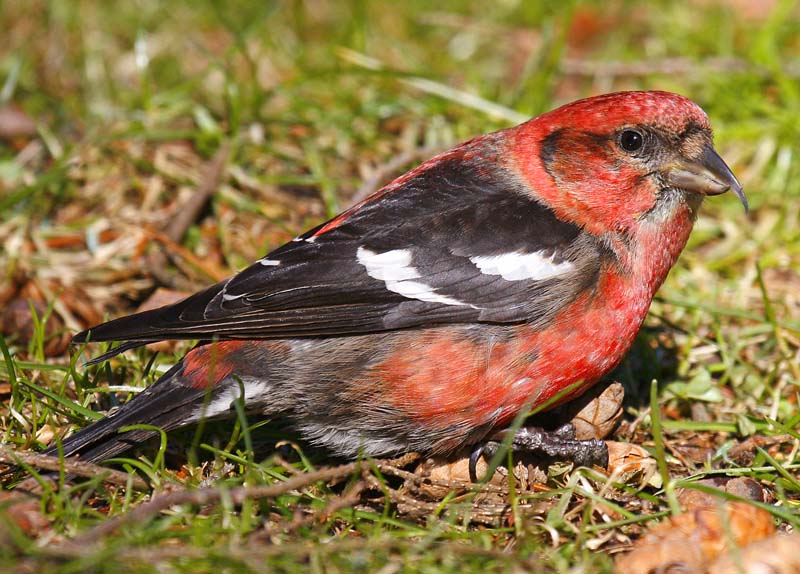
Adult White-winged Crossbills exhibit a distinctive appearance with a unique bill that crosses at the tips, designed for prying open conifer cones. Males are particularly striking, showcasing a rosy-red plumage with contrasting black wings and two prominent white wing bars. Females, on the other hand, are more subdued in coloration, displaying a greenish-yellow body with similar wing markings. Juveniles resemble females but often show more streaking on their undersides.
Compared to other finches, White-winged Crossbills might be confused with the Red Crossbill (Loxia curvirostra), but they can be distinguished by their smaller size and the white wing bars absent in the latter. When perched, these crossbills often assume an upright posture, and their feeding technique involves agile maneuvers to access seeds from cones.
In flight, the White-winged Crossbill exhibits a distinctive silhouette, with a stocky build and a unique flight pattern characterized by rapid wingbeats interspersed with short glides. Their wing bars are visible even in flight, aiding identification. Observers may notice their social nature as they often travel in flocks, chattering noisily among the treetops.
Having trouble telling birds apart? Upload a photo to our bird identification tool for an instant species match.
White-winged Crossbill Habitat and Range
Preferred Habitat
The White-winged Crossbill primarily inhabits the coniferous forests of the boreal regions in North America and parts of Eurasia. These birds favor dense stands of spruce, fir, and pine, where they find abundant cone crops. In North America, they are often found at elevations ranging from sea level to 1,500 meters, depending on the availability of conifer trees.
During winter, White-winged Crossbills may shift to lower elevations or move southward in search of food, particularly during years of poor cone production. They are rarely found in urban environments, preferring the seclusion of expansive forests. However, during irruptive years, they may venture into suburban areas with mature conifers, delighting local birdwatchers.
Unlike many other bird species, White-winged Crossbills do not significantly alter their habitat preferences seasonally, remaining loyal to coniferous forests year-round. Their presence is closely tied to the availability of conifer seeds, which dictates their distribution and movements.
Geographic Range
The White-winged Crossbill breeds across the boreal forests of North America and Eurasia. In North America, their breeding range extends from Alaska through Canada and into the northern United States, including parts of New England, the Great Lakes region, and the northern Rockies. In Europe and Asia, they are found in similar habitats across Scandinavia and Russia.
During the winter months, their range may expand significantly southward due to irruptive movements triggered by food scarcity. These irruptions can bring them as far south as the central United States, including states like Missouri and Kansas, where they are otherwise uncommon.
Their presence in specific regions can be unpredictable, varying drastically from year to year. Population density hotspots are often in areas with exceptionally abundant cone crops, such as the boreal forests of Canada. In contrast, their occurrence in southern regions is sporadic and largely dependent on the availability of food during winter.
Want to know which birds visit your area? Browse our backyard birds by location guides for region-specific species lists.
What Does the White-winged Crossbill Eat?
White-winged Crossbills have a specialized diet that primarily consists of seeds from conifer cones, such as those of spruce, pine, and fir. Their crossed bills are perfectly adapted to pry open these cones and extract the seeds inside. They exhibit a fascinating feeding technique, often hanging upside down to access seeds from the underside of branches.
During the breeding season, their diet expands to include insects, which provide essential protein for feeding nestlings. Insects like caterpillars and beetles supplement their seed-heavy diet, ensuring adequate nutrition during this crucial period.
In winter, White-winged Crossbills rely heavily on their ability to locate and exploit abundant cone crops. They may forage throughout the day in flocks, often covering large areas to find sufficient food. Their diet remains largely unchanged seasonally, though they may consume more insects in summer when available.
White-winged Crossbill Behavior and Social Structure
White-winged Crossbills exhibit highly social behaviors, often forming large flocks outside of the breeding season. These flocks can number in the dozens, and their constant chatter is a characteristic sound in their forested habitats. They are nomadic in nature, moving in search of food resources, especially during winter irruptions.
Territorial behavior is less pronounced in White-winged Crossbills compared to other finches. During the breeding season, males perform elaborate courtship displays, singing from perches to attract females. Once paired, they maintain loose territories centered around nesting sites.
These birds display little aggression towards conspecifics, and their social structure is relatively harmonious. In the presence of predators, White-winged Crossbills typically rely on the safety of numbers, taking flight and dispersing to confuse and avoid threats. Their daily activity patterns revolve around feeding, with peak activity occurring in the early morning and late afternoon.
White-winged Crossbill Nesting and Reproduction
White-winged Crossbills construct their nests high in conifer trees, often in dense stands of spruce or fir. They use twigs, moss, and lichens to build a well-camouflaged cup-shaped nest. These nests are generally located near the trunk of the tree, providing stability and protection from the elements.
The typical clutch size ranges from 3 to 4 eggs, which are pale blue with brown speckles. The female incubates the eggs for about 12 to 14 days, during which the male provides food. After hatching, both parents participate in feeding the chicks, which fledge approximately 15 to 20 days post-hatching.
White-winged Crossbills can raise more than one brood per year if conditions allow, taking advantage of abundant food resources to maximize reproductive success. Their breeding season is relatively flexible, often aligning with peak cone production in their habitat.
White-winged Crossbill Sounds and Vocalizations
The primary song of the White-winged Crossbill is a series of melodic warbles and trills, delivered rapidly in a high-pitched, lively manner. This song is often accompanied by various call notes, including a distinctive "jeet-jeet" sound used in social interactions.
Their alarm calls are sharp and persistent, alerting others in the flock to potential threats. During the dawn chorus, males sing more vigorously, establishing territory and attracting mates. The song and calls of the White-winged Crossbill can be compared to those of the Red Crossbill, though they tend to be softer and less varied in pitch.
Interesting Facts About the White-winged Crossbill
- 1White-winged Crossbills can consume up to 3,000 conifer seeds in a single day, demonstrating their efficient feeding adaptations.
- 2The crossed bill of the White-winged Crossbill is a specialized tool, allowing it to access seeds that many other birds cannot.
- 3Unlike most finches, White-winged Crossbills can breed at any time of year if food is abundant, showcasing their reproductive flexibility.
- 4During winter irruptions, White-winged Crossbills can travel hundreds of miles outside their typical range in search of food.
- 5White-winged Crossbills are known for their acrobatic foraging behavior, often seen hanging upside down on branches to access seeds.
- 6The species is named for the prominent white wing bars that contrast sharply with the darker plumage of both males and females.
- 7White-winged Crossbills may store seeds in tree crevices during periods of abundance, providing a food reserve for leaner times.
White-winged Crossbill Conservation Status
The White-winged Crossbill is currently classified as Least Concern by the IUCN, with a population trend that appears stable. However, fluctuations in food availability due to changing climate conditions pose a potential threat to their long-term stability. Habitat loss from logging and forest management practices can also impact local populations. Conservation efforts focus on preserving boreal forests and maintaining healthy conifer populations. Monitoring programs track irruptive movements and population dynamics, providing valuable data for future conservation strategies. Historically, the population of White-winged Crossbills has remained resilient, thanks in part to their adaptability and wide geographic range.
Other Fringillidae Species


Birds Similar to the White-winged Crossbill
These species are often confused with the White-winged Crossbill due to similar appearance or overlapping range.


