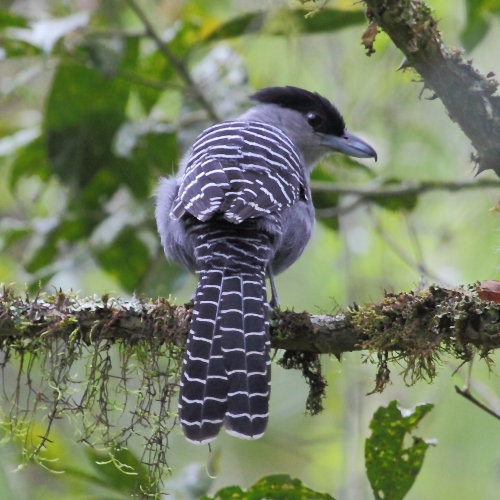
Reddish-winged Bare-eye
Phlegopsis erythroptera
Order: Passeriformes / Family: Thamnophilidae

Wikimedia Commons
About the Reddish-winged Bare-eye
The Reddish-winged Bare-eye (Phlegopsis erythroptera) is a captivating member of the Thamnophilidae family, predominantly residing in the humid lowland forests of South America. This species, known for its striking reddish wings, is largely found within the Amazon basin, encompassing countries like Brazil, Colombia, and Peru. The bird plays a significant ecological role as an ant-follower, often seen accompanying army ants to feed on flushed insects. This mutualistic behavior highlights its importance in the forest ecosystem, aiding in insect population control and contributing to the ecological balance of its habitat. The Reddish-winged Bare-eye thrives in dense, undisturbed forests where the undergrowth is thick and the canopy provides ample cover. Such environments offer both a plentiful supply of food and protection from predators. Despite its specialized habits, the bird remains a key indicator of forest health, often reflecting broader ecological changes in its environment. Seasonal behaviors of the Reddish-winged Bare-eye include slight altitudinal movements, though they primarily remain within their tropical range throughout the year. These movements might relate to variations in food availability or breeding activities. During the breeding season, males become more vocal and territorial, using their calls to establish dominance and attract mates. The Reddish-winged Bare-eye's reliance on pristine forest habitats makes it particularly sensitive to deforestation and habitat fragmentation, underscoring the importance of conservation efforts to preserve these vital ecosystems. Maintaining the integrity of its habitat ensures the survival of not only the Reddish-winged Bare-eye but also the myriad of species that share its intricate forest environment.
The Reddish-winged Bare-eye belongs to the family Thamnophilidae, within the order Passeriformes. These birds typically live average 6-8 years, with a maximum recorded of 12 years..
How to Identify a Reddish-winged Bare-eye
Identifying the Reddish-winged Bare-eye involves noting its unique coloration and structure. Adult birds showcase a deep reddish-brown wing, which stands in stark contrast to the primarily dark gray to black body. These striking reddish wings are the most distinctive field mark distinguishing this species from other antbirds. Juveniles, in contrast, typically show lighter, more subdued coloration, with less pronounced wing markings. There is minimal sexual dimorphism in this species, as both males and females share similar plumage, although males may appear slightly more vibrant during the breeding season. In flight, the Reddish-winged Bare-eye presents a distinctive silhouette with broad, rounded wings and a somewhat stubby tail, indicative of its specialization for short, agile flights through dense vegetation. When perched, the bird often adopts a horizontal posture, which aids in its stealthy movements through the forest understory. Similar species include other members of the genus Phlegopsis, but the unique wing coloration and vocalizations help differentiate the Reddish-winged Bare-eye from its relatives and other sympatric antbirds.
Having trouble telling birds apart? Upload a photo to our bird identification tool for an instant species match.
Reddish-winged Bare-eye Habitat and Range
Preferred Habitat
The Reddish-winged Bare-eye inhabits the dense tropical rainforests of the Amazon basin, favoring areas with thick undergrowth and a closed canopy. These forests, rich in biodiversity, provide the ideal environment for the bird to forage and breed. The species thrives at low elevations, typically below 1000 meters, where the climate remains consistently humid and warm. While primarily a forest dweller, the Reddish-winged Bare-eye shows little tolerance for fragmented or disturbed habitats, often retreating deeper into undisturbed areas as deforestation progresses. Unlike some adaptable bird species, it does not frequent urban or suburban areas, remaining firmly tied to its forested home. Seasonal habitat shifts are minor, as the bird remains within its tropical environment year-round, relying on the evergreen nature of its habitat to provide constant resources.
Geographic Range
The Reddish-winged Bare-eye's range is confined to the Amazon basin, a region encompassing parts of several South American countries, including Brazil, Colombia, Peru, and Ecuador. These countries host the bird primarily in their lowland rainforest regions, where it finds the dense vegetation essential for its survival. Unlike many migratory birds, the Reddish-winged Bare-eye is a resident species, maintaining a consistent presence in its range throughout the year. The lack of significant migration reduces its vulnerability to habitat changes outside its immediate environment but increases its reliance on the preservation of local forest habitats. Within its range, the bird can be found in areas of high population density, particularly in undisturbed forest tracts where army ant swarms are common. The bird's presence is often a sign of a healthy, biodiverse forest ecosystem, making it a focus for conservationists aiming to protect these critical regions.
Want to know which birds visit your area? Browse our backyard birds by location guides for region-specific species lists.
What Does the Reddish-winged Bare-eye Eat?
The Reddish-winged Bare-eye primarily feeds on insects, largely benefiting from its association with army ants. As these ants march through the forest, they flush out various insects, which the bird deftly captures. This behavior exemplifies the bird's role as an ant-follower, a specialization that shapes its diet and feeding habits. During periods when army ants are less active, the bird supplements its diet with a variety of insects and arachnids found in the leaf litter and undergrowth. The Reddish-winged Bare-eye exhibits a keen ability to catch small prey, typically less than 2 cm in length, displaying quick, agile movements. Feeding occurs primarily during daylight hours, with peak activity in the morning and late afternoon. This schedule aligns with the activity patterns of its prey, maximizing foraging efficiency. Seasonal changes in diet are minimal, as the bird's reliance on army ants provides a relatively stable food source throughout the year.
Reddish-winged Bare-eye Behavior and Social Structure
The Reddish-winged Bare-eye exhibits intriguing behaviors closely tied to its forest habitat. Socially, the bird often participates in mixed-species flocks, benefiting from the vigilance of other species while foraging. This behavior enhances its ability to evade predators and increases foraging success. Territorial behavior becomes most pronounced during the breeding season when males actively defend their domains through vocalizations and displays. Courtship involves the male showcasing his vibrant wings and engaging in a series of vocal and visual displays to attract a mate. The bird's response to predators includes a combination of stealth and flight, using its plumage to blend into the forest shadows. Throughout the day, the Reddish-winged Bare-eye maintains a consistent activity pattern, foraging in the undergrowth and participating in the dawn chorus, a period of heightened vocal activity that marks the beginning of daily routines. This chorus not only serves as a communication tool but also reinforces social bonds within the species.
Reddish-winged Bare-eye Nesting and Reproduction
Nesting for the Reddish-winged Bare-eye involves constructing a cup-shaped nest, typically fashioned from leaves, twigs, and other forest debris. The nest is often situated 1 to 3 meters above the ground in dense shrubbery or low trees, providing both concealment and protection from predators. A typical clutch consists of 2 to 3 eggs, with both parents sharing incubation duties over a period of approximately 14 to 16 days. Once hatched, the chicks rely heavily on their parents for food and protection. The fledging period lasts about 12 to 15 days, during which time the young birds develop the skills necessary for independent survival. Parental roles are shared, with both male and female contributing to feeding and caring for the young. The Reddish-winged Bare-eye typically raises one brood per year, with breeding activity closely tied to periods of food abundance in the forest.
Reddish-winged Bare-eye Sounds and Vocalizations
The Reddish-winged Bare-eye's primary song is a rapid series of clear, whistled notes that rise and fall in pitch, creating a melodious and distinctive pattern. These vocalizations serve as a key tool for communication and territory establishment. The bird also produces a variety of call notes, including soft chips and harsher alarm calls used to signal the presence of predators. During the early morning, the Reddish-winged Bare-eye participates in the dawn chorus, contributing to the vibrant acoustic landscape of the forest. The bird's calls are reminiscent of a simple flute melody, clear and penetrating, which can travel considerable distances through the dense forest. These sounds play a crucial role in maintaining social bonds and coordinating movements within its habitat.
Interesting Facts About the Reddish-winged Bare-eye
- 1The Reddish-winged Bare-eye relies on army ants to flush out insects, showcasing a unique foraging strategy.
- 2Despite its reliance on dense forests, the bird's vocalizations can be heard up to 100 meters away.
- 3The Reddish-winged Bare-eye's striking reddish wings are used in courtship displays to attract mates.
- 4This bird is an important indicator of forest health, reflecting changes in biodiversity and habitat quality.
- 5The species remains sedentary throughout the year, emphasizing its strong ties to the Amazon rainforest.
- 6Both male and female Reddish-winged Bare-eyes participate equally in nest building and chick rearing.
- 7The bird's diet consists mainly of insects less than 2 cm long, highlighting its specialized feeding habits.
Reddish-winged Bare-eye Conservation Status
The Reddish-winged Bare-eye is currently classified as Least Concern by the IUCN, though its population trend is decreasing due to habitat loss. Deforestation and habitat fragmentation pose significant threats to its survival, as the bird depends on intact forest environments. Conservation efforts focus on preserving large tracts of undisturbed rainforest, which are crucial for maintaining viable populations. Historical data indicates that populations were more widespread before extensive human encroachment began altering its habitat. Efforts to curb deforestation and promote sustainable land use practices are vital for the continued existence of this species. Additionally, the bird serves as an important ambassador for rainforest conservation, helping raise awareness of the broader ecological importance of these habitats.