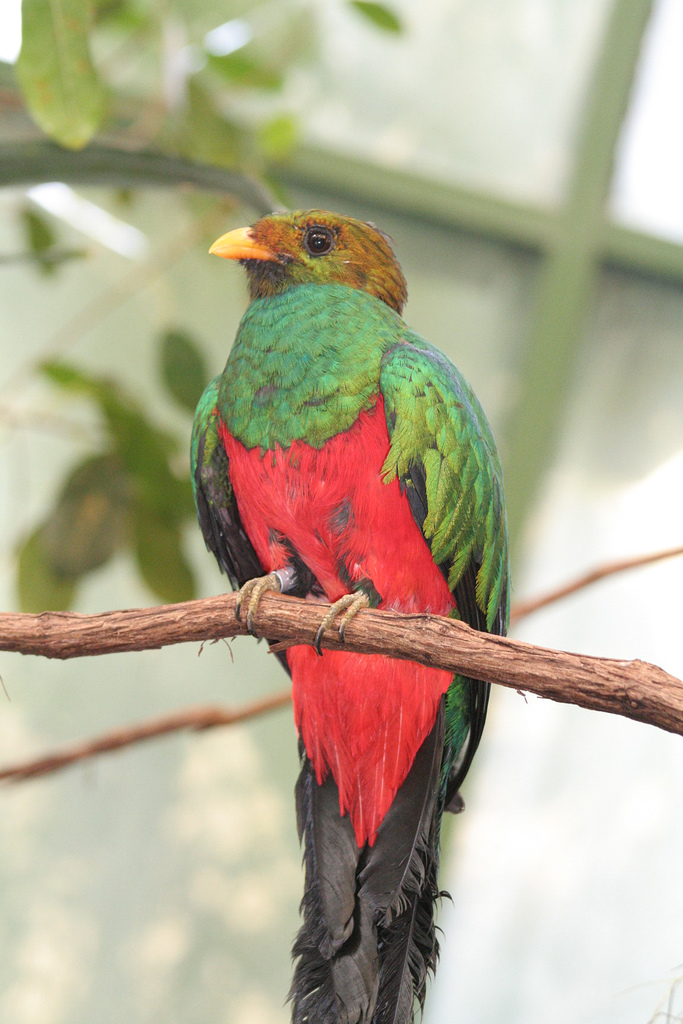
Resplendent Quetzal
Pharomachrus mocinno
Order: Trogoniformes / Family: Trogonidae

Wikimedia Commons
About the Resplendent Quetzal
The Resplendent Quetzal, Pharomachrus mocinno, is a striking bird belonging to the Trogonidae family, renowned for its vibrant plumage and cultural significance. This species inhabits the cloud forests of Central America, notably in countries such as Guatemala, Costa Rica, and Panama. Found primarily in montane regions at elevations ranging from 1,200 to 3,000 meters, its presence often indicates a healthy and undisturbed forest ecosystem. The Resplendent Quetzal plays a crucial role in its habitat as a seed disperser, particularly for the wild avocado trees, which rely on the bird to spread their seeds through defecation. This ecological service maintains the biodiversity of the region's forests. The bird's bright, shimmering green and red plumage makes it a symbol of freedom and beauty in Mesoamerican cultures. Various indigenous groups, including the Maya and Aztec, revered the Resplendent Quetzal, associating it with deities and royalty. Today, it is the national bird of Guatemala and appears on the country's flag and currency. The Resplendent Quetzal is a relatively sedentary bird, with some local movements influenced by food availability rather than long-scale migrations. Seasonal changes in altitude occur as they follow fruiting patterns, moving to lower elevations during the non-breeding season when food is scarcer in higher regions. Despite their tendency to stay within a particular range, habitat fragmentation and climate change are leading to shifts in their distribution patterns. Observers often find the Resplendent Quetzal in pairs or small family groups during the breeding season, which typically spans from March to June. During this time, males display their stunning tail feathers to attract mates. After the breeding season, they might form loose flocks to forage for fruits, particularly in areas where food sources are abundant. As an indicator species, their presence reflects the health of their habitat, thus making them invaluable for conservation efforts.
The Resplendent Quetzal belongs to the family Trogonidae, within the order Trogoniformes. These birds typically live typically around 8 years, with some individuals reaching up to 12 years..
How to Identify a Resplendent Quetzal
The Resplendent Quetzal is unmistakable due to its iridescent plumage and extraordinary tail. Adult males are particularly resplendent, featuring metallic green upperparts that shimmer with hues of gold and blue, contrasted by a vibrant red breast. Their tail feathers extend well beyond their bodies, reaching lengths up to 65 centimeters, which is twice the length of their body. Females, while less flamboyant, share similar green upperparts but have shorter tails and more subdued red underparts. Juveniles resemble females but with duller colors and shorter tails. Confusion may arise with other trogons, such as the Slaty-tailed Trogon, but no other species in the region has the combination of bright red breast and elongated tail feathers. In flight, the Resplendent Quetzal exhibits a unique silhouette with its long tail streaming behind, providing a distinct identification mark. When perched, it often sits upright with its tail cascading below, enhancing its grandeur. Observing these birds requires patience, as their plumage can blend seamlessly into the canopy despite their bright colors.
Having trouble telling birds apart? Upload a photo to our bird identification tool for an instant species match.
Resplendent Quetzal Habitat and Range
Preferred Habitat
The Resplendent Quetzal thrives in the cloud forests of Central America, particularly within the highlands of countries such as Guatemala, Costa Rica, and Panama. These forests, characterized by high humidity and persistent cloud cover, provide a rich array of fruiting trees and dense foliage. Typically found at elevations between 1,200 and 3,000 meters, the quetzal may shift to lower altitudes during periods of reduced food availability. Unlike many other forest species, the Resplendent Quetzal does not adapt well to urban environments, relying instead on pristine and continuous forest tracts. Seasonal shifts in habitat occur as they follow the fruiting patterns of their primary food sources. These altitudinal movements ensure they have access to food year-round, although they remain primarily within forested regions.
Geographic Range
The range of the Resplendent Quetzal is confined to Central America. During the breeding season, they inhabit the cloud forests from southern Mexico through Guatemala, Honduras, El Salvador, Nicaragua, Costa Rica, and into western Panama. This distribution is largely dictated by the availability of suitable forest habitat. While primarily sedentary, these birds exhibit altitudinal movements, descending to lower elevations outside the breeding season. Specific hotspots include the Monteverde Cloud Forest Reserve in Costa Rica and the Sierra de las Minas Biosphere Reserve in Guatemala. Despite their limited range, they remain relatively widespread in suitable habitats, though localized populations face pressure from habitat destruction.
Want to know which birds visit your area? Browse our backyard birds by location guides for region-specific species lists.
What Does the Resplendent Quetzal Eat?
The Resplendent Quetzal primarily feeds on fruits, with a particular preference for wild avocados and members of the Lauraceae family. These fruits are crucial as they provide the necessary fats and nutrients. When avocados are scarce, the quetzal supplements its diet with other fruits, insects, and small invertebrates. This dietary flexibility allows the bird to adapt to seasonal changes in food availability. They forage by gleaning fruits directly from branches or by catching insects mid-air. Feeding typically occurs during the cooler morning and late afternoon hours to avoid the midday heat. The size of prey is generally small, with a preference for easily digestible items that provide quick energy.
Resplendent Quetzal Behavior and Social Structure
The Resplendent Quetzal exhibits fascinating behaviors, particularly during the breeding season. Males engage in elaborate courtship displays, showcasing their iridescent plumage and long tail feathers in an effort to attract females. These displays often involve a combination of aerial maneuvers and vocalizations. Socially, quetzals are generally solitary or found in pairs, coming together in small family groups during the breeding season. They exhibit territorial behavior, defending their chosen nesting sites from intruders. Outside of the breeding period, they may form loose flocks to exploit abundant fruit sources. Their response to predators includes seeking cover within dense foliage, utilizing their camouflaged plumage. Daily activity patterns revolve around feeding and maintenance of territory during daylight hours, with peak activity in the morning and late afternoon.
Resplendent Quetzal Nesting and Reproduction
The nesting habits of the Resplendent Quetzal involve selecting natural cavities in rotten trees or using abandoned woodpecker holes. Both males and females participate in excavating and preparing the nest. Typical clutch size ranges from two to three eggs, which both parents incubate for approximately 17 to 19 days. The chicks remain in the nest for about 23 to 31 days after hatching, during which both parents actively feed and care for them. Parental roles are shared equally, with both contributing to feeding and protection. Typically, the Resplendent Quetzal raises one brood per year, though favorable conditions may allow for a second.
Resplendent Quetzal Sounds and Vocalizations
The vocalizations of the Resplendent Quetzal are as distinctive as its appearance. Its primary song consists of a series of sharp, whistling notes, often described as 'kyow' or 'quay-ow' with a rhythmic and melodious quality. Call notes are softer, used for communication between mates and during courtship. Alarm calls, given in response to potential threats, are louder and more urgent. During the dawn chorus, males sing more frequently, establishing territory and attracting mates. These sounds, clear and pleasant, resonate through their forested habitat, echoing the bird's elusive presence.
Interesting Facts About the Resplendent Quetzal
- 1The Resplendent Quetzal's tail feathers can grow up to 65 centimeters, over twice the length of its body.
- 2In ancient Maya civilization, the quetzal's feathers were more valuable than gold and used in royal headdresses.
- 3Despite their striking plumage, Resplendent Quetzals are adept at blending into the forest canopy.
- 4Quetzals have a specialized tongue that helps them grip the slippery fruit, making them efficient feeders.
- 5The quetzal played a significant role in Mesoamerican mythology, symbolizing freedom and prosperity.
- 6During courtship, male quetzals perform aerial displays, showcasing their long tail feathers to attract mates.
- 7The word 'quetzal' is derived from the Nahuatl language, translating to 'tail feather of the quetzal bird.'
Resplendent Quetzal Conservation Status
The Resplendent Quetzal is classified as Near Threatened by the IUCN, with populations experiencing a declining trend. Primary threats include habitat loss due to deforestation and agricultural expansion. Conservation efforts focus on protecting and restoring cloud forest habitats, with initiatives led by local and international organizations. Historical population changes reflect a reduction of suitable habitats, particularly in regions experiencing rapid development. Protected areas, such as national parks in Costa Rica and Guatemala, play a crucial role in safeguarding the quetzal's future. Continued efforts aim to stabilize and increase populations through habitat conservation and education.
Other Trogonidae Species


Birds Similar to the Resplendent Quetzal
These species are often confused with the Resplendent Quetzal due to similar appearance or overlapping range.