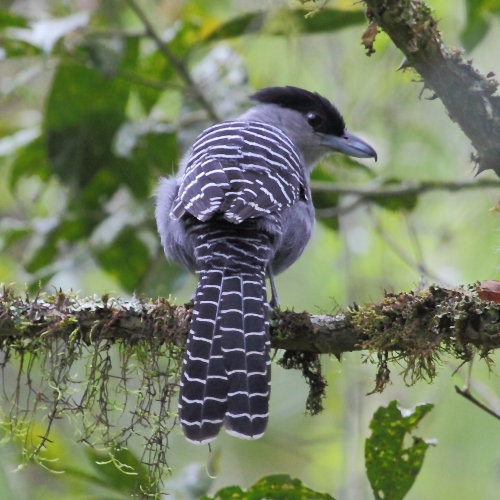
Rio Branco Antbird
Cercomacra carbonaria
Order: Passeriformes / Family: Thamnophilidae

Wikimedia Commons
About the Rio Branco Antbird
The Rio Branco Antbird, scientifically known as Cercomacra carbonaria, is a striking member of the Thamnophilidae family. This species is endemic to Brazil, where it resides in the unique white-sand forests along the Rio Branco and Rio Negro basins. The bird is adapted to these nutrient-poor, sandy environments where it plays a crucial role in the ecosystem. As an insectivorous bird, it helps control insect populations, contributing to the ecological balance of its habitat.
The Rio Branco Antbird is particularly significant due to its restricted range and specialized habitat, which face increasing threats from deforestation and habitat degradation. The bird's presence is often an indicator of the health of the white-sand forest ecosystem, making it a species of interest to conservationists and ornithologists alike.
Ecologically, the Rio Branco Antbird is an integral part of its environment. It is commonly found in the understory, where it forages for insects and other arthropods. This foraging behavior not only helps maintain insect populations but also supports the antbird's energy needs for breeding and territorial defense. Notably, the Rio Branco Antbird exhibits seasonal behavior patterns, with some variation in activity levels and vocalizations during the breeding season.
The Rio Branco Antbird belongs to the family Thamnophilidae, within the order Passeriformes. These birds typically live average 3 years with a maximum recorded of 6 years.
How to Identify a Rio Branco Antbird
The Rio Branco Antbird is a small passerine known for its distinctive coloration and features. Adult males exhibit a predominantly black plumage with a contrasting white belly and wing patches, creating a stark and memorable appearance. Females, on the other hand, have a more subdued coloration, with a mix of brown and gray shades along with the characteristic white belly, although their wing patterns are less pronounced than those of the males.
Juveniles resemble females in their muted tones but can often be distinguished by their slightly duller and more uniform plumage. The species can be confused with other antbirds sharing its habitat, such as the Blackish Antbird, but can be distinguished by the broader white markings and the specific tonal quality of its vocalizations.
In flight, the Rio Branco Antbird displays a short, rounded wing silhouette and a relatively short tail, which it often flicks while perching. When perched, these birds maintain an upright posture typical of many antbirds, often staying still for long periods as they scan for prey.
Having trouble telling birds apart? Upload a photo to our bird identification tool for an instant species match.
Rio Branco Antbird Habitat and Range
Preferred Habitat
The primary habitat of the Rio Branco Antbird is the white-sand forest, a rare and specialized ecosystem found in parts of the Amazon Basin, particularly in Brazil. These forests, characterized by their sandy soil and sparse understory, provide a unique environment where the antbird thrives. The elevation in these areas is generally low, often fewer than 200 meters above sea level.
Unlike many birds that may shift habitats seasonally, the Rio Branco Antbird shows a strong preference for this habitat type year-round. It does not occur frequently in urban or heavily disturbed areas, demonstrating a preference for remote, undisturbed forests. This habitat specialization makes the species highly susceptible to habitat loss due to logging and land conversion.
Geographic Range
The range of the Rio Branco Antbird is limited to northern Brazil, particularly centered around the white-sand forests along the Rio Branco and Rio Negro rivers. This bird does not exhibit migratory behavior and is considered a resident species within this narrow geographic range.
In terms of population density, the Rio Branco Antbird is generally found in low densities, a characteristic typical of species with such specialized habitat requirements. While sightings outside of the main range are rare, they occasionally occur in similar habitats where the environmental conditions meet the bird's specific needs. The lack of migration corridors and a breeding range restricted to such a small area underscore the importance of habitat conservation efforts.
Want to know which birds visit your area? Browse our backyard birds by location guides for region-specific species lists.
What Does the Rio Branco Antbird Eat?
The Rio Branco Antbird primarily feeds on insects and other small arthropods, making it an essential part of the food web in its ecosystem. Its diet includes ants, beetles, spiders, and occasionally small caterpillars. During the wet season, when insect activity peaks, the antbird increases its foraging activity to take advantage of the abundance of prey.
The Rio Branco Antbird uses a foraging technique known as 'gleaning,' where it picks insects off leaves and branches while moving through the understory. It prefers small prey items, generally less than a centimeter in length, which it captures with quick, precise movements.
Feeding primarily occurs during the early morning and late afternoon, aligning with the periods of highest insect activity. This feeding schedule allows the antbird to conserve energy during the hotter parts of the day when insect availability decreases.
Rio Branco Antbird Behavior and Social Structure
The Rio Branco Antbird exhibits a solitary or paired social structure, rarely forming larger groups. It maintains small territories, which it actively defends against intruders through vocal displays and occasional physical confrontations with conspecifics. During the breeding season, males become particularly vocal, using their calls to establish and maintain territory boundaries.
Courtship displays include a combination of vocalizations and physical displays, such as wing flicking and tail fanning. The antbird's response to predators involves a mix of alarm calls and evasive maneuvers, often diving into dense vegetation to escape.
Daily activity patterns show the bird being most active during dawn and dusk, corresponding with its feeding schedule. Unlike some other antbird species, the Rio Branco Antbird does not typically engage in mixed-species flocks, preferring to remain with its mate or alone.
Rio Branco Antbird Nesting and Reproduction
The nesting behavior of the Rio Branco Antbird involves the construction of cup-shaped nests, usually situated low in the understory of the white-sand forest. These nests are constructed from a combination of plant fibers, leaves, and spider silk, providing a secure and camouflaged environment for the eggs.
A typical clutch consists of two eggs, which both parents incubate over a period of approximately 14 to 16 days. Following hatching, the chicks remain in the nest for about 10 to 12 days, during which time both parents participate in feeding and caring for the young.
The Rio Branco Antbird typically raises one brood per year, although in some favorable conditions, a second brood may be attempted. Parental roles are well defined, with both males and females sharing responsibilities equally throughout the breeding cycle.
Rio Branco Antbird Sounds and Vocalizations
The primary song of the Rio Branco Antbird is a series of sharp, staccato notes delivered in a rapid sequence. This song can be described as a high-pitched trill with a somewhat metallic quality, often repeated multiple times in succession.
Call notes are short and clipped, serving as contact calls between mates or as alarm calls in response to potential threats. These calls, while less complex than the primary song, are vital for maintaining pair bonds and coordinating activities.
During the dawn chorus, the Rio Branco Antbird becomes notably vocal, marking its territory and signaling its presence to neighboring birds. This behavior is consistent with many antbird species, which rely heavily on vocal communication.
Interesting Facts About the Rio Branco Antbird
- 1The Rio Branco Antbird was only described as a distinct species in 1991, highlighting its relatively recent recognition in ornithology.
- 2This bird is exclusively found in white-sand forests, which cover less than 10% of the Amazon Basin, making its habitat extremely specialized.
- 3Despite its name, the Rio Branco Antbird isn't related to the true ant-following antbirds but shares similar ecological niches.
- 4The species' vocalizations are vital for territory defense, with males often engaging in vocal battles to assert dominance.
- 5Rio Branco Antbirds are monogamous, forming long-term pair bonds that last through multiple breeding seasons.
- 6Their nests, often built close to the ground, can be difficult to spot due to their intricate camouflage with surrounding vegetation.
- 7Antbirds, including the Rio Branco Antbird, exhibit high site fidelity, often returning to the same breeding territories year after year.
Rio Branco Antbird Conservation Status
Currently, the Rio Branco Antbird is classified as Vulnerable on the IUCN Red List, reflecting its restricted range and the threats it faces from habitat destruction. The primary threats to its population include deforestation for agriculture and logging, along with habitat fragmentation. Conservation efforts focus on protecting the remaining tracts of white-sand forest, with some areas designated as protected reserves. Despite these efforts, the population trend remains concerning, with ongoing habitat loss posing a significant risk to the species' long-term survival. Historically, the Rio Branco Antbird's population has been stable in pristine habitats, but the increasing human encroachment into these areas necessitates continued conservation attention.