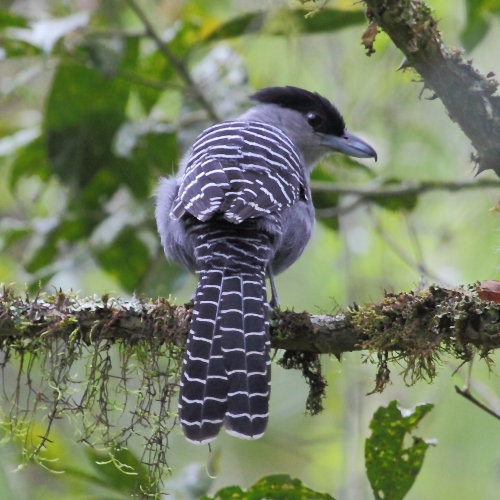
Rio Suno Antwren
Myrmotherula sunensis
Order: Passeriformes / Family: Thamnophilidae

Wikimedia Commons
About the Rio Suno Antwren
The Rio Suno Antwren, scientifically known as Myrmotherula sunensis, is a small, agile bird endemic to the rich biodiversity of the Amazon Basin. This bird belongs to the family Thamnophilidae and thrives in the dense undergrowth of lowland rainforests. Its presence predominantly in the Rio Suno region of Ecuador gives it its common name. The antwren plays a crucial ecological role as an insectivore, helping to control insect populations and contributing to the intricate food web of its habitat.
The Rio Suno Antwren is particularly significant for its specialized habitat preferences and its contribution to the diversity of the Amazonian bird community. It is typically found in thick, humid understorey, making it difficult to spot. It prefers secondary growth and disturbed forests, which makes it somewhat resilient to habitat changes compared to other more specialized Amazonian species. Yet, it remains vulnerable to large-scale deforestation and habitat fragmentation.
Ecologically, the Rio Suno Antwren is important for maintaining the balance of insect populations. Its diet primarily consists of small arthropods, which it gleans from foliage. Its presence indicates a healthy understorey ecosystem, as it relies on the complex structure of tropical forests to thrive. During the breeding season, which coincides with the rainy season, its activity increases, with pairs engaging in vocal duets to establish territories.
The bird's known range includes parts of Ecuador and Peru, where it inhabits subtropical or tropical moist lowland forests. It can often be found near streams and other water bodies within these forests, taking advantage of the rich insect life supported by the humidity and dense vegetation. The Rio Suno Antwren's ability to adapt to secondary forests suggests some resilience to environmental changes; however, continuous deforestation poses a significant threat to its long-term survival.
The Rio Suno Antwren belongs to the family Thamnophilidae, within the order Passeriformes. These birds typically live 3-5 years, with max recorded at 7 years.
How to Identify a Rio Suno Antwren
The Rio Suno Antwren is a small bird, approximately 10 cm in length, with a striking black and white color pattern. Adult males feature a predominantly black plumage with prominent white wing bars and a white belly, while females have a slightly browner tone with similar white markings. Juveniles resemble females but with more muted colors.
One of the key identification features of the Rio Suno Antwren is its distinct wing flicking behavior, often seen as the bird forages actively in the lower strata of the forest. The bird's small size and constant movement make it a challenge to spot, as it blends seamlessly with the dappled sunlight of its forest habitat.
In terms of similar species, the Rio Suno Antwren can be confused with other Myrmotherula species, such as the White-flanked Antwren. However, the latter has more extensive white markings and a slightly different vocalization. The Rio Suno Antwren's flight is quick and direct, often covering short distances between dense foliage, and it typically adopts an upright perching posture, which can aid in differentiation from similar species.
Having trouble telling birds apart? Upload a photo to our bird identification tool for an instant species match.
Rio Suno Antwren Habitat and Range
Preferred Habitat
The Rio Suno Antwren inhabits the dense undergrowth of tropical moist lowland forests, with a particular affinity for secondary and disturbed forests. It thrives at elevations below 1000 meters, often along riverbanks and in areas with a complex structure of shrubs and low trees.
This bird is frequently found in regions where the forest canopy allows patches of sunlight to penetrate, providing the necessary microhabitats for its insect prey. It shows some flexibility in habitat preferences, occasionally venturing into altered landscapes where secondary growth predominates.
While the Rio Suno Antwren primarily resides in rural environments, it can sometimes be observed in the outskirts of urban areas where suitable forest patches remain. Seasonal habitat shifts are minimal, as this species does not migrate and remains within its established territories throughout the year.
Geographic Range
The Rio Suno Antwren has a relatively restricted range, found primarily in the western Amazon Basin. It is known to inhabit regions within Ecuador, particularly around the Rio Suno area, and extends into parts of northeastern Peru.
This bird does not undertake long-distance migrations, instead maintaining a stable presence within its home range year-round. Its population density is highest in areas where the forest is dense and humid, supporting abundant insect life.
Due to its limited range and habitat specificity, the Rio Suno Antwren is considered a valuable species for studying the impacts of deforestation and habitat fragmentation in the Amazon. Its presence is often an indicator of healthy forest ecosystems, reflecting the overall biodiversity of the region.
Want to know which birds visit your area? Browse our backyard birds by location guides for region-specific species lists.
What Does the Rio Suno Antwren Eat?
The diet of the Rio Suno Antwren is primarily insectivorous, consisting mainly of small arthropods such as ants, spiders, and beetles. It employs a gleaning technique, meticulously picking prey from foliage and twigs as it moves through the underbrush.
Seasonal changes in its diet are minimal, as the Amazonian environment provides a consistent supply of prey year-round. However, during the rainy season, when insect activity increases, the Rio Suno Antwren's foraging activity intensifies, contributing to its breeding success.
The bird typically forages alone or in pairs, occasionally joining mixed-species flocks that move through the forest. Its adeptness at gleaning allows it to exploit microhabitats within the understorey, ensuring a steady food supply despite competition from other insectivores.
Rio Suno Antwren Behavior and Social Structure
The Rio Suno Antwren exhibits a territorial and predominantly monogamous social structure. During the breeding season, pairs engage in vocal duets, which serve both to strengthen pair bonds and to defend territory boundaries from rival pairs.
Courtship displays include fluttering wings and mutual preening, enhancing the bond between mates. This bird is generally solitary or found in pairs, though it may join mixed-species flocks for foraging efficiency.
In the face of predators, the Rio Suno Antwren relies on its cryptic plumage and elusive movements to escape detection. When alarmed, it often freezes, blending into its surroundings, or swiftly retreats deeper into the undergrowth.
Daily activity patterns show peaks in the early morning and late afternoon when foraging conditions are optimal. It spends considerable time in the mid to lower canopy levels, maintaining a low profile to avoid detection by both predators and competitors.
Rio Suno Antwren Nesting and Reproduction
The Rio Suno Antwren constructs cup-shaped nests, intricately woven with fine plant fibers, leaves, and spider silk, typically located in dense undergrowth or low shrubs.
Nests are usually sited 1 to 3 meters above ground, providing concealment from predators. The clutch size ranges from two to three eggs, which are creamy white with brown speckles.
Both parents participate in incubation, which lasts approximately 14 to 16 days. After hatching, both parents continue to feed and care for the fledglings until they are ready to leave the nest, around 10 to 14 days post-hatching.
The Rio Suno Antwren usually raises one brood per year, timed with the peak of the rainy season to ensure ample food supply for the growing chicks. Parental roles are shared equally, with both adults taking turns incubating and feeding the young.
Rio Suno Antwren Sounds and Vocalizations
The primary song of the Rio Suno Antwren is a series of high-pitched, rapid notes that rise and fall in a rhythmic pattern, often compared to a soft, mechanical trill. This song is used primarily during the breeding season to establish territory and attract mates.
Call notes are sharp and repetitive, serving as contact calls between pairs or family groups. Alarm calls are more strident and are used to alert nearby individuals to the presence of predators.
During the dawn chorus, the Rio Suno Antwren's song is more frequent, contributing to the symphony of sounds that characterizes the Amazonian morning. Its vocalizations, while subtle, are distinct enough to identify the species when coupled with a keen ear and knowledge of its behavior.
Interesting Facts About the Rio Suno Antwren
- 1The Rio Suno Antwren was first described in 1999, making it one of the more recently recognized species in the Amazon Basin.
- 2Despite its small size of approximately 10 cm, the Rio Suno Antwren plays a key role in controlling insect populations within its forest habitat.
- 3This bird's name reflects its primary habitat near the Rio Suno in Ecuador, emphasizing the importance of specific geographic regions in bird nomenclature.
- 4The Rio Suno Antwren's specialized diet includes primarily ants and beetles, showcasing its role as an important insectivore.
- 5It exhibits a unique wing-flicking behavior when foraging, which helps in identifying the species despite its elusive nature.
- 6The Rio Suno Antwren is part of the diverse Thamnophilidae family, which includes over 200 species of antbirds thriving in tropical regions.
- 7Studies suggest that the Rio Suno Antwren's adaptability to secondary forests offers some resilience against habitat changes, but deforestation remains a threat.
Rio Suno Antwren Conservation Status
The Rio Suno Antwren is currently classified as Least Concern by the IUCN, but its population trend is decreasing due to habitat loss. Deforestation and habitat fragmentation in the Amazon Basin are the primary threats to its survival. Conservation efforts focus on preserving large tracts of continuous forest and promoting sustainable land-use practices. Protecting critical habitats, particularly in Ecuador and Peru, is essential for maintaining healthy populations of this species. Historically, the Rio Suno Antwren has maintained stable populations in undisturbed areas, but as deforestation continues, its habitat becomes increasingly fragmented. Conservation measures that emphasize habitat connectivity are crucial for the long-term viability of this species.