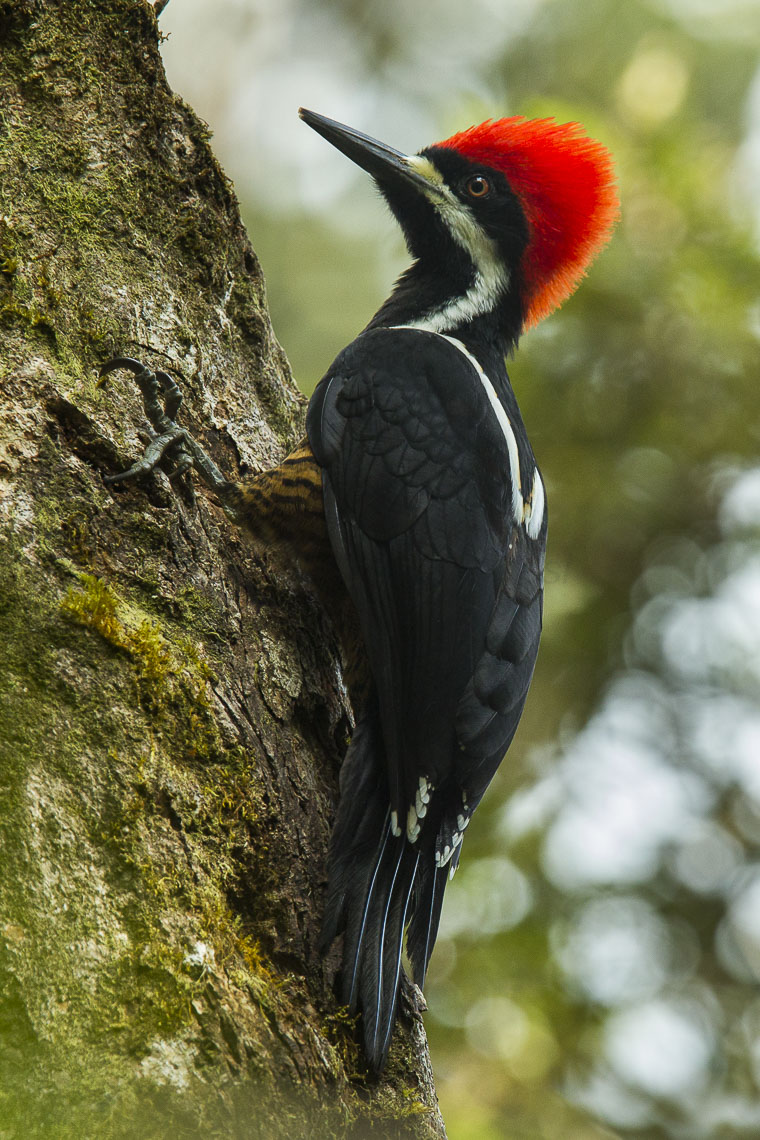
Robust Woodpecker
Campephilus robustus
Order: Piciformes / Family: Picidae

Wikimedia Commons
About the Robust Woodpecker
The Robust Woodpecker, known scientifically as Campephilus robustus, is a remarkable bird found primarily in the subtropical and tropical forests of South America, particularly in Brazil, Paraguay, and northern Argentina. This species plays a crucial role in its ecosystem by controlling insect populations and creating cavities that benefit other species. As a member of the Picidae family, the Robust Woodpecker is distinguished by its large size, reaching up to 36 centimeters in length. Its robust body, as the name suggests, is well-suited for the vigorous pecking needed to excavate wood in search of insects. These woodpeckers prefer dense, humid forests, often near watercourses where the trees are old and the canopy is thick, providing ample feeding and nesting opportunities. Their presence is an indicator of a healthy forest ecosystem due to their reliance on large tracts of uninterrupted habitat. Seasonally, the Robust Woodpecker remains fairly sedentary, with only minor local movements in search of food or suitable nesting sites. Unlike some migratory woodpeckers, this species does not undertake long-distance migrations, relying instead on the stable resources of its habitat throughout the year. The Robust Woodpecker's ecological role extends beyond insect control. By excavating tree cavities, it inadvertently provides nesting sites for secondary cavity-nesters such as small birds and mammals. These interactions highlight the woodpecker's importance in maintaining biodiversity within its range. The bird's strong bill, adapted for chiseling wood, enables it to break into tough bark and reach insects hidden within, thus contributing to forest health by reducing pest populations. This species is also of significant interest to researchers due to its unique adaptive traits and behaviors, which provide insights into the evolution of woodpecker species. Observing the Robust Woodpecker in its natural environment offers birders and naturalists a glimpse into the intricate dynamics of forest ecosystems in South America.
The Robust Woodpecker belongs to the family Picidae, within the order Piciformes. These birds typically live average 8-12 years with a maximum recorded of 15 years..
How to Identify a Robust Woodpecker
The adult Robust Woodpecker is characterized by its striking red crest, which is more prominent in males, and its black and white plumage. The bird's back and wings are predominantly black, while the face and underparts exhibit a contrasting white. The white facial markings form a distinctive pattern that helps differentiate it from similar species. In males, the red crest extends from the forehead to the nape, whereas females display a smaller, less vivid crest. Juvenile Robust Woodpeckers resemble adults but have duller plumage and less pronounced head markings. When in flight, the bird's broad wings and undulating flight pattern are typical of woodpeckers, with deep, deliberate wingbeats followed by short glides. Perched, the Robust Woodpecker exhibits a sturdy posture, often seen clinging to tree trunks or large branches. Compared to other woodpeckers in its range, its size and the extent of red on the crest are key identification markers. Confusion with other Campephilus species can occur, but the distinct facial pattern and habitat preferences provide reliable clues for accurate identification.
Having trouble telling birds apart? Upload a photo to our bird identification tool for an instant species match.
Robust Woodpecker Habitat and Range
Preferred Habitat
The Robust Woodpecker thrives in subtropical and tropical forests, favoring areas with old-growth trees and dense canopy cover. It is predominantly found in the Atlantic Forest biome, a biodiversity hotspot in Brazil, extending into parts of Paraguay and Argentina. The bird occupies elevations ranging from lowland forests to mid-elevation montane regions, often up to 1,500 meters. Seasonal habitat shifts are minimal, as the species tends to remain within forested areas year-round. While the Robust Woodpecker can occasionally be found in degraded forest patches, its preference for intact, mature forests makes it less common in urban or heavily disturbed environments. The presence of large, decaying trees is crucial for nesting and foraging, emphasizing the importance of forest conservation for its survival.
Geographic Range
The Robust Woodpecker's range encompasses southeastern Brazil, northeastern Argentina, and eastern Paraguay, with its stronghold in the Atlantic Forest region. Breeding populations are primarily concentrated in the coastal and inland forests of Brazil, particularly in states like São Paulo, Paraná, and Santa Catarina. The bird is non-migratory, with no significant long-distance movement between breeding and wintering grounds. However, local movements within its range may occur in response to food availability or habitat disturbances. Population density is highest in areas where primary forest has been preserved, though it can be found in secondary forests if sufficient resources are present. The species' range has historically been impacted by deforestation, leading to isolated populations and habitat fragmentation.
Want to know which birds visit your area? Browse our backyard birds by location guides for region-specific species lists.
What Does the Robust Woodpecker Eat?
The Robust Woodpecker primarily feeds on insects, particularly ants and beetle larvae, which it extracts from tree bark using its strong, chisel-like bill. During the breeding season, its diet may shift slightly to include more insect larvae to meet the increased nutritional demands of raising young. The bird employs a characteristic drumming technique to locate and extract prey, tapping rhythmically on tree trunks to detect hollow spots harboring insects. This foraging method not only secures food but also plays a role in communication and territory establishment. In addition to insects, the Robust Woodpecker occasionally consumes fruit and seeds, supplementing its diet when insect availability is low. This dietary flexibility is crucial for survival in varying environmental conditions. Feeding activity peaks during the early morning and late afternoon when the bird is most active, allowing it to exploit the cooler, more humid conditions of the forest.
Robust Woodpecker Behavior and Social Structure
The Robust Woodpecker exhibits a predominantly solitary lifestyle, though pairs may remain together throughout the year, especially during the breeding season. These woodpeckers are territorial and use drumming as a primary means of defending their territory and attracting mates. The drumming is a loud, resonant sound produced by rapid bill strikes on resonant tree surfaces, serving both as a communication tool and a territorial marker. Courtship displays include synchronized drumming duets and mutual preening, reinforcing pair bonds. The bird's daily activity patterns revolve around feeding and territory maintenance, with peak activity occurring during the cooler hours of dawn and dusk. Although not typically found in large flocks, the Robust Woodpecker may occasionally associate with mixed-species foraging groups, benefiting from increased vigilance against predators. When threatened, the woodpecker exhibits a range of behaviors, including retreating up tree trunks, freezing motionless against bark, or flying away with loud alarm calls to alert others.
Robust Woodpecker Nesting and Reproduction
Nest sites for the Robust Woodpecker are typically located in large, dead or dying trees where the bird excavates a cavity using its powerful bill. The entrance hole is generally round and situated several meters above the ground to avoid ground predators. Nest construction begins in late winter to early spring, with the female laying a clutch of 2-4 eggs. Both parents share incubation duties, which last approximately 14-16 days. After hatching, the chicks remain in the nest for about 25-30 days, during which time both parents actively feed them. Parental roles are shared, with both male and female participating in feeding and brooding. The species commonly raises one brood per year, although a second brood may occur in favorable conditions. Nest cavities, once abandoned, often serve as vital resources for other cavity-nesting species.
Robust Woodpecker Sounds and Vocalizations
The primary song of the Robust Woodpecker is a rhythmic drumming pattern characterized by rapid, evenly spaced beats on resonant wood surfaces. This drumming serves as both a territorial signal and a mating call. In addition to drumming, the bird emits a series of sharp, high-pitched calls that can be heard echoing through the forest. These calls vary in tone and intensity, often used as contact notes between mates or as alarm signals to alert others of potential threats. During the dawn chorus, the Robust Woodpecker's vocalizations contribute to the rich tapestry of forest sounds, blending with the calls of other avian species. The bird's vocal repertoire, while not as melodious as some songbirds, is nonetheless distinctive and an essential aspect of its behavioral ecology.
Interesting Facts About the Robust Woodpecker
- 1The Robust Woodpecker can drum up to 20 times per second, using its specialized bill to produce sound.
- 2Despite its name, the Robust Woodpecker is not the largest woodpecker; the Ivory-billed Woodpecker holds that title.
- 3The bird's tongue is long and barbed, ideal for extracting insects from tight crevices.
- 4Robust Woodpeckers often reuse their nesting cavities, which are later occupied by other species.
- 5The species' preference for old-growth forests makes it a key indicator of forest health.
- 6Its drumming can be heard over long distances, serving as an effective communication tool in dense forests.
- 7The Robust Woodpecker's presence in a forest can significantly reduce pest populations, benefiting the ecosystem.
Robust Woodpecker Conservation Status
The IUCN currently lists the Robust Woodpecker as Near Threatened, with its population trend showing signs of decline. The primary threat to this species is habitat loss due to deforestation and conversion of forests to agriculture and urban areas. This fragmentation results in isolated populations, reducing genetic diversity and resilience. Conservation efforts focus on habitat preservation and restoration, particularly in the Atlantic Forest, where legal protections and sustainable land-use practices are promoted. Historical population changes have seen declines in certain areas, correlating with increased human activity and habitat degradation. Ongoing research and monitoring are essential to inform conservation strategies and ensure the long-term survival of the Robust Woodpecker.
Other Picidae Species


Birds Similar to the Robust Woodpecker
These species are often confused with the Robust Woodpecker due to similar appearance or overlapping range.