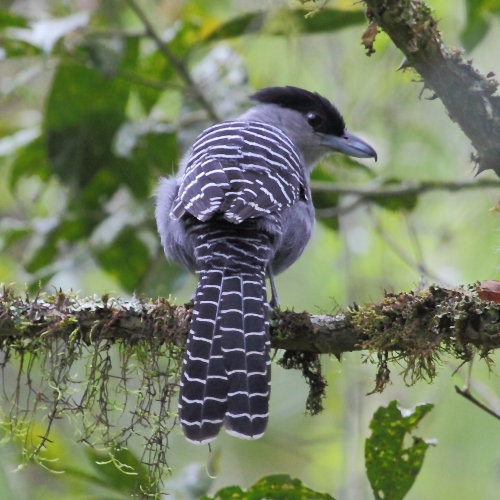
Rondonia Bushbird
Clytoctantes atrogularis
Order: Passeriformes / Family: Thamnophilidae

Wikimedia Commons
About the Rondonia Bushbird
The Rondonia Bushbird, scientifically known as Clytoctantes atrogularis, is a captivating species endemic to the Amazon Basin, particularly in the state of Rondônia, Brazil. This bird belongs to the Thamnophilidae family, a group primarily composed of antbirds. The Rondonia Bushbird is especially significant due to its rarity and the relatively limited data available about its population size and distribution. Discovered only in the late 20th century, this species has sparked interest for its elusive nature and specialized habitat preferences, residing predominantly in dense understory vegetation within lowland tropical forests. These birds play a crucial role in their ecosystem as insectivores, helping to control insect populations. The Rondonia Bushbird is particularly adapted to a life concealed within the foliage, a necessity for survival in the dense Amazonian forest. Throughout the year, they remain within their restricted range, showing little to no migratory behavior. Seasonal changes in the Amazon, such as periods of flooding, may affect their foraging habits and the availability of prey, but the Rondonia Bushbird maintains a year-round presence in its habitat. This species is an essential component of the Amazon's rich biodiversity, contributing to the intricate web of life that defines this globally significant ecoregion. The bird's presence is an indicator of the overall health of the forest ecosystem, as it relies on the undisturbed, mature forest for survival. The importance of conserving their habitat cannot be overstated, as it ensures the continued existence of not only the Rondonia Bushbird but also countless other species that depend on the same environment.
The Rondonia Bushbird belongs to the family Thamnophilidae, within the order Passeriformes. These birds typically live average 3-4 years, with a maximum recorded of 5 years..
How to Identify a Rondonia Bushbird
The Rondonia Bushbird is a small passerine with several distinctive field marks that aid in its identification. Adults typically exhibit a deep brown plumage on the upperparts, which provides excellent camouflage against the forest floor. One of the key identifying traits of the Rondonia Bushbird is its striking black throat patch, which is more pronounced in males than in females. This patch contrasts sharply with their otherwise muted coloration. Juveniles resemble adults but may have a less distinct throat patch and slightly duller overall plumage. Males and females are generally similar, although males tend to have a slightly broader throat patch. When observing the Rondonia Bushbird, note its compact body and relatively short tail, which are typical of many understory-dwelling bird species. In flight, the bird displays a quick, direct path, although it is more often seen maneuvering through dense vegetation. The Rondonia Bushbird's perching posture is somewhat upright, often seen clinging to vertical branches or stems as it searches for insects. While confusion with other antbird species is possible, the combination of the black throat and the bird's specific range helps in accurate identification.
Having trouble telling birds apart? Upload a photo to our bird identification tool for an instant species match.
Rondonia Bushbird Habitat and Range
Preferred Habitat
The Rondonia Bushbird is closely tied to the lowland tropical forests of the Amazon Basin, with a strong preference for dense understory vegetation. This habitat provides the necessary cover and food resources required for its survival. The species is typically found at elevations ranging from 100 to 400 meters, primarily in mature, undisturbed forests. These birds rely on the complex structure of the forest understory, which offers both protection from predators and a rich supply of insects. Seasonal changes in the Amazon, such as the wet season, may cause temporary shifts in microhabitat use, but the Rondonia Bushbird does not exhibit significant seasonal movements. Unlike some bird species that can adapt to urban or heavily altered landscapes, the Rondonia Bushbird is rarely found outside of pristine forest environments. Its presence is a strong indicator of a healthy, intact forest ecosystem, making its conservation critical in the face of ongoing deforestation in the region.
Geographic Range
The Rondonia Bushbird's range is highly restricted, confined to a small portion of the southwestern Amazon Basin in Brazil, particularly in the state of Rondônia. There is no evidence to suggest that this species engages in long-distance migration, as it is generally considered a sedentary resident within its range. The exact boundaries of its distribution are not fully understood, largely due to its elusive nature and the challenges of conducting fieldwork in dense tropical forests. However, sightings and records indicate a concentration in areas with mature, undisturbed forest cover. The population density of the Rondonia Bushbird is likely uneven, with potential hotspots in regions where suitable habitat remains intact. Conservation efforts are crucial to protecting the limited range of this species, as habitat destruction poses a significant threat to its survival. The bird's presence within a narrow geographic area makes it particularly vulnerable to deforestation, which is rapidly altering the landscape in Rondônia and other parts of the Amazon Basin.
Want to know which birds visit your area? Browse our backyard birds by location guides for region-specific species lists.
What Does the Rondonia Bushbird Eat?
The Rondonia Bushbird's diet consists primarily of insects, which it expertly hunts within the dense understory of its forest habitat. This bird employs a technique known as 'sallying,' where it darts out from a perch to capture prey in mid-air or glean insects from foliage. The Rondonia Bushbird's foraging strategy is well-suited to its environment, as the bird takes advantage of its agile flight to maneuver through tight spaces while pursuing its quarry. While insects form the bulk of its diet, the bird may also consume spiders and other small arthropods as secondary food sources. Seasonal variations in prey availability can influence the Rondonia Bushbird's diet, with certain insect populations peaking during the wet season. This dietary flexibility allows the bird to sustain itself even when specific prey types become scarce. The bird typically feeds during the day, exhibiting peak foraging activity in the early morning and late afternoon when insect activity is highest.
Rondonia Bushbird Behavior and Social Structure
The Rondonia Bushbird exhibits behavior typical of many understory-dwelling birds, with solitary or paired individuals being the most common social structure observed. These birds are known for their secretive nature, often remaining hidden within dense vegetation. Territorial behavior is evident, with males engaging in vocalizations to establish and defend their territory from intruders. During the breeding season, courtship displays involve visual signals and vocalizations, aiding in mate attraction and pair bonding. The Rondonia Bushbird is primarily diurnal, with activity peaks during the early morning and late afternoon. Flocking behavior is uncommon, as these birds prefer a more solitary existence, likely due to their specialized niche and the competition for limited resources in the understory. The Rondonia Bushbird's response to predators includes remaining motionless to avoid detection and utilizing its excellent camouflage to blend into its surroundings. This strategy, combined with its cryptic plumage, makes it particularly challenging for predators to locate.
Rondonia Bushbird Nesting and Reproduction
The nesting behavior of the Rondonia Bushbird reflects its adaptation to life in the dense understory. Nests are typically constructed low to the ground, often in shrubs or small trees, where they remain concealed by foliage. The nest itself is a cup-shaped structure made from twigs, leaves, and other plant materials, providing both camouflage and comfort. Clutch size for the Rondonia Bushbird generally consists of two to three eggs, although exact numbers can vary depending on environmental conditions. Both parents participate in the incubation process, which lasts approximately two weeks. After hatching, both male and female share responsibilities in feeding and caring for the young. The fledging period lasts around three weeks, during which time the chicks develop rapidly, preparing for their eventual independence. The number of broods per year is typically one, although favorable conditions may allow for a second brood. The careful selection of nesting sites and shared parental duties highlight the bird's commitment to ensuring the survival of its offspring in a challenging environment.
Rondonia Bushbird Sounds and Vocalizations
The vocalizations of the Rondonia Bushbird are a key component of its behavior, particularly in territorial defense and mate attraction. The primary song consists of a series of sharp, high-pitched notes delivered in rapid succession. This song has a rhythmic quality, often described as a 'ticking' sound, which echoes through the forest understory. In addition to its primary song, the Rondonia Bushbird also emits various call notes used for communication between individuals, such as soft 'chit' sounds. Alarm calls are harsher and more abrupt, serving to alert others of potential threats. During the dawn chorus, the Rondonia Bushbird's song can be heard intermingling with the calls of other bird species, contributing to the vibrant acoustic tapestry of the Amazonian forest. The distinctiveness of the bird's song aids in its detection during field surveys, despite its often-hidden presence.
Interesting Facts About the Rondonia Bushbird
- 1The Rondonia Bushbird was only officially described in 1986, making it a relatively recent discovery in ornithology.
- 2This bird is known to inhabit some of the most remote and inaccessible regions of the Amazon, adding to the challenge of studying it.
- 3Despite its elusive nature, the Rondonia Bushbird's song can sometimes be heard up to 100 meters away in dense forest.
- 4The black throat patch of the Rondonia Bushbird is a key characteristic, setting it apart from other antbirds in its range.
- 5Due to its rarity, the Rondonia Bushbird is often considered a 'holy grail' species for birdwatchers visiting the Amazon.
- 6The species' reliance on undisturbed forest makes it a valuable bioindicator for assessing ecosystem health.
- 7Though primarily insectivorous, the Rondonia Bushbird occasionally consumes small spiders, showcasing its dietary flexibility.
Rondonia Bushbird Conservation Status
Currently, the Rondonia Bushbird is classified as Near Threatened on the IUCN Red List, reflecting its limited range and the ongoing threats to its habitat. The primary concern for this species is deforestation, driven by logging, agriculture, and infrastructure development in the Amazon Basin. These activities result in habitat fragmentation and loss, posing a significant threat to the bird's survival. Conservation efforts focus on protecting and preserving the remaining intact forest areas within its range. Initiatives to establish protected areas and enforce logging regulations are critical in mitigating habitat loss. The species' population trend remains uncertain, with some evidence suggesting a decline due to habitat degradation. Historical data on population numbers are sparse, making it challenging to assess long-term trends accurately. Continued research and monitoring are essential to understanding the full impact of environmental changes on the Rondonia Bushbird and to inform effective conservation strategies.