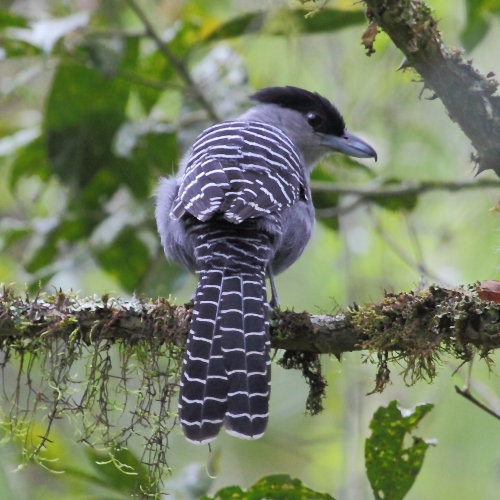
Rondonia Warbling-Antbird
Hypocnemis ochrogyna
Order: Passeriformes / Family: Thamnophilidae

Wikimedia Commons
About the Rondonia Warbling-Antbird
The Rondonia Warbling-Antbird, scientifically known as Hypocnemis ochrogyna, inhabits the dense tropical forests of South America, primarily in the Amazon Basin of Brazil. This species is a member of the Thamnophilidae family, a group known for its variety of antbirds that thrive in the understory of vibrant, biodiverse ecosystems. These birds play a significant role in their ecological niche, often seen following ant swarms to catch escaping insects. Their population is concentrated in the state of Rondônia, but they also extend into northern Bolivia, indicating a preference for lowland tropical forests. The Rondonia Warbling-Antbird's presence in these regions underscores the importance of preserving Amazonian habitats that face threats from deforestation and habitat fragmentation. Seasonally, this antbird may exhibit subtle shifts in behavior, particularly during the breeding season, when males become more vocal and territorial. Additionally, their capacity to adapt to secondary growth forests, although limited, provides some resilience against habitat loss. The species' ecological role extends beyond mere insect control; it contributes to the intricate web of life that characterizes the Amazon rainforest. The Rondonia Warbling-Antbird's interactions with its environment highlight the interconnectedness of forest ecosystems, emphasizing the need for comprehensive conservation strategies.
The Rondonia Warbling-Antbird belongs to the family Thamnophilidae, within the order Passeriformes. These birds typically live 5 years with a maximum recorded of 8 years.
How to Identify a Rondonia Warbling-Antbird
Adult Rondonia Warbling-Antbirds display a distinctive plumage pattern that aids in their identification. Males typically exhibit a gray crown and nape with a contrasting black face mask. Their upperparts are a rich brown, providing effective camouflage amid the forest understory. The breast is adorned with a mix of white and black streaks, while the belly is generally lighter. Females differ with a more subdued coloration, lacking the stark black face mask and possessing a more uniform brown plumage. Juveniles resemble females but may appear even duller and lack the defined streaks on the breast. The bird's perching posture is typically upright, often seen holding its tail slightly cocked, which can aid in identification. In flight, its silhouette is compact and agile, suited for navigating dense vegetation. While similar species such as the Yellow-breasted Warbling-Antbird may cause confusion, the Rondonia Warbling-Antbird's specific range and distinct vocalizations assist in proper identification.
Having trouble telling birds apart? Upload a photo to our bird identification tool for an instant species match.
Rondonia Warbling-Antbird Habitat and Range
Preferred Habitat
The Rondonia Warbling-Antbird thrives in humid, lowland tropical forests, particularly favoring the dense understory. These habitats are characterized by thick foliage that provides cover and abundant insect prey. It is primarily a resident of the Amazon Basin, with sightings most frequent in the state of Rondônia, Brazil. The bird is typically found at elevations below 500 meters, although it may ascend slightly higher in search of food or suitable nesting sites. While it shows some flexibility in inhabiting secondary forests, it remains heavily reliant on primary forest ecosystems. Unlike some more adaptable species, the Rondonia Warbling-Antbird is rarely observed in urban settings, underscoring its dependence on undisturbed habitats. Seasonal habitat shifts are minimal, as the species is non-migratory and remains within its established territories year-round.
Geographic Range
The Rondonia Warbling-Antbird's range is largely confined to the southwestern Amazon Basin. It is predominantly found in the Brazilian state of Rondônia, but its distribution extends into adjacent areas such as northern Bolivia. The species does not undertake long-distance migrations, maintaining year-round territories within this range. This restricted distribution highlights the species' vulnerability to habitat changes within the Amazon. Population density is generally consistent across its range, although local abundance can vary based on habitat quality and availability of food resources. The bird's presence in these regions is a testament to the ecological diversity and complexity of the Amazon rainforest.
Want to know which birds visit your area? Browse our backyard birds by location guides for region-specific species lists.
What Does the Rondonia Warbling-Antbird Eat?
The diet of the Rondonia Warbling-Antbird primarily consists of insects and other small arthropods. It often engages in a foraging behavior known as "ant-following," where it exploits swarms of army ants to catch fleeing prey. This opportunistic feeding strategy allows it to capitalize on the movement of ants to access a variety of insects hidden in the leaf litter. During the wet season, when insect abundance is highest, the bird's diet may diversify slightly to include more varied arthropods. Prey size typically ranges from small beetles to spiders, with the bird employing a quick, darting motion to capture its food. Foraging occurs throughout the day, with peak activity in the morning and late afternoon, coinciding with the cooler temperatures that encourage more insect movement.
Rondonia Warbling-Antbird Behavior and Social Structure
The Rondonia Warbling-Antbird exhibits a fascinating array of behaviors that are both social and territorial. It often forms monogamous pairs that maintain and defend territories year-round. During the breeding season, males become particularly vocal, using their melodious song to assert dominance and attract mates. The bird's social structure is generally centered around these pairs, although they may occasionally join mixed-species flocks, especially outside the breeding season. Courtship displays are subtle but involve synchronized movements and vocal duets between pairs. In response to predators, the Rondonia Warbling-Antbird employs a range of alarm calls, often retreating into dense cover to avoid detection. Daily activity patterns include periods of intense foraging interspersed with quieter intervals of rest and preening.
Rondonia Warbling-Antbird Nesting and Reproduction
The Rondonia Warbling-Antbird constructs its nest in the dense understory of tropical forests. Nests are typically cup-shaped and made from a combination of leaves, twigs, and fibers, often positioned close to the ground or in low shrubs. The female lays a clutch of two to three eggs, which she incubates with the help of her mate. The incubation period lasts approximately 14 to 16 days, after which the chicks hatch and are fed by both parents. Fledging occurs about 10 to 12 days later, with young birds remaining in the parental territory for several weeks. The species typically raises one brood per year, although favorable conditions may occasionally allow for a second. Parental roles are shared, with both sexes participating in feeding and protecting the young.
Rondonia Warbling-Antbird Sounds and Vocalizations
The primary song of the Rondonia Warbling-Antbird is a series of clear, melodious whistles that rise and fall in pitch. This song is often delivered in duets between mated pairs, creating a harmonious blend that resonates through the forest. The bird also produces a variety of call notes, including short, sharp chips used as contact calls between individuals. Alarm calls are harsher and more insistent, designed to warn of potential threats. During the dawn chorus, the Rondonia Warbling-Antbird's song is particularly prominent, serving as both a territorial marker and a means of communication with nearby conspecifics.
Interesting Facts About the Rondonia Warbling-Antbird
- 1The Rondonia Warbling-Antbird is one of six species within its genus, each with a distinct vocalization pattern.
- 2This antbird species was only formally described in 2007, highlighting the ongoing discovery of Amazonian biodiversity.
- 3Ant-following behavior is a key survival strategy, allowing the bird to access prey that would otherwise remain hidden.
- 4Despite their small size, these birds play a crucial role in controlling insect populations within their habitat.
- 5The Rondonia Warbling-Antbird's song can carry over long distances, effectively communicating across the dense forest.
Rondonia Warbling-Antbird Conservation Status
The Rondonia Warbling-Antbird is currently classified as Least Concern by the IUCN, though its population trend is decreasing due to ongoing habitat loss. The primary threat comes from deforestation in the Amazon Basin, driven by logging, agriculture, and infrastructure development. Conservation efforts focus on habitat preservation and sustainable land-use practices to mitigate these impacts. Historically, the population has fluctuated in response to the extent of available habitat, emphasizing the need for continuous monitoring and conservation action.