Roraiman Antbird
Schistocichla saturata
Order: Passeriformes / Family: Thamnophilidae

Wikimedia Commons
About the Roraiman Antbird
The Roraiman Antbird, Schistocichla saturata, resides primarily in the lush cloud forests of the Guiana Shield, particularly in Venezuela's Gran Sabana and Guyana's Pakaraima Mountains. This bird belongs to the Thamnophilidae family, a group renowned for their intricate calls and specialized feeding habits. As a member of the subtropical forest community, the Roraiman Antbird plays a crucial role in insect population control, preying on ants and other invertebrates that inhabit the dense undergrowth.
The ecological significance of the Roraiman Antbird extends beyond its dietary habits; it contributes to the biodiversity of its region, sharing its habitat with other endemic species. The bird's presence indicates a healthy, undisturbed ecosystem, as it thrives in areas with little human encroachment. The Roraiman Antbird is a territorial species, often seen in pairs or small family groups, maintaining clearly defined territories throughout the year.
The breeding season varies slightly with elevation and latitude but generally peaks during the rainy season, when food availability is highest. During this time, their vocalizations become more frequent and complex, serving both to attract mates and to defend their territory. Although the Roraiman Antbird is not known to migrate, its behavioral patterns shift with the changing seasons, adapting to the availability of food and changes in its environment.
The Roraiman Antbird belongs to the family Thamnophilidae, within the order Passeriformes. These birds typically live average 4-7 years with a maximum recorded of 10 years..
How to Identify a Roraiman Antbird
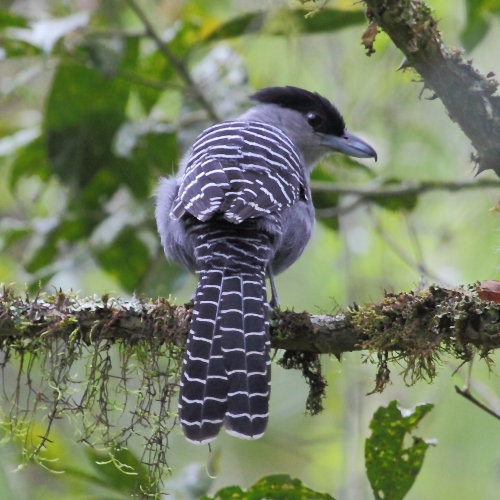
The Roraiman Antbird is a small passerine, measuring approximately 14-15 cm in length. It features a striking black-and-white plumage, with the male exhibiting a more pronounced contrast between the deep black of its head and wings and the white of its throat and belly. The female is similarly colored but tends to have slightly more muted tones, with grayish tinges blending into the black areas.
Juvenile Roraiman Antbirds resemble females but display a browner hue across their plumage until they reach maturity. In the field, observers may confuse the Roraiman Antbird with other sympatric antbirds, particularly the White-plumed Antbird. However, the latter species exhibits distinctive white feather tufts on its face, setting it apart from Schistocichla saturata.
In flight, the Roraiman Antbird's silhouette is characterized by its relatively short, rounded wings and a straight, narrow tail, often difficult to observe due to its preference for skimming low across the forest floor. When perched, it often adopts an upright posture, which helps it remain vigilant for potential predators.
Having trouble telling birds apart? Upload a photo to our bird identification tool for an instant species match.
Roraiman Antbird Habitat and Range
Preferred Habitat
The Roraiman Antbird inhabits montane cloud forests, thriving best at elevations between 1,200 and 2,300 meters. These forests provide a humid, cool climate with dense understory vegetation, ideal for foraging and nesting. The bird's preference for undisturbed habitats means it is rarely observed in areas undergoing significant human activity.
This species shows little variation in habitat preference across its range, consistently favoring dense forested areas with abundant leaf litter. Although primarily a forest dweller, the Roraiman Antbird exhibits some adaptability, occasionally venturing into secondary growth areas if they closely resemble its native habitat.
Unlike some other antbird species, the Roraiman Antbird does not typically inhabit urban or suburban environments, underscoring its reliance on pristine forest conditions for survival and reproduction.
Geographic Range
The Roraiman Antbird is endemic to the Guiana Shield, with a range encompassing parts of southern Venezuela, particularly the Gran Sabana region, and extending into western Guyana's Pakaraima Mountains. Its distribution is closely tied to the unique topography and climate of this area, characterized by high-altitude plateaus and a tropical montane climate.
Though non-migratory, the Roraiman Antbird's range is somewhat restricted by its specialized habitat requirements. It is most common in areas where suitable forest cover remains intact, avoiding regions where deforestation or habitat fragmentation is prevalent. Within its range, population densities are highest in regions where cloud forests are most expansive and least disturbed by human activities.
The bird's range does not extend into the lowland regions of the Amazon Basin or coastal plains, remaining confined to its montane environment throughout the year.
Want to know which birds visit your area? Browse our backyard birds by location guides for region-specific species lists.
What Does the Roraiman Antbird Eat?
The Roraiman Antbird feeds primarily on insects, with ants and other small arthropods forming the core of its diet. It employs a foraging strategy known as ant-following, where it trails army ant columns to capture fleeing prey. This behavior highlights the bird's dependence on specific insect populations for sustenance.
During the wet season, when insect abundance peaks, the Roraiman Antbird may diversify its diet to include beetles, spiders, and caterpillars. The bird's sharp, pointed beak is well-suited for probing leaf litter and extracting hidden prey.
Feeding activity occurs mostly during the early morning and late afternoon, taking advantage of the cooler temperatures and increased insect activity during these times. The bird's reliance on forest floor foraging makes it particularly susceptible to changes in undergrowth structure and composition.
Roraiman Antbird Behavior and Social Structure
The Roraiman Antbird exhibits a social structure centered around monogamous pairs that maintain territories year-round. Territorial disputes are common, especially during the breeding season, when vocal displays and physical confrontations may occur.
Courtship involves complex vocalizations and display flights, where males show off their plumage and agility to attract a mate. Once paired, both members of the pair participate in defending the territory and raising young.
Flocking behavior is uncommon, as the Roraiman Antbird tends to avoid large groups, preferring intimate family units. In response to predators, these antbirds rely on their cryptic plumage and evasive flight patterns to avoid detection, often darting into dense vegetation when threatened.
The daily routine of the Roraiman Antbird includes morning and evening foraging sessions, with midday often spent resting in the cooler, shaded areas of the forest. This pattern ensures energy conservation during the hottest part of the day.
Roraiman Antbird Nesting and Reproduction
Roraiman Antbirds construct cup-shaped nests made from a mix of plant fibers, moss, and leaves, typically positioned in the fork of a shrub or low tree, camouflaged within dense foliage. The nest site is usually chosen for its proximity to food sources and cover from predators.
A typical clutch consists of two to three eggs, with both parents sharing incubation duties over approximately 14 days. After hatching, the chicks remain in the nest for an additional 12-15 days before fledgling, during which both parents are involved in feeding and protecting the young.
The Roraiman Antbird generally raises one brood per year, timed to coincide with the peak of the wet season, ensuring ample food supply for the growing chicks. Parental care extends beyond fledging, with juveniles often staying within the natal territory for some time.
Roraiman Antbird Sounds and Vocalizations
The Roraiman Antbird's primary song consists of a series of sharp, metallic notes delivered in rapid succession, resembling the sound of a small metal hammer tapping on an anvil. These vocalizations serve to establish and defend territory, particularly during the breeding season.
In addition to their song, Roraiman Antbirds produce various call notes used for communication between mates and family members. Alarm calls are harsher and more abrupt, alerting nearby birds to potential threats.
The Roraiman Antbird participates in the dawn chorus, where its song contributes to the symphony of sounds that greet the morning in its forest habitat. Its vocalizations are distinctive, ensuring easy identification among the cacophony of tropical bird calls.
Interesting Facts About the Roraiman Antbird
- 1The Roraiman Antbird is named after Mount Roraima, a tepui in the Guiana Shield where it is commonly found.
- 2Despite their small size, Roraiman Antbirds are fierce defenders of their territory, often engaging in physical displays to ward off rivals.
- 3The species' reliance on ant-following for foraging is a behavior shared with only a few other bird species in the world.
- 4Roraiman Antbirds are rarely seen outside their forest habitat, making them a prized sighting for birdwatchers traveling to the region.
- 5The dense fog and mist of the cloud forests they inhabit contribute to a unique microclimate, essential for their survival.
- 6The Roraiman Antbird's vocalizations are among the most distinct in the Thamnophilidae family due to their harsh, metallic quality.
- 7This species has evolved to blend seamlessly with the forest floor, an adaptation crucial for avoiding aerial predators.
Roraiman Antbird Conservation Status
Currently, the Roraiman Antbird is classified as 'Least Concern' by the IUCN, thanks to its stable population and remote habitat. However, its dependency on pristine forest environments makes it vulnerable to deforestation and habitat fragmentation, primarily due to logging and agricultural expansion. Conservation efforts focus on preserving the unique cloud forests of the Guiana Shield, ensuring that the habitats remain intact and free from human interference. Protected areas in Venezuela and Guyana play a crucial role in safeguarding the Roraiman Antbird's habitat. While the population remains stable, continuous monitoring is essential to detect any changes in numbers or distribution, especially as environmental pressures increase in the region.