
Rose-breasted Grosbeak
Pheucticus ludovicianus
Order: Passeriformes / Family: Cardinalidae
Wikimedia Commons
About the Rose-breasted Grosbeak
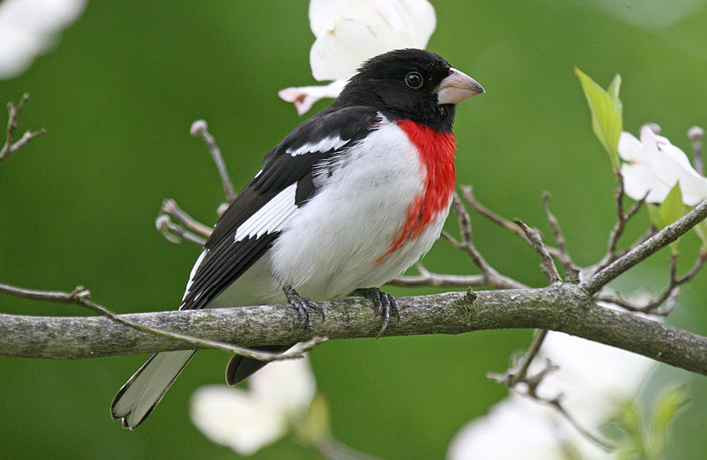
The Rose-breasted Grosbeak (Pheucticus ludovicianus) is a medium-sized songbird that belongs to the family Cardinalidae, commonly found across North America. This species is celebrated not only for its vibrant plumage but also for its rich, melodious song that often draws comparisons to the American Robin. Male Rose-breasted Grosbeaks are particularly striking, with a black head, white underparts, and a vivid rose-red patch on their chests. Females, while less colorful, possess a subtler beauty with their brown and streaked plumage. These birds primarily inhabit deciduous and mixed woodlands, favoring areas with dense foliage that provide both cover and ample foraging opportunities. During the breeding season, which spans from May to July, they can be found nesting in the northern United States and southern Canada. The Rose-breasted Grosbeak plays a vital role in its ecosystem, serving as both a predator of insects and a disperser of seeds, thus contributing significantly to the health and regeneration of its habitat. In winter, they migrate to Central and South America, where they occupy tropical and subtropical forests. Their migratory patterns are fascinating, as they travel great distances, often covering thousands of miles between their breeding and wintering grounds. These journeys highlight the species' adaptability and resilience in the face of various environmental challenges. The Rose-breasted Grosbeak's presence is a positive indicator of forest health, and their melodious songs enliven the woodlands they inhabit. By understanding the ecological role and significance of the Rose-breasted Grosbeak, conservationists and bird enthusiasts can work together to protect these birds and the habitats they rely upon, ensuring that future generations can appreciate their beauty and song.
The Rose-breasted Grosbeak belongs to the family Cardinalidae, within the order Passeriformes. These birds typically live average lifespan of 7-8 years, with a maximum recorded of 12 years..
How to Identify a Rose-breasted Grosbeak
Adult male Rose-breasted Grosbeaks are unmistakable with their black head, wings, and back, contrasting sharply with their white underparts and the striking rose-red patch on their breast. Females and juveniles are more subtly colored, exhibiting brown streaked plumage that provides excellent camouflage in their wooded habitats. The females' bills are pale and conical, a feature shared by both sexes, which is ideal for cracking seeds. In flight, the Rose-breasted Grosbeak displays white patches on its wings and tail, aiding identification from a distance. When perched, they exhibit a stout body and a noticeable thick neck, which is characteristic of grosbeaks. The distinctive coloration of males makes them relatively easy to identify, while the more subdued females can sometimes be confused with other brown-streaked songbirds such as the female Purple Finch or the female Red-winged Blackbird. However, the grosbeak's larger size, distinctive bill, and behavior can aid in proper identification.
Having trouble telling birds apart? Upload a photo to our bird identification tool for an instant species match.
Rose-breasted Grosbeak Habitat and Range
Preferred Habitat
The Rose-breasted Grosbeak typically inhabits deciduous and mixed forests across its range. Preferring regions with dense tree cover, these birds are often found in areas such as the eastern woodlands of the United States and southern Canada. During the breeding season, they favor forest edges and clearings, which provide ample nesting sites and food resources. In the winter months, they migrate to Central and South America, where they inhabit tropical forests and secondary growth woodlands. They are adaptable and can occasionally be found in suburban gardens and parks, especially during migration. Their presence in both urban and rural environments highlights their adaptability to different habitat types.
Geographic Range
The breeding range of the Rose-breasted Grosbeak spans across the northeastern United States and southern Canada, extending westward to the Great Plains. Key states and provinces such as Minnesota, Wisconsin, and Ontario are known breeding hotspots. During migration, these birds travel through the central and eastern United States, utilizing major flyways such as the Mississippi and Atlantic corridors. In winter, the Rose-breasted Grosbeak can be found in Central America, including countries like Mexico, and further south into Colombia and Ecuador. While they are considered a common species within their range, local population densities can vary, with higher concentrations often found in areas with abundant food resources and suitable habitat.
Want to know which birds visit your area? Browse our backyard birds by location guides for region-specific species lists.
What Does the Rose-breasted Grosbeak Eat?
The diet of the Rose-breasted Grosbeak is diverse, consisting primarily of insects, seeds, and fruits. During the breeding season, they consume a higher proportion of insects, such as beetles, caterpillars, and grasshoppers, which provide essential protein for raising young. As the seasons change, their diet shifts towards more seeds and fruits, including various berries and wild fruits. The grosbeak's stout, conical bill is well-suited for cracking open seeds, making them efficient foragers. They typically feed during the day, often foraging in trees and shrubs but occasionally coming to the ground to search for fallen seeds and insects.
Want to attract Rose-breasted Grosbeaks to your yard? See our recommended feeders and seed types for the best results.
Rose-breasted Grosbeak Behavior and Social Structure
Rose-breasted Grosbeaks exhibit fascinating behaviors, particularly during the breeding season. Males are territorial and will sing vigorously to establish and defend their territory from rivals. Their song is a beautiful, melodious series of notes, often described as similar to a robin's song but more powerful and varied. Courtship involves the male displaying his striking plumage and performing fluttering flights to attract a mate. Once paired, grosbeaks are monogamous and work together to raise their young. Outside of the breeding season, Rose-breasted Grosbeaks are more social, often joining mixed-species flocks during migration and in their wintering habitats. They are primarily diurnal, with peak activity occurring in the early morning and late afternoon. In response to predators, they may issue sharp alarm calls and take cover in dense foliage.
Rose-breasted Grosbeak Nesting and Reproduction
Rose-breasted Grosbeaks construct their nests in deciduous trees, often at heights ranging from 5 to 20 feet. The female typically selects the nest site and constructs a loose, cup-shaped nest using twigs, grasses, and leaves. The clutch size ranges from 3 to 5 eggs, which are pale blue to greenish with brown spots. Both parents share incubation duties over a period of about 11 to 14 days. After hatching, the chicks are altricial, requiring extensive care and feeding by both parents. The young fledge approximately 9 to 12 days after hatching, though they remain dependent on the parents for several weeks. The Rose-breasted Grosbeak usually produces one brood per year, although in favorable conditions, a second brood may occur.
Rose-breasted Grosbeak Sounds and Vocalizations
The primary song of the Rose-breasted Grosbeak is a series of rich, melodious phrases that resemble a more refined version of the American Robin's song. The pitch is clear, and the tempo is steady, with a series of rising and falling notes. In addition to their song, these grosbeaks produce a sharp, metallic 'chink' call note, commonly heard during flight or when they are alarmed. At dawn, their songs are often more vibrant and persistent, contributing to the dawn chorus that fills the forest. Their calls and songs play a crucial role in communication, territory establishment, and mate attraction.
Interesting Facts About the Rose-breasted Grosbeak
- 1Male Rose-breasted Grosbeaks can sing over 1,000 different song variations in a single day.
- 2The Rose-breasted Grosbeak's song is often compared to that of a robin, but with a sweeter, more melodic tone.
- 3Despite their striking appearance, female Rose-breasted Grosbeaks are adept at camouflage due to their streaked brown plumage.
- 4Rose-breasted Grosbeaks can migrate up to 2,500 miles between their breeding and wintering grounds.
- 5These birds are known to hybridize with Black-headed Grosbeaks where their ranges overlap, producing unique offspring.
- 6Rose-breasted Grosbeaks play a crucial role in controlling insect populations, particularly during the breeding season.
- 7Their powerful beaks can exert a force strong enough to crack open the hard shells of seeds and nuts.
Rose-breasted Grosbeak Conservation Status
The Rose-breasted Grosbeak is currently listed as a species of Least Concern by the IUCN, with a stable population trend. Despite this status, they face threats from habitat loss, particularly in their wintering grounds in Central and South America, where deforestation reduces available habitat. In North America, pesticide use can impact their food supply. Conservation efforts focus on preserving their breeding and wintering habitats, along with monitoring population trends. Historically, the population has remained relatively stable, though fluctuations occur in response to environmental changes.
Attracting Rose-breasted Grosbeaks to Your Feeder
The Rose-breasted Grosbeak is a regular visitor to backyard bird feeders across its range. At the Eye On The Fly feeding station, we observe Rose-breasted Grosbeaks regularly and capture footage with our feeder cameras.
Other Cardinalidae Species


Birds Similar to the Rose-breasted Grosbeak
These species are often confused with the Rose-breasted Grosbeak due to similar appearance or overlapping range.


