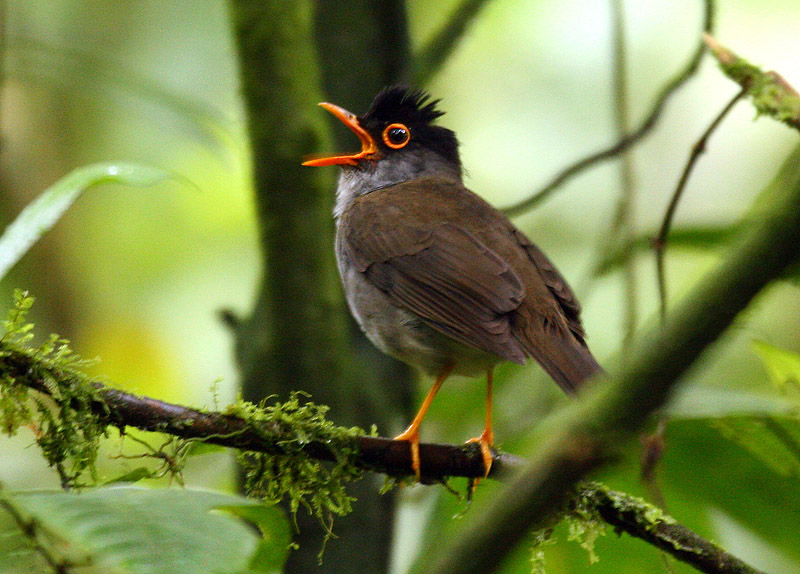
Ruddy-capped Nightingale-Thrush
Catharus frantzii
Order: Passeriformes / Family: Turdidae

Wikimedia Commons
About the Ruddy-capped Nightingale-Thrush
The Ruddy-capped Nightingale-Thrush (Catharus frantzii) is a small, charismatic songbird belonging to the family Turdidae. It thrives in the montane forests of Central America, particularly in countries such as Costa Rica, Honduras, and Panama. This species is highly valued by bird enthusiasts for its enchanting vocalizations, often described as ethereal or flute-like. The Ruddy-capped Nightingale-Thrush plays a crucial role in its ecosystem, acting as both a seed disperser and an insect population controller. Its presence in diverse forest habitats indicates healthy ecosystems, as it requires a rich understory and abundant cover. During the breeding season, typically from March to July, the Ruddy-capped Nightingale-Thrush becomes especially visible and vocal, establishing territories with its resonant song. Even outside the breeding season, it maintains a conspicuous presence in its preferred habitats, contributing to the ecological balance of the montane regions. The Ruddy-capped Nightingale-Thrush's adaptability to various elevations, from 1,200 to 3,000 meters, allows it to inhabit a range of mountain forest environments. It shows a preference for moist, dense undergrowth where it can forage and nest effectively. While primarily a resident species, some local altitudinal movements occur, influenced by seasonal changes in food availability. These movements ensure the bird remains in optimal conditions throughout the year. The species' ecological significance lies in its dual role as both predator and prey within its ecosystem. It preys on a variety of insects and fruits, thereby managing pest populations and aiding in seed dispersal. In turn, the Ruddy-capped Nightingale-Thrush serves as prey for larger avian predators and mammals, supporting the broader food web.
The Ruddy-capped Nightingale-Thrush belongs to the family Turdidae, within the order Passeriformes. These birds typically live average 4-6 years with a maximum recorded of 8 years..
How to Identify a Ruddy-capped Nightingale-Thrush
The Ruddy-capped Nightingale-Thrush is best identified by its distinct chestnut crown, which contrasts with its otherwise muted plumage. Adult birds display a soft grayish-brown body with a slightly paler underside, and their wings and tail exhibit a subtle olive tint. The eyes are encircled by a thin pale ring, adding to their distinct facial appearance. Juveniles resemble adults but with more subdued coloration and a mottled pattern on the underparts. Male and female Ruddy-capped Nightingale-Thrushes are similar in appearance, making sexing in the field challenging without behavioral observations. When perched, they exhibit a slightly upright posture, often flicking their wings and tail nervously. In flight, they show a rapid, direct pattern, with their small size making them appear nimble and agile. Confusion may arise with similar species like the Slaty-backed Nightingale-Thrush, but the latter lacks the characteristic chestnut crown. The Ruddy-capped Nightingale-Thrush's silhouette is compact, with a medium-length tail and rounded wings, aiding quick maneuvers through dense foliage.
Having trouble telling birds apart? Upload a photo to our bird identification tool for an instant species match.
Ruddy-capped Nightingale-Thrush Habitat and Range
Preferred Habitat
The Ruddy-capped Nightingale-Thrush prefers montane forests with thick understory vegetation, where it finds ample food and shelter. It thrives in cloud forests, characterized by high humidity and a continuous canopy. These environments provide the dense foliage necessary for nesting and foraging. The species inhabits elevations from 1,200 to 3,000 meters, often found in regions like the Talamanca Range in Costa Rica. During the non-breeding season, it may descend to lower elevations if food becomes scarce. Although primarily a forest-dweller, it occasionally ventures into semi-rural gardens and plantations adjacent to its natural habitat. However, it avoids highly urbanized areas, preferring the cover and resources provided by natural forest environments.
Geographic Range
The Ruddy-capped Nightingale-Thrush is a resident species primarily found in the highlands of Central America. Its range extends from southern Mexico through Guatemala, Honduras, Nicaragua, Costa Rica, and into western Panama. Within this range, it occupies specific montane forest regions, with populations concentrated in the Talamanca and Chiriquí mountains. The species does not typically undergo long migratory journeys, but it may exhibit local altitudinal movements in response to seasonal food availability and climatic conditions. Areas with high population densities include the Monteverde Cloud Forest Reserve in Costa Rica, where the bird's rich song is a familiar sound to visitors. Despite its relatively limited range, the Ruddy-capped Nightingale-Thrush remains widespread within its preferred habitats.
Want to know which birds visit your area? Browse our backyard birds by location guides for region-specific species lists.
What Does the Ruddy-capped Nightingale-Thrush Eat?
The Ruddy-capped Nightingale-Thrush primarily feeds on a diet of insects and fruits, making it an opportunistic omnivore. Its insectivorous diet includes beetles, caterpillars, and spiders, which it gleans from foliage and leaf litter. The bird's foraging technique involves hopping along the ground or low branches, flicking through leaves to uncover hidden prey. During the breeding season, when energy demands are high, insects constitute a larger portion of its diet. In contrast, during the non-breeding season, it consumes more fruits, aiding in seed dispersal. The Ruddy-capped Nightingale-Thrush prefers small to medium-sized fruits, often plucked from shrubs and small trees. It typically feeds during the early morning and late afternoon, avoiding the heat of midday.
Want to attract Ruddy-capped Nightingale-Thrushs to your yard? See our recommended feeders and seed types for the best results.
Ruddy-capped Nightingale-Thrush Behavior and Social Structure
The Ruddy-capped Nightingale-Thrush is generally solitary or found in pairs, especially during the breeding season. It exhibits strong territorial behavior, with males frequently singing to defend their territory from intruders. Courtship displays involve males presenting food to females and engaging in synchronized movements. Outside the breeding season, this thrush may form loose foraging groups with other small birds, although it does not exhibit true flocking behavior. When threatened by predators such as raptors or mammals, it utilizes dense cover for concealment, often remaining motionless until the danger passes. The Ruddy-capped Nightingale-Thrush's daily activity pattern includes early morning and late afternoon foraging, with periods of rest during the hotter parts of the day.
Ruddy-capped Nightingale-Thrush Nesting and Reproduction
The Ruddy-capped Nightingale-Thrush constructs a cup-shaped nest, typically hidden in dense shrubbery or low branches. The nest, built from twigs, mosses, and leaves, provides adequate concealment from predators. It is usually situated 1 to 3 meters above the ground, ensuring protection and proximity to foraging areas. The female lays a clutch of 2 to 4 eggs, which she incubates for approximately 12 to 14 days. Both parents participate in feeding the chicks, which fledge about 14 to 16 days after hatching. In a favorable season, the pair may raise two broods, taking advantage of the abundant resources provided by their montane forest habitat.
Ruddy-capped Nightingale-Thrush Sounds and Vocalizations
The Ruddy-capped Nightingale-Thrush is renowned for its melodious song, a series of flute-like notes that rise and fall in a rhythmic pattern. The song is typically delivered from a concealed perch, with pauses allowing for the bird to listen and respond to neighbors. Its call notes are softer, consisting of a few high-pitched whistles and chirps used primarily for communication between mates. When alarmed, it emits a sharper, more urgent series of calls to alert others of potential danger. During the dawn chorus, the Ruddy-capped Nightingale-Thrush's song enhances the symphony of sounds echoing through the montane forests.
Interesting Facts About the Ruddy-capped Nightingale-Thrush
- 1The Ruddy-capped Nightingale-Thrush's song can be heard over 300 meters away, a testament to its powerful vocalization.
- 2This species can live up to 6 years in the wild, a respectable lifespan for a small passerine bird.
- 3Despite its small size, the Ruddy-capped Nightingale-Thrush plays a vital role in controlling insect populations.
- 4The bird's nest is cleverly camouflaged, blending seamlessly with the surrounding foliage to evade predators.
- 5The Ruddy-capped Nightingale-Thrush has been documented to consume over a dozen different fruit species in its range.
- 6Its territorial song serves as both a mating call and a deterrent to other males, showcasing its dual purpose.
- 7The bird's adaptability to various elevations allows it to experience diverse microclimates within its montane habitat.
Ruddy-capped Nightingale-Thrush Conservation Status
The Ruddy-capped Nightingale-Thrush is currently listed as Least Concern by the IUCN, with stable population trends observed across its range. However, habitat destruction poses a significant threat, particularly due to deforestation for agriculture and urban development. Conservation efforts focus on protecting montane forest habitats and promoting sustainable land use practices. Historical population declines have been mitigated by the establishment of protected areas, such as national parks and reserves, which provide safe havens for this and other forest-dependent species. Continued conservation vigilance remains essential to ensure its long-term survival.
Attracting Ruddy-capped Nightingale-Thrushs to Your Feeder
The Ruddy-capped Nightingale-Thrush is a regular visitor to backyard bird feeders across its range. At the Eye On The Fly feeding station, we observe Ruddy-capped Nightingale-Thrushs regularly and capture footage with our feeder cameras.
Other Turdidae Species


Birds Similar to the Ruddy-capped Nightingale-Thrush
These species are often confused with the Ruddy-capped Nightingale-Thrush due to similar appearance or overlapping range.