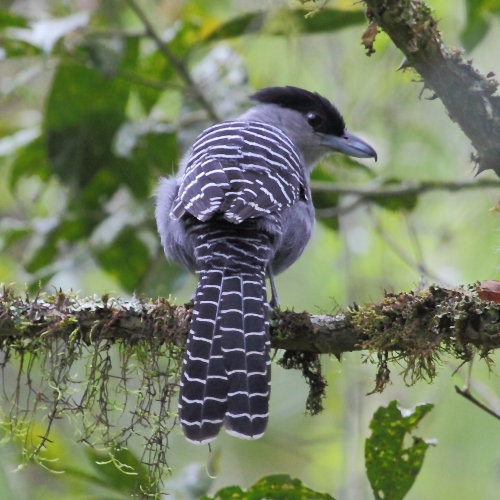
Rufous-backed Antwren
Epinecrophylla haematonota
Order: Passeriformes / Family: Thamnophilidae

Wikimedia Commons
About the Rufous-backed Antwren
The Rufous-backed Antwren (Epinecrophylla haematonota) is a small passerine bird that belongs to the family Thamnophilidae. It primarily inhabits the dense, humid understory of lowland Amazonian rainforests. This species is predominantly found in countries such as Brazil, Colombia, Ecuador, Peru, and Bolivia. The antwren plays a significant ecological role as an insectivore, contributing to the control of arthropod populations within its habitat. In the lush Amazonian environment, this bird thrives in an intricate ecosystem, where it forms part of a complex food web. The Rufous-backed Antwren is not just a resident of these forests but an active participant in maintaining their biodiversity. Its presence indicates a healthy, undisturbed forest, as it tends to avoid areas of significant human disturbance. Observing this bird provides insight into the health of the Amazonian ecosystem. Throughout the year, the Rufous-backed Antwren remains within the same geographic range, exhibiting little to no seasonal movement. This sedentary lifestyle is typical for many forest-dwelling birds in the tropics, where resources remain relatively stable year-round. The bird's breeding season aligns with the region's wet season, taking advantage of the abundance of food resources. During this time, their vocal activity increases as males establish territories and seek mates. The importance of the Rufous-backed Antwren extends beyond its ecological roles. It serves as a flagship species for conservation efforts in the Amazon, highlighting the need to protect these vast tracts of rainforest from deforestation and degradation. Its presence underscores the richness of avian diversity in one of the world's most crucial biodiversity hotspots. Conservationists and bird enthusiasts alike value the Rufous-backed Antwren not only for its beauty but also for the broader environmental implications of its habitat preservation.
The Rufous-backed Antwren belongs to the family Thamnophilidae, within the order Passeriformes. These birds typically live average lifespan is 4-5 years, with some reaching up to 7 years..
How to Identify a Rufous-backed Antwren
Identifying the Rufous-backed Antwren is facilitated by its unique plumage and size. Adult males exhibit a distinctive rufous-brown back and wings, with a contrasting grayish-white underside. This coloration makes them easily recognizable against the green foliage of their forest habitat. Females, while similar, often have a slightly duller appearance, lacking the vibrant rufous tones of the males. Juveniles resemble adults but tend to have a more subdued coloration as they mature. One of the key identification marks of the Rufous-backed Antwren is its relatively small size, measuring around 10 cm in length. Its short, rounded wings and long tail contribute to its compact silhouette, which is well-suited to maneuvering through dense undergrowth. Unlike some other antbirds, this species does not exhibit striking sexual dimorphism, making close observation crucial for gender differentiation. Comparison with similar species, such as the White-flanked Antwren, can lead to confusion. However, the Rufous-backed Antwren's distinct back coloration sets it apart. In flight, its rapid, fluttering wingbeats are characteristic of many antwrens, while its perching posture is typically horizontal, allowing it to blend seamlessly with its surroundings.
Having trouble telling birds apart? Upload a photo to our bird identification tool for an instant species match.
Rufous-backed Antwren Habitat and Range
Preferred Habitat
The Rufous-backed Antwren thrives in the humid, lowland rainforests of the Amazon Basin. Preferring dense understory, it is frequently found in areas with thick vegetation and ample leaf litter. This habitat type provides both abundant food sources and protection from predators. The species inhabits elevations ranging from sea level to about 500 meters. Unlike some other birds, the Rufous-backed Antwren shows little variation in habitat preference across seasons, remaining closely tied to its forest environment year-round. While it is primarily a forest species, it can occasionally be found in secondary growth areas, provided these maintain some degree of dense vegetation. The bird's absence from urban areas underscores its preference for undisturbed natural habitats.
Geographic Range
The Rufous-backed Antwren's range is primarily confined to the Amazon Basin, encompassing parts of Brazil, Colombia, Ecuador, Peru, and Bolivia. Within this extensive area, the bird occupies regions with intact lowland rainforest, avoiding open or heavily disturbed areas. Its distribution is largely continuous across its range, with population density varying according to habitat quality. While it is not migratory, the bird's range does not extend beyond the Amazonian lowlands, highlighting its specialization in this unique ecosystem. Areas such as the Amazon River basin and its tributaries provide ideal conditions for the species, supporting robust populations where suitable habitat persists. As deforestation poses a threat to its range, conservation efforts focus on preserving these critical rainforest habitats.
Want to know which birds visit your area? Browse our backyard birds by location guides for region-specific species lists.
What Does the Rufous-backed Antwren Eat?
Insectivorous by nature, the Rufous-backed Antwren primarily consumes small arthropods, including insects such as ants, beetles, and caterpillars. Its foraging technique involves gleaning insects from leaves and branches, often seen hopping and flitting through the understory in search of prey. The bird's diet remains consistent throughout the year, reflecting the stable availability of its food sources in the rainforest. Prey size typically ranges from small to medium, aligning with the bird's modest size. Feeding occurs throughout the day, with peaks in activity during the cooler morning and late afternoon hours. The Rufous-backed Antwren often forages in mixed-species flocks, benefiting from the increased vigilance and predator detection provided by these groups.
Rufous-backed Antwren Behavior and Social Structure
The Rufous-backed Antwren exhibits a complex social structure, often participating in mixed-species flocks that traverse the understory. These flocks enhance foraging efficiency and provide added security against predators. The species exhibits territorial behavior during the breeding season when males establish and defend territories through vocalizations and displays. Courtship involves the male performing subtle displays to attract a mate, including tail flicking and soft calls. The bird's daily activity pattern is diurnal, with peak activity occurring during early morning and late afternoon. At night, it roosts in dense vegetation, hidden from nocturnal predators. In response to threats, the Rufous-backed Antwren employs cryptic behavior, freezing or retreating into thick cover. Its reliance on dense foliage for protection and foraging underlines its adaptability to the rainforest environment.
Rufous-backed Antwren Nesting and Reproduction
Rufous-backed Antwrens construct cup-shaped nests, typically placed low in dense understory vegetation. They utilize materials such as plant fibers, leaves, and moss, intricately woven to form a secure structure. The nesting site selection favors areas with ample cover to shield from predators. Clutch size generally ranges from two to three eggs, with both parents sharing incubation duties over a period of approximately 14 to 16 days. Once hatched, the chicks remain in the nest for about 10 to 12 days before fledging. Both parents participate in feeding the young, ensuring a steady supply of insects. The species typically raises one brood per year, timed with the wet season to capitalize on food abundance.
Rufous-backed Antwren Sounds and Vocalizations
The Rufous-backed Antwren's primary song consists of a series of sharp, high-pitched notes delivered in rapid succession, often described as a trill. This song functions in both territorial defense and mate attraction. Call notes are shorter and more abrupt, serving as communication between individuals. Alarm calls, used in response to predators, are harsher and more urgent. During the early morning hours, the bird participates in a dawn chorus, contributing to the vibrant soundscape of the rainforest. Its vocalizations, though not as melodious as some songbirds, are distinctive and serve critical roles in its social and reproductive behavior.
Interesting Facts About the Rufous-backed Antwren
- 1The Rufous-backed Antwren is often found in mixed-species flocks with other antbirds, benefiting from cooperative foraging.
- 2Despite its small size, the Rufous-backed Antwren plays a crucial role in controlling insect populations in its habitat.
- 3The species' distinctive rufous coloration helps it blend into the leaf litter, providing camouflage from predators.
- 4Rufous-backed Antwrens are vocal birds, with males singing to defend territories and attract mates during the breeding season.
- 5The bird's reliance on intact forest habitats makes it an important indicator species for assessing rainforest health.
- 6Rufous-backed Antwrens are known for their agility, navigating the dense understory with ease in pursuit of prey.
- 7Their nests are well-camouflaged, often resembling the surrounding vegetation to avoid detection by predators.
Rufous-backed Antwren Conservation Status
The Rufous-backed Antwren is currently classified as a species of Least Concern by the IUCN. However, its population trend is decreasing due to ongoing habitat loss from deforestation and land conversion in the Amazon Basin. Primary threats include logging, agricultural expansion, and infrastructure development. Conservation efforts focus on habitat protection and sustainable land-use practices. Historically, the species has maintained stable populations in undisturbed areas, but continued deforestation poses significant long-term risks. Conservationists emphasize the importance of preserving large tracts of intact rainforest to ensure the survival of this and many other Amazonian species.