
Rufous-bellied Antwren
Isleria guttata
Order: Passeriformes / Family: Thamnophilidae

Wikimedia Commons
About the Rufous-bellied Antwren
The Rufous-bellied Antwren (Isleria guttata) plays a vital role in the ecosystems of South America's tropical forests. Found predominantly in the Amazon Basin, this small bird thrives in the understory of humid lowland rainforests, from eastern Colombia and Venezuela to northern Bolivia and the Brazilian Amazon. Its presence indicates a healthy forest ecosystem, as it relies on lush, insect-rich environments. During the wetter months, the Rufous-bellied Antwren engages in breeding activities, taking advantage of the increased availability of insects. As a member of the Thamnophilidae family, this species participates in the complex web of predator-prey interactions, acting as both predator and prey. Socially, the Rufous-bellied Antwren often joins mixed-species flocks, particularly outside of the breeding season, enhancing its foraging efficiency and protection against predators. The bird's behavior and ecological role are critical to maintaining the balance of its habitat, as it helps control insect populations and serves as a food source for larger predators. Its adaptability to different forest types, from varzea to terra firme, underscores its ecological significance. However, deforestation poses a significant threat, potentially disrupting its natural habitats and, consequently, the delicate balance of the ecosystems it supports. This tiny bird's survival is intricately linked to the health of the tropical forests, making it an important indicator species for conservationists and biologists studying environmental changes in the Amazon.
The Rufous-bellied Antwren belongs to the family Thamnophilidae, within the order Passeriformes. These birds typically live average 3 years with max recorded 5 years.
How to Identify a Rufous-bellied Antwren
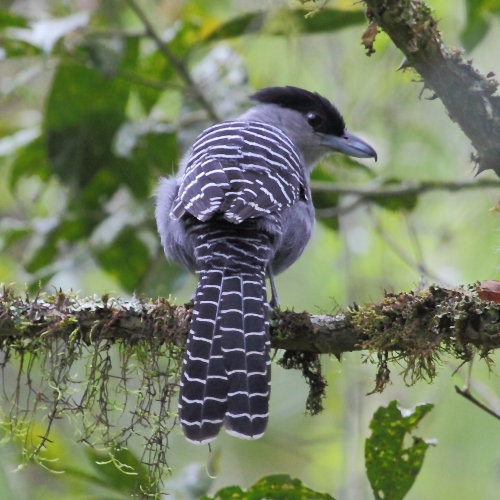
Identifying the Rufous-bellied Antwren involves observing several distinctive field marks. Adults possess a conspicuous rufous belly, contrasting sharply with their darker upperparts. Males typically display a more pronounced black cap, while females exhibit a subtler, grayish head. Juvenile birds often have duller plumage, lacking the vibrant belly coloration of adults. Despite these clear markings, the Rufous-bellied Antwren can be confused with similar species such as the Ferruginous Antbird, yet the latter lacks the Rufous-bellied’s distinctive underpart coloration. In flight, the Rufous-bellied Antwren presents a compact silhouette with rapid wingbeats. Its perching posture is often upright, aiding in the display of its striking underparts. Observing these key characteristics, along with its preferred habitat, can greatly assist in differentiating it from other antwrens in the field.
Having trouble telling birds apart? Upload a photo to our bird identification tool for an instant species match.
Rufous-bellied Antwren Habitat and Range
Preferred Habitat
The Rufous-bellied Antwren inhabits dense tropical forests, thriving in lowland rainforests with abundant foliage. It is commonly found in the understory and mid-canopy layers, favoring areas with thick vegetation. This species adapts to a variety of forest types, including varzea (seasonally flooded forests) and terra firme (non-flooded forests). It generally stays within elevations ranging from sea level to about 500 meters. Seasonal shifts in habitat are minimal as the Rufous-bellied Antwren remains in forested areas year-round, avoiding urban and heavily disturbed regions. Its preference for undisturbed habitats highlights the importance of conservation efforts focused on preserving intact forest ecosystems.
Geographic Range
The Rufous-bellied Antwren's range encompasses much of the Amazon Basin, spanning across several South American countries. It is found from eastern Colombia and Venezuela down through the Guianas, and into northern and central Brazil. The bird's range extends westward to eastern Ecuador and Peru, and southward into northern Bolivia. While it is largely sedentary, with no significant migratory patterns, it may exhibit local movements in response to seasonal variations in food availability. Population density hotspots are typically in areas with well-preserved forest cover, where the species can thrive without facing significant habitat disruption.
Want to know which birds visit your area? Browse our backyard birds by location guides for region-specific species lists.
What Does the Rufous-bellied Antwren Eat?
The Rufous-bellied Antwren primarily feeds on insects and other small arthropods, which it gleans from leaves and branches in the forest understory. During the breeding season, it intensifies its foraging efforts to meet the increased nutritional demands. Its diet may include ants, beetles, spiders, and caterpillars, varying with seasonal availability. The bird employs a methodical foraging technique, moving deliberately through foliage and often joining mixed-species flocks to exploit different foraging niches. This cooperative behavior increases its foraging success, allowing it to exploit areas rich in prey while benefiting from the vigilance of other birds.
Rufous-bellied Antwren Behavior and Social Structure
Rufous-bellied Antwrens exhibit complex social behaviors, often joining mixed-species flocks to enhance foraging efficiency and predator avoidance. They maintain territories during the breeding season, with pairs engaging in vocal duets to reinforce bonds and assert territorial claims. Courtship involves subtle displays and vocalizations, sometimes accompanied by wing flicking. The species is largely sedentary, showing little inclination for long-distance movement. Rufous-bellied Antwrens are diurnal, with peak activity occurring during the early morning and late afternoon when foraging conditions are optimal. When threatened by predators, they rely on dense vegetation for cover and emit sharp alarm calls to alert nearby birds.
Rufous-bellied Antwren Nesting and Reproduction
The Rufous-bellied Antwren builds small, cup-shaped nests, often constructed from twigs, leaves, and moss, camouflaged within dense foliage. Nests are typically placed low in the understory, well-concealed to protect from predators. Clutch size generally ranges from two to three eggs, with both parents sharing incubation duties for about 14-16 days. After hatching, the chicks fledge within approximately 12-14 days, during which both parents actively feed and protect them. The species typically raises one brood per year, although conditions such as food abundance may influence this. Parental investment is high, as both male and female contribute equally to nurturing and defending their young.
Rufous-bellied Antwren Sounds and Vocalizations
The primary song of the Rufous-bellied Antwren is a rapid series of high-pitched notes, often described as a 'ting-ting-ting' sequence. These vocalizations are used in territorial defense and mate attraction. Additionally, the bird emits sharp call notes, particularly during alarm situations, which serve to alert nearby conspecifics of potential threats. During the dawn chorus, the Rufous-bellied Antwren actively participates, its song blending with the myriad of other sounds in the tropical forest. Its calls are comparable to the sounds of a tinkling bell, clear yet subtle within the dense jungle acoustics.
Interesting Facts About the Rufous-bellied Antwren
- 1The Rufous-bellied Antwren is often found in mixed-species flocks, which can include up to 30 different bird species in a single flock.
- 2Despite its small size, the Rufous-bellied Antwren's territory can extend over several hectares, showcasing its need for extensive foraging grounds.
- 3This antwren's song has been likened to the tinkling of small bells, providing a unique soundscape in the dense Amazonian forests.
- 4The species' preference for dense underbrush makes it challenging to observe, adding excitement for birdwatchers attempting to spot it.
- 5Rufous-bellied Antwrens have been known to follow army ant swarms, capturing insects that attempt to escape the marauding ants.
Rufous-bellied Antwren Conservation Status
Currently, the Rufous-bellied Antwren holds a status of Least Concern on the IUCN Red List, suggesting a relatively stable population. However, deforestation in the Amazon Basin poses a significant threat to its habitat, potentially leading to future declines. Conservation efforts aim to preserve large tracts of intact forest to ensure viable populations remain. Historical population changes have been linked to habitat loss and fragmentation. Continued monitoring and habitat protection initiatives are essential to safeguard the future of this species and the ecosystems it supports.
Other Thamnophilidae Species



Birds Similar to the Rufous-bellied Antwren
These species are often confused with the Rufous-bellied Antwren due to similar appearance or overlapping range.
