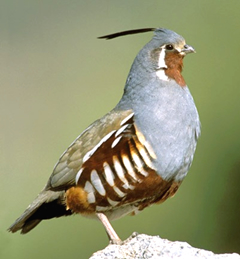
Rufous-breasted Wood-Quail
Odontophorus speciosus
Order: Galliformes / Family: Odontophoridae

Wikimedia Commons
About the Rufous-breasted Wood-Quail
The Rufous-breasted Wood-Quail, known scientifically as Odontophorus speciosus, is a captivating bird species belonging to the family Odontophoridae. This bird is renowned for its rich rufous breast, which sets it apart in the lush forest habitats it favors. Found primarily in the cloud forests and subtropical zones of the eastern Andes, the Rufous-breasted Wood-Quail inhabits regions spanning Colombia, Ecuador, and Peru. Its ecological significance is considerable, as it plays a vital role in the forest ecosystem by participating in seed dispersal and contributing to the control of insect populations.
Rufous-breasted Wood-Quails prefer dense undergrowth in humid montane forests, where their ground-dwelling habits help aerate the soil and promote seed germination. These forests, often shrouded in mist, provide an environment rich in biodiversity, supporting a myriad of plant and animal species. The Rufous-breasted Wood-Quail's presence within these habitats indicates a healthy and balanced ecosystem, as they require relatively undisturbed environments to thrive.
Seasonally, the Rufous-breasted Wood-Quail showcases fascinating behaviors, particularly during the breeding season when vocalizations increase. Their calls, resonating through the forest, play a crucial role in maintaining pair bonds and establishing territories. The quail's ecological role extends beyond the immediate ecosystem, as their presence helps indicate the health of the broader landscape. Conservation of their habitats is therefore essential, not only for the Rufous-breasted Wood-Quail but for the multitude of species that share their environment.
The Rufous-breasted Wood-Quail belongs to the family Odontophoridae, within the order Galliformes. These birds typically live average lifespan is 6-8 years, with some individuals reaching 11 years..
How to Identify a Rufous-breasted Wood-Quail
The Rufous-breasted Wood-Quail is a medium-sized bird, measuring approximately 25-28 cm in length. Its most striking feature is the deep rufous coloration of its breast, contrasting sharply with the black-and-white streaked head. The back and wings are predominantly olive-brown, providing excellent camouflage against the forest floor. Adult males and females appear similar, though males may exhibit slightly brighter plumage. Juveniles, on the other hand, often have duller and more mottled coloration, allowing them to blend seamlessly into their surroundings.
In terms of silhouette, the Rufous-breasted Wood-Quail is compact with a rounded body and short tail, typical of ground-dwelling galliforms. The posture is notably upright when the bird is alert, giving it a distinctive profile that helps differentiate it from similar species. While in flight, which is rare and typically brief, their wings produce a characteristic whirring sound due to their rapid beats. Confusion may occur with the Chestnut Wood-Quail, but the latter lacks the Rufous-breasted's distinctive chest coloration.
The Rufous-breasted Wood-Quail's perching habits are infrequent, as they prefer to remain on the forest floor, foraging quietly among the leaf litter. This behavior, combined with their cryptic plumage, can make them challenging to observe in their natural habitat. However, their vocalizations are a reliable means of detection, often leading birders to their well-concealed presence.
Having trouble telling birds apart? Upload a photo to our bird identification tool for an instant species match.
Rufous-breasted Wood-Quail Habitat and Range
Preferred Habitat
The preferred habitat of the Rufous-breasted Wood-Quail includes dense montane forests, particularly those with thick undergrowth and abundant leaf litter. This bird thrives at elevations ranging from 800 to 2500 meters above sea level, often in areas characterized by high humidity and frequent cloud cover. These conditions are typically found in the eastern slopes of the Andes, where these quails make their homes in countries like Colombia, Ecuador, and Peru.
Within these forests, the Rufous-breasted Wood-Quail rarely ventures into open spaces, instead favoring the protective cover of lush vegetation. Their preference for such environments means they are seldom found in urban or suburban areas, highlighting their reliance on undisturbed forest ecosystems. Seasonal shifts may occur, but these are usually limited to minor altitudinal movements in response to food availability or climatic changes rather than large-scale migrations.
The presence of the Rufous-breasted Wood-Quail within a forest indicates a richly structured habitat that supports a variety of other species, underscoring the importance of conserving such environments for biodiversity maintenance.
Geographic Range
The geographic range of the Rufous-breasted Wood-Quail extends across the eastern Andes, primarily within the countries of Colombia, Ecuador, and Peru. In Colombia, these birds are often found in the cloud forests of the Central and Eastern Andes. Meanwhile, in Ecuador, their range includes the subtropical and temperate zones of the eastern Andes, particularly in regions such as the Podocarpus National Park. In Peru, the Rufous-breasted Wood-Quail inhabits the dense montane forests along the eastern slopes of the Andes, from Cajamarca in the north to further south in the regions of Cusco and Puno.
The population of the Rufous-breasted Wood-Quail tends to be more concentrated in areas where forest cover remains relatively intact, highlighting the species' sensitivity to habitat fragmentation. Hotspots of population density are typically found in protected forest reserves and national parks, where human disturbance is minimal.
Although the Rufous-breasted Wood-Quail is not considered a migratory species, some populations may exhibit minor movements in response to seasonal variations in food supply or weather conditions. These movements are generally restricted to shifts in elevation rather than long-distance migrations, reflecting the bird's strong dependency on specific habitat types.
Want to know which birds visit your area? Browse our backyard birds by location guides for region-specific species lists.
What Does the Rufous-breasted Wood-Quail Eat?
The diet of the Rufous-breasted Wood-Quail is primarily composed of seeds, fruits, and small invertebrates, which they forage from the forest floor. Their feeding habits are highly adapted to their dense forest environment, where they use their robust bills to sift through leaf litter and soil in search of food. In addition to seeds and fruits, which provide essential carbohydrates and nutrients, these quails also consume insects and other small arthropods, adding protein to their diet.
Seasonal variations in diet are observed, with a higher emphasis on insect consumption during the breeding season when protein demands increase. During this time, the Rufous-breasted Wood-Quail may spend more hours foraging to meet the nutritional needs of growing chicks. The size of prey items typically ranges from small beetles and ants to larger caterpillars, which they efficiently capture using their keen eyesight and quick reflexes.
Foraging usually occurs at dawn and dusk, taking advantage of the cooler temperatures and lower predation risk. The Rufous-breasted Wood-Quail's ability to blend into the forest undergrowth allows it to forage in relative safety, avoiding detection by predators. Their quiet, methodical foraging technique is characteristic of many ground-dwelling birds and underscores their role in the ecosystem as both seed dispersers and insect controllers.
Rufous-breasted Wood-Quail Behavior and Social Structure
The Rufous-breasted Wood-Quail exhibits a fascinating array of behaviors that reflect its adaptation to life in dense forest environments. Socially, these birds are typically found in small family groups or coveys, usually consisting of 5 to 15 individuals. This social structure provides numerous benefits, including increased vigilance against predators and enhanced foraging efficiency.
Territorial behavior is pronounced during the breeding season, when pairs establish and defend territories using vocalizations and displays. These vocalizations, often heard echoing through the forest at dawn and dusk, serve to reinforce pair bonds and deter intruders. Courtship displays involve a series of calls and subtle movements, which help strengthen the bond between mates.
In response to predators, the Rufous-breasted Wood-Quail relies on its cryptic plumage and swift, low flight to escape danger. When threatened, individuals may also freeze in place, blending into the forest floor. Daily activity patterns are characterized by foraging during the cooler hours of the day, with periods of rest and preening interspersed throughout.
Flocking patterns change with the seasons, with coveys often breaking up into smaller units during the breeding season. This change allows pairs to focus on nesting responsibilities while still providing the benefits of group living. The Rufous-breasted Wood-Quail's behavior is a testament to its adaptation to the challenges of forest life, highlighting its role as a key component of its ecosystem.
Rufous-breasted Wood-Quail Nesting and Reproduction
The nesting habits of the Rufous-breasted Wood-Quail are closely tied to the forest floor, where they construct their nests in well-hidden locations. Nests are typically shallow depressions lined with leaves and grasses, providing a comfortable and camouflaged environment for eggs. These nests are often situated under dense vegetation or within thickets, offering protection from predators and the elements.
The typical clutch size ranges from 4 to 8 eggs, which are cream-colored and speckled with brown. Both parents share incubation duties, which last approximately 22 to 24 days. During this period, the adults take turns incubating the eggs and foraging for food, maintaining a constant presence at the nest to deter predators.
Upon hatching, the chicks are precocial, meaning they are relatively mature and mobile. This adaptation allows them to leave the nest shortly after hatching, following their parents in search of food. Both parents play a role in caring for the young, guiding them to foraging sites and offering protection.
The fledging period lasts about two to three weeks, after which the young quails become more independent, though they often remain with the family group for several months. The Rufous-breasted Wood-Quail typically raises one brood per year, with breeding timed to coincide with periods of abundant food availability. Nesting success is heavily influenced by habitat quality and the presence of predators, underscoring the importance of conservation efforts in protecting suitable nesting environments.
Rufous-breasted Wood-Quail Sounds and Vocalizations
The Rufous-breasted Wood-Quail is known for its distinctive vocalizations, which play a crucial role in communication and territorial defense. The primary song consists of a series of rhythmic, whistling notes, often described as a rising and falling "whu-whu-whu" that echoes through the forest. This song is typically delivered by both males and females, especially during the breeding season, to reinforce pair bonds and delineate territory boundaries.
Call notes are varied and can include soft clucks and chirps used for communication within the family group. Alarm calls are sharper and more urgent, serving to alert other members of the covey to potential threats. During the dawn chorus, the Rufous-breasted Wood-Quail's calls contribute to the symphony of sounds that mark the beginning of a new day in the forest.
Comparatively, their calls may remind listeners of other galliformes, such as the chachalacas, though the Rufous-breasted Wood-Quail's vocalizations are generally softer and more melodic. These sounds are an integral part of the quail's behavior, facilitating social interactions and enhancing their survival in the dense forest environment.
Interesting Facts About the Rufous-breasted Wood-Quail
- 1The Rufous-breasted Wood-Quail is rarely seen flying; instead, it prefers to run swiftly on the ground to escape predators.
- 2These quails are known for their communal roosting habits, often huddling together at night for warmth and protection.
- 3Rufous-breasted Wood-Quails have a unique dust-bathing behavior, which helps them maintain feather condition and deter parasites.
- 4Despite their secretive nature, Rufous-breasted Wood-Quails are vocal birds, particularly during the breeding season when their calls echo through the forest.
- 5Their cryptic plumage provides excellent camouflage, making them difficult to spot even for experienced birders.
- 6These quails play a role in seed dispersal, helping to maintain the diversity and health of their forest habitats.
- 7The Rufous-breasted Wood-Quail's diet shifts seasonally, with a greater focus on insects during the breeding season to meet the nutritional needs of their young.
Rufous-breasted Wood-Quail Conservation Status
The Rufous-breasted Wood-Quail is currently classified as Least Concern by the IUCN, but its populations are experiencing pressures from habitat loss and fragmentation. Deforestation for agriculture and logging poses significant threats, as these activities reduce the availability of suitable habitats. Despite this, the bird's population trend is considered stable, largely due to its presence in protected areas and national parks. Conservation efforts are focused on habitat preservation and restoration, ensuring that the montane forests these quails depend on remain intact. Programs aimed at sustainable land management and reforestation are critical, as they help maintain the ecological balance necessary for the Rufous-breasted Wood-Quail and other forest-dependent species. Historically, the Rufous-breasted Wood-Quail has maintained a relatively stable population due to its adaptability to varying forest conditions. However, ongoing monitoring is essential to detect any future changes in population dynamics and to implement timely conservation measures. The preservation of this species is intrinsically linked to the health of its forest habitat, making broader conservation initiatives vital for its continued survival.