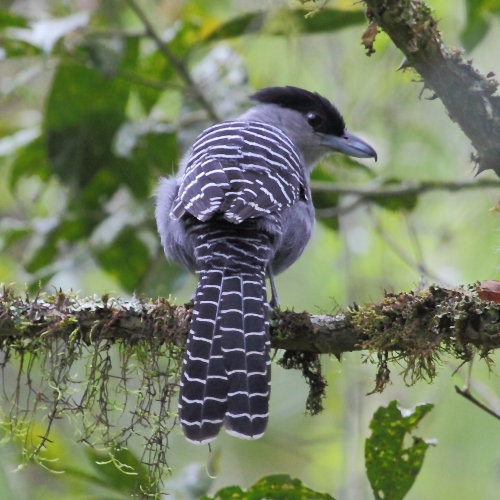
Rufous-faced Antbird
Schistocichla rufifacies
Order: Passeriformes / Family: Thamnophilidae

Wikimedia Commons
About the Rufous-faced Antbird
The Rufous-faced Antbird (Schistocichla rufifacies) is a distinctive member of the Thamnophilidae family, known for its vibrant rufous facial markings and preference for dense, humid forest undergrowth. This bird is primarily found in the lowland tropical forests of South America, particularly thriving in regions with rich, complex understory vegetation. Its presence is strongly associated with the Amazon Basin, spanning countries such as Brazil, Peru, and Colombia, where vast stretches of pristine forest provide the ideal habitat.
This antbird plays a significant ecological role as an insectivore, contributing to the control of insect populations in its habitat. By foraging through leaf litter and low vegetation, the Rufous-faced Antbird aids in maintaining the ecological balance within these biodiverse regions. It is often seen following army ant swarms, a behavior that not only facilitates efficient prey capture but also highlights its integration into the forest's intricate food web.
The species exhibits notable seasonal behaviors, particularly during the breeding season, which typically occurs at the onset of the rainy season. This timing ensures an abundance of food resources for feeding their young. During this period, the antbird becomes more territorial and vocal, using its distinctive calls to establish and defend its territory. Outside of breeding, the Rufous-faced Antbird remains relatively secretive, often heard rather than seen, as it navigates the dense foliage in search of sustenance.
Conservation-wise, the Rufous-faced Antbird's reliance on large, undisturbed forest tracts means it is vulnerable to habitat destruction. Deforestation for agriculture and logging poses significant threats to its habitat, highlighting the importance of preserving these ecosystems not only for the antbird but for the myriad species that share its environment. Efforts to protect the Amazonian forests are thus crucial in ensuring the continued survival of this and other forest-dependent species.
The Rufous-faced Antbird belongs to the family Thamnophilidae, within the order Passeriformes. These birds typically live average 5-7 years with a maximum recorded of 9 years..
How to Identify a Rufous-faced Antbird
The Rufous-faced Antbird is small, measuring approximately 13 cm in length. Adult plumage is characterized by its distinctive rufous face, which contrasts with its otherwise predominantly brown and gray body. The rufous coloration extends from the face to the throat, with a subtle transition into the body feathers. Males and females are similar in appearance, though females may display slightly duller shades of rufous. Juveniles resemble adults but often have a more muted color palette with less defined facial markings, aiding in their camouflage within the forest undergrowth.
In the field, the Rufous-faced Antbird is often confused with other members of the Thamnophilidae family, particularly those with overlapping ranges. However, its unique facial coloration serves as a reliable field mark to distinguish it from similar species. Its flight is typically short and direct, as it prefers to hop and flit through the understory rather than undertaking long flights.
When perching, the Rufous-faced Antbird adopts a characteristic posture, often leaning forward slightly with its tail held low. This posture, combined with its skulking behavior, makes it a challenge to spot, as it tends to remain close to the ground, navigating through dense vegetation. Observers are more likely to detect its presence by the sound of rustling leaves or its vocalizations than by visual confirmation.
Having trouble telling birds apart? Upload a photo to our bird identification tool for an instant species match.
Rufous-faced Antbird Habitat and Range
Preferred Habitat
The Rufous-faced Antbird predominantly inhabits lowland tropical forests, favoring areas with dense understory vegetation. It thrives in primary and well-developed secondary forests, where a complex structure of foliage provides both food resources and shelter. These habitats are typically found at elevations ranging from sea level to about 1000 meters, though the species is most commonly observed in the lower elevations of the Amazon Basin.
During the wet season, when breeding activity peaks, the Rufous-faced Antbird may shift slightly to areas with abundant food resources, particularly those influenced by the movements of army ant swarms. While it primarily resides in forested regions, it can also be found in forest edges and occasionally in well-preserved forest fragments within rural landscapes. The species does not generally adapt well to urban environments, as it requires the dense cover and particular microhabitats found in undisturbed forests.
The preservation of these habitats is crucial, as deforestation and habitat fragmentation pose significant threats to the Rufous-faced Antbird. Conservation efforts often focus on maintaining large contiguous tracts of forest to support the diverse needs of the species and other forest-dependent wildlife.
Geographic Range
The Rufous-faced Antbird is primarily found across the humid lowland forests of the Amazon Basin. Its breeding range encompasses regions in Brazil, particularly the western Amazon, as well as portions of eastern Peru and southern Colombia. This distribution overlaps with some of the most biodiverse areas on the planet, underscoring the species' reliance on these rich ecosystems.
Unlike many migratory birds, the Rufous-faced Antbird is largely sedentary, with no significant long-distance migrations. Instead, it exhibits localized movements, particularly in response to seasonal variations in food availability within its home range. These movements may lead it to different parts of the forest, especially during the breeding season and times of resource abundance.
Population density is generally higher in areas where the forest remains intact, with significant numbers recorded in protected areas such as national parks and reserves that offer undisturbed habitats. Despite its limited range, the species benefits from the conservation of these vital habitats within the Amazon Basin, where ongoing efforts aim to mitigate the impacts of deforestation and land conversion.
Want to know which birds visit your area? Browse our backyard birds by location guides for region-specific species lists.
What Does the Rufous-faced Antbird Eat?
The Rufous-faced Antbird primarily feeds on a diet of insects and arthropods, which it gleans from the forest floor and low vegetation. Its diet consists of ants, beetles, spiders, and other invertebrates, which it captures through a combination of meticulous searching and opportunistic feeding. This antbird is particularly known for its association with army ant swarms, a behavior that allows it to capitalize on the insects flushed out by the advancing ant columns.
During the rainy season, the abundance of prey increases, providing the Rufous-faced Antbird with ample food to support its breeding activities. In contrast, during drier periods, the bird may need to forage over larger areas or shift its diet slightly to include more readily available food sources.
The Rufous-faced Antbird forages by hopping through the underbrush, using its acute sense of sight and hearing to detect prey. It often follows mixed-species flocks, which can help increase its feeding efficiency by alerting it to the locations of food resources. This opportunistic feeding strategy enables it to exploit a variety of foraging opportunities within its tropical forest habitat.
Rufous-faced Antbird Behavior and Social Structure
The Rufous-faced Antbird exhibits a solitary and secretive nature. It is often seen alone or in pairs, particularly during the breeding season when it becomes more territorial. Territorial males engage in vocal displays to ward off rivals, using their distinctive calls to establish dominance within their chosen areas. This territoriality is not as pronounced outside the breeding season, when the bird may be found foraging in loose associations with other species.
Courtship displays are subtle, involving vocal exchanges and mutual preening between mates. The birds often remain close to each other while foraging, maintaining visual contact through their calls. Despite their generally solitary behavior, Rufous-faced Antbirds may participate in mixed-species flocks, particularly when following army ant swarms. This behavior provides safety in numbers and increases foraging success.
In response to predators, the Rufous-faced Antbird relies on its cryptic plumage and the dense forest cover for protection. It remains motionless and silent when threatened, blending seamlessly into its environment. Its daily activity largely revolves around foraging, with peak activity occurring during the cooler hours of the morning and late afternoon when insect prey is most active.
Rufous-faced Antbird Nesting and Reproduction
Rufous-faced Antbirds construct small, cup-shaped nests, typically located low in the understory, often less than a meter above the ground. These nests are intricately built using materials such as leaves, twigs, and rootlets, bound together with spider silk to provide structure and support. The choice of nesting site plays a critical role in camouflage, often selected in dense thickets or among vines to conceal the nest from predators.
The breeding season coincides with the onset of the rainy season, ensuring a plentiful supply of insects to feed the growing chicks. A typical clutch consists of two eggs, which are incubated by both parents over a period of approximately 14-16 days. During this time, the parents take turns foraging and incubating, ensuring that one adult is always present to protect the eggs.
Once hatched, the chicks remain in the nest for another two weeks, during which both parents actively feed them a diet rich in insects. Fledging occurs around 14-16 days post-hatching, and the young birds continue to be cared for by the parents even after leaving the nest. The Rufous-faced Antbird typically raises one brood per year, with the timing of breeding carefully aligned with environmental conditions to maximize reproductive success.
Rufous-faced Antbird Sounds and Vocalizations
The Rufous-faced Antbird's primary song is a series of sharp, metallic notes delivered in a steady rhythm, often described as 'chip-chip-chip.' This vocalization serves as both a territorial call and a method of communication between mates. The pitch is fairly high, and the quality of the sound is consistent, allowing it to carry well through dense forest vegetation.
In addition to its primary song, the Rufous-faced Antbird emits a variety of call notes used in different contexts. These include soft 'churr' sounds used during courtship or while maintaining contact with a mate, as well as more strident alarm calls when predators are nearby. During the dawn chorus, the antbird's calls blend with the symphony of other forest birds, contributing to the rich acoustic tapestry of the tropical forest.
The antbird's alarm calls are particularly important for alerting nearby birds to potential threats, and they often trigger a chain reaction of calls from other species when a predator is detected. This communal alarm system enhances the survival chances of all birds within the vicinity, showcasing the cooperative nature of these forest ecosystems.
Interesting Facts About the Rufous-faced Antbird
- 1The Rufous-faced Antbird is named for its distinctive rufous facial plumage, a key field mark for identification.
- 2This antbird species is known to follow army ant swarms, capturing insects that the ants flush out as they move.
- 3Despite its small size, the Rufous-faced Antbird's call can be heard over 100 meters away in dense forest.
- 4The species is a part of the Thamnophilidae family, which includes nearly 200 species of antbirds, emphasizing their diversity.
- 5Rufous-faced Antbirds construct their nests low to the ground, often less than one meter high, to avoid detection.
- 6They exhibit monogamous pair bonds, with both parents sharing responsibilities for rearing the young.
- 7The Rufous-faced Antbird's reliance on intact forest makes it an important indicator species for ecosystem health.
Rufous-faced Antbird Conservation Status
The Rufous-faced Antbird is currently classified as Least Concern by the IUCN, although its population is suspected to be declining due to ongoing habitat loss. The primary threat facing this species is deforestation, driven by agricultural expansion, logging, and infrastructure development in the Amazon Basin. These activities fragment the continuous tracts of forest necessary for the antbird's survival and disrupt the complex ecosystems upon which it depends. Despite these threats, significant conservation efforts are underway to protect the Amazon's biodiversity, including the establishment of protected areas and the promotion of sustainable land-use practices. Historical population data suggest that while the Rufous-faced Antbird has faced pressures from habitat loss, its population has remained relatively stable in areas where forest cover has been preserved. Continued monitoring and research are vital to understanding the full impact of environmental changes on the Rufous-faced Antbird and to developing effective conservation strategies. Collaborative efforts between governments, NGOs, and local communities are essential to safeguarding the future of this species and the rich biodiversity of its tropical forest home.