
Rufous-fronted Wood-Quail
Odontophorus erythrops
Order: Galliformes / Family: Odontophoridae

Wikimedia Commons
About the Rufous-fronted Wood-Quail
The Rufous-fronted Wood-Quail (Odontophorus erythrops) is a captivating bird species native to the dense tropical forests of western South America. These birds are known for their vibrant plumage and distinctive calls, which echo through the undergrowth of the forest. The Rufous-fronted Wood-Quail plays a pivotal role in the ecosystem as both a seed disperser and a prey species for larger predators. Found primarily in Colombia and Ecuador, this bird inhabits humid lowland and montane forests, where it contributes to the biodiversity by aiding in seed dispersal through its diet, which includes a variety of fruits and seeds. The Rufous-fronted Wood-Quail's preference for dense, primary forests makes it an important indicator species for forest health. During the breeding season, which typically occurs during the rainy months, these birds become more vocal and active. Their calls and movements through the forest floor increase, making them more visible to experienced birders. Outside the breeding season, the Rufous-fronted Wood-Quail may form small groups or coveys, which assist in mutual protection and foraging efficiency. Despite their elusive nature, these birds hold significant ecological importance, maintaining the balance of tropical forest ecosystems by participating in both seed dispersal and acting as a prey base for avian and mammalian predators.
The Rufous-fronted Wood-Quail belongs to the family Odontophoridae, within the order Galliformes. These birds typically live typically 5-7 years with a maximum recorded of 9 years..
How to Identify a Rufous-fronted Wood-Quail
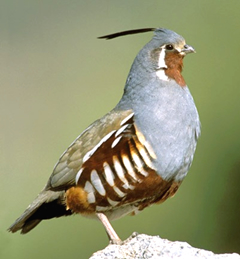
The Rufous-fronted Wood-Quail is a medium-sized bird with a robust build, measuring approximately 25-28 cm in length. Its most notable feature is the rich rufous coloring on its forehead and face, which contrasts with the darker brown and black plumage on the rest of the body. The bird's upperparts are mottled with black and brown, providing excellent camouflage against the forest floor. Its underparts display a more uniform brown hue, which sometimes includes subtle barring. Males and females appear similar, though males may exhibit slightly brighter plumage. Juveniles resemble adults but have a duller overall coloration, making them less conspicuous. The Rufous-fronted Wood-Quail can be confused with similar species, such as the Chestnut Wood-Quail, but its distinctive rufous facial markings and vocalizations set it apart. In flight, the bird presents a compact silhouette with rounded wings and a short tail. When perching or foraging, it often adopts a crouched posture, blending seamlessly into the leaf litter.
Having trouble telling birds apart? Upload a photo to our bird identification tool for an instant species match.
Rufous-fronted Wood-Quail Habitat and Range
Preferred Habitat
The Rufous-fronted Wood-Quail thrives in the humid tropical forests of western Colombia and Ecuador. These birds prefer dense, primary forests with thick undergrowth, which provide ample cover and foraging opportunities. They are typically found at elevations ranging from sea level to 1,500 meters, though they rarely venture into higher altitudes. Seasonal shifts in habitat are minimal, as these birds are non-migratory and remain within their preferred forested environments year-round. While primarily found in rural and remote areas, occasional sightings near forest edges suggest some adaptability to habitat fringes.
Geographic Range
The Rufous-fronted Wood-Quail's range is restricted to the western slopes of the Andes in Colombia and Ecuador. In Colombia, they are primarily found in the Chocó region, while in Ecuador, their presence is noted in the western lowlands and foothills. These birds are non-migratory, maintaining territories within their limited range throughout the year. Population density is highest in undisturbed primary forests, where their ecological role as seed dispersers and prey species is most pronounced. As human activities encroach upon their habitat, the Rufous-fronted Wood-Quail's range remains a critical focus for conservation.
Want to know which birds visit your area? Browse our backyard birds by location guides for region-specific species lists.
What Does the Rufous-fronted Wood-Quail Eat?
The diet of the Rufous-fronted Wood-Quail consists mainly of seeds, fruits, and small invertebrates. During the wet season, when fruits are abundant, these birds take advantage of the increased availability of fleshy fruits and berries. They forage primarily on the ground, using their strong legs to scratch and uncover food hidden beneath the leaf litter. Their foraging technique involves rapid pecking and scratching motions, which help them locate and consume small insects and other invertebrates. The Rufous-fronted Wood-Quail adjusts its diet seasonally, with a greater reliance on seeds and invertebrates during drier months when fruits are less plentiful. This adaptability in diet enables the bird to maintain its role as a vital seed disperser and insect controller within its habitat.
Rufous-fronted Wood-Quail Behavior and Social Structure
Rufous-fronted Wood-Quails are generally found in small family groups or coveys, which can consist of up to 12 individuals. These groups maintain well-defined territories, which they defend vocally and through displays involving raised crests and spread tails. Courtship involves complex displays, with males performing calls and rituals to attract females. Rufous-fronted Wood-Quails are largely terrestrial, spending much of their time foraging on the forest floor. They are diurnal, with peak activity during the cooler hours of the morning and late afternoon. When threatened, they often freeze to avoid detection or burst into a brief, noisy flight to escape predators. Their social structure facilitates cooperative foraging and alerts for potential threats, aiding their survival in dense forest environments.
Rufous-fronted Wood-Quail Nesting and Reproduction
Rufous-fronted Wood-Quails construct their nests on the ground, often situated in dense undergrowth to provide cover from predators. The nest itself is a simple scrape in the leaf litter lined with leaves and grass. Typical clutch size ranges from 4 to 6 eggs. Both parents participate in incubation, which lasts approximately 18-20 days. The young are precocial, leaving the nest shortly after hatching, though they remain under parental supervision for guidance and protection. Fledging occurs within two weeks, with the juveniles gaining independence relatively quickly. These birds generally raise one brood per year, though favorable conditions may lead to occasional second broods.
Rufous-fronted Wood-Quail Sounds and Vocalizations
The Rufous-fronted Wood-Quail's vocalizations are a defining feature, with the primary song consisting of a series of rhythmic whistles and trills. These calls have a melodic yet haunting quality, carrying well through dense forest habitats. Alarm calls are shorter, more abrupt notes designed to alert the covey to danger. During the dawn chorus, their calls become more frequent and complex, often overlapping with those of neighboring quail. The sound is reminiscent of distant musical notes, providing an auditory signal of their presence.
Interesting Facts About the Rufous-fronted Wood-Quail
- 1The Rufous-fronted Wood-Quail's calls can be heard up to 500 meters away, serving as a territorial signal.
- 2These birds have a communal dust-bathing behavior, which helps in feather maintenance and parasite control.
- 3Despite being ground-dwellers, Rufous-fronted Wood-Quails can burst into flight at speeds of up to 40 km/h when startled.
- 4The Rufous-fronted Wood-Quail's diet includes over 50 different plant species, showcasing its role in seed dispersal.
- 5During courtship, male Rufous-fronted Wood-Quails perform a unique dance, involving bobbing and wing-flapping.
Rufous-fronted Wood-Quail Conservation Status
The Rufous-fronted Wood-Quail is currently listed as Near Threatened on the IUCN Red List. The primary threat to its population is habitat loss due to deforestation and agricultural expansion in western Colombia and Ecuador. While some populations are stable in protected areas, others face significant declines due to ongoing habitat degradation. Conservation efforts focus on habitat protection and restoration, as well as raising awareness of the species' ecological importance. Historical population changes indicate a reduction in range and numbers, highlighting the need for continued conservation measures.
Other Odontophoridae Species


Birds Similar to the Rufous-fronted Wood-Quail
These species are often confused with the Rufous-fronted Wood-Quail due to similar appearance or overlapping range.
