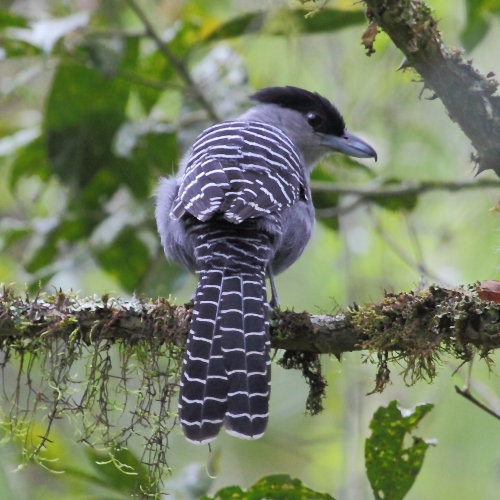
Rufous-tailed Antwren
Epinecrophylla erythrura
Order: Passeriformes / Family: Thamnophilidae

Wikimedia Commons
About the Rufous-tailed Antwren
The Rufous-tailed Antwren (Epinecrophylla erythrura) is a small, charismatic songbird in the Thamnophilidae family, known for its specialized habitat preferences and unique ecological role in the tropical forests of South America. This bird is primarily found in the Amazon Basin, including regions of Brazil, Peru, and Bolivia, where it thrives in the dense understory of humid lowland forests and occasionally in subtropical or tropical swamplands. Adapting to its environment, the Rufous-tailed Antwren plays a crucial role in insect population control, as it feeds predominantly on small insects and arthropods. Its presence indicates a healthy forest ecosystem, as it relies on rich biodiversity for sustenance. During the breeding season, which generally occurs in the wet months from November to March, these birds become more vocal and conspicuous as they establish territories and engage in courtship behaviors. The Rufous-tailed Antwren contributes significantly to the ecological balance by participating in complex interspecies interactions, including mixed-species flocks where it may join other antbirds and insectivores to forage more efficiently. This social behavior highlights the bird's adaptability and its role in facilitating diverse avian communities. The bird's seasonal behaviors are closely tied to the availability of food resources, and its movements within the forest can vary as it seeks out optimal feeding and nesting sites. Understanding the ecology of the Rufous-tailed Antwren provides insights into the intricate dynamics of tropical ecosystems and underscores the importance of conserving these vital habitats.
The Rufous-tailed Antwren belongs to the family Thamnophilidae, within the order Passeriformes. These birds typically live average 4-6 years, with some individuals reaching up to 8 years..
How to Identify a Rufous-tailed Antwren
The Rufous-tailed Antwren is a small bird, measuring about 10 centimeters in length. Its most distinguishing feature is its rufous tail, which contrasts with its otherwise muted plumage. The bird exhibits a predominantly gray-brown coloration on its upperparts, making it well-suited for blending into the forest understory. Males and females are similar in appearance, although females may exhibit slightly duller coloring. Juveniles resemble adults but may have less pronounced rufous on their tails. In flight, this antwren displays a rapid, darting motion that is characteristic of many small forest-dwelling birds. Its perching posture is typically horizontal, often seen flicking its tail energetically as it forages. Similar species, such as the Gray Antwren, can be differentiated by their lack of rufous on the tail and their more uniform gray plumage. Observers should also note its unique vocalizations, which can aid in identification when visual confirmation is challenging.
Having trouble telling birds apart? Upload a photo to our bird identification tool for an instant species match.
Rufous-tailed Antwren Habitat and Range
Preferred Habitat
The Rufous-tailed Antwren primarily inhabits the dense, humid understory of lowland tropical forests in the Amazon Basin. It shows a preference for areas with thick vegetation near streams and swamps, which provide abundant insects. Typically found at elevations below 600 meters, this bird is almost exclusively associated with forest interiors and rarely ventures into open areas or urban environments. Seasonal habitat shifts are minimal, as the bird remains within its forested range year-round, capitalizing on the consistent availability of food resources. The preservation of its natural habitat is crucial, as deforestation and habitat fragmentation pose significant threats to its continued survival.
Geographic Range
The Rufous-tailed Antwren's range encompasses the vast Amazon Basin, with its presence confirmed in countries such as Brazil, Peru, and Bolivia. Its distribution is largely confined to the tropical rainforests, where it resides year-round. Unlike some migratory species, the Rufous-tailed Antwren does not undertake long-distance migrations, instead relying on the rich, diverse environment of the Amazon to meet its dietary and nesting needs. Population density is notably higher in pristine forest areas where human disturbance is minimal. While specific regional hotspots are challenging to identify due to the bird's elusive nature, it remains a fairly common resident within its range, provided that suitable habitat conditions persist.
Want to know which birds visit your area? Browse our backyard birds by location guides for region-specific species lists.
What Does the Rufous-tailed Antwren Eat?
The Rufous-tailed Antwren primarily feeds on small insects and arthropods, which it skillfully extracts from the dense leaf litter and vegetation of the forest floor. Its diet includes ants, beetles, spiders, and caterpillars, which it hunts using a combination of gleaning and probing techniques. Seasonal variations in its diet are minimal, as its habitat supports a year-round abundance of prey. The bird forages throughout the day, often as part of a mixed-species flock, which enhances its foraging efficiency and provides safety in numbers against potential predators. Its small size allows it to access narrow crevices and foliage layers, giving it an advantage in locating hidden prey items. This diet plays a vital role in regulating insect populations within its ecosystem.
Rufous-tailed Antwren Behavior and Social Structure
The Rufous-tailed Antwren is a socially complex species, often found in pairs or small family groups. It exhibits strong territorial behavior during the breeding season, vigorously defending its space from intruders. Courtship involves a series of displays, including vocalizations and tail flicking, designed to attract a mate and reinforce pair bonds. Outside the breeding season, the bird is more cooperative, frequently joining mixed-species foraging flocks. This behavior not only increases foraging success but also helps in deterring predators. Daily activity peaks during the cooler morning and late afternoon hours when insect activity is high. In response to predators, the antwren utilizes rapid, erratic flight patterns and seeks cover in dense vegetation. It communicates through a series of sharp calls, coordinating movements within flocks and deterring potential threats.
Rufous-tailed Antwren Nesting and Reproduction
The Rufous-tailed Antwren constructs its nest in the dense understory, often in a shrub or low tree fork. The nest is cup-shaped, woven from fine grasses, plant fibers, and spider silk, providing a secure and camouflaged environment for the eggs. Typically, the female lays a clutch of two to three eggs, which she incubates for about 14 to 16 days. Both parents participate in feeding the chicks, which fledge approximately 10 to 12 days post-hatching. The parental roles are well-defined, with the male frequently provisioning food while the female remains with the nestlings. This species often raises two broods per year, although reproductive success can vary with environmental conditions. Nest predation by snakes and small mammals poses a significant threat, influencing nesting success rates.
Rufous-tailed Antwren Sounds and Vocalizations
The primary song of the Rufous-tailed Antwren is a rapid series of high-pitched, clear notes that rise and fall in pitch, creating a melodious and distinctive sound. These vocalizations serve multiple purposes, such as territory defense and mate attraction. In addition to its song, the bird emits sharp call notes used for communication within flocks and as alarm signals to warn of predators. During the dawn chorus, the Rufous-tailed Antwren is particularly vocal, contributing to the vibrant soundscape of the forest. Its calls are reminiscent of other antbirds but can be distinguished by their unique rhythm and tonal quality.
Interesting Facts About the Rufous-tailed Antwren
- 1The Rufous-tailed Antwren is often mistaken for the Pygmy Antwren due to its similar size and habitat preferences.
- 2Unlike many birds, the Rufous-tailed Antwren does not migrate, staying in the same area year-round.
- 3This species is part of a diverse family that includes over 200 species of antbirds, each with unique foraging strategies.
- 4The Rufous-tailed Antwren's diet is so specialized that it primarily consists of ants and small insects.
- 5The bird's rapid tail flicking is thought to startle prey, making it easier to catch.
- 6Despite its small size, the Rufous-tailed Antwren has a surprisingly loud voice that carries well through dense forest.
- 7Its presence in mixed-species flocks underscores its role as a cooperative participant in the ecosystem.
Rufous-tailed Antwren Conservation Status
Currently, the Rufous-tailed Antwren is classified as Least Concern by the IUCN, although its population is suspected to be decreasing due to habitat loss. Deforestation, driven by agricultural expansion and logging, poses the most significant threat to its survival. Conservation efforts focus on preserving large tracts of undisturbed forest to ensure the continued existence of its habitat. Additionally, protected areas within its range, such as national parks and reserves, play a critical role in safeguarding populations. Historical population data are sparse, but the ongoing habitat destruction highlights the need for continued monitoring and conservation action.