
Rufous-tailed Palm-Thrush
Cichladusa ruficauda
Order: Passeriformes / Family: Muscicapidae
Wikimedia Commons
About the Rufous-tailed Palm-Thrush
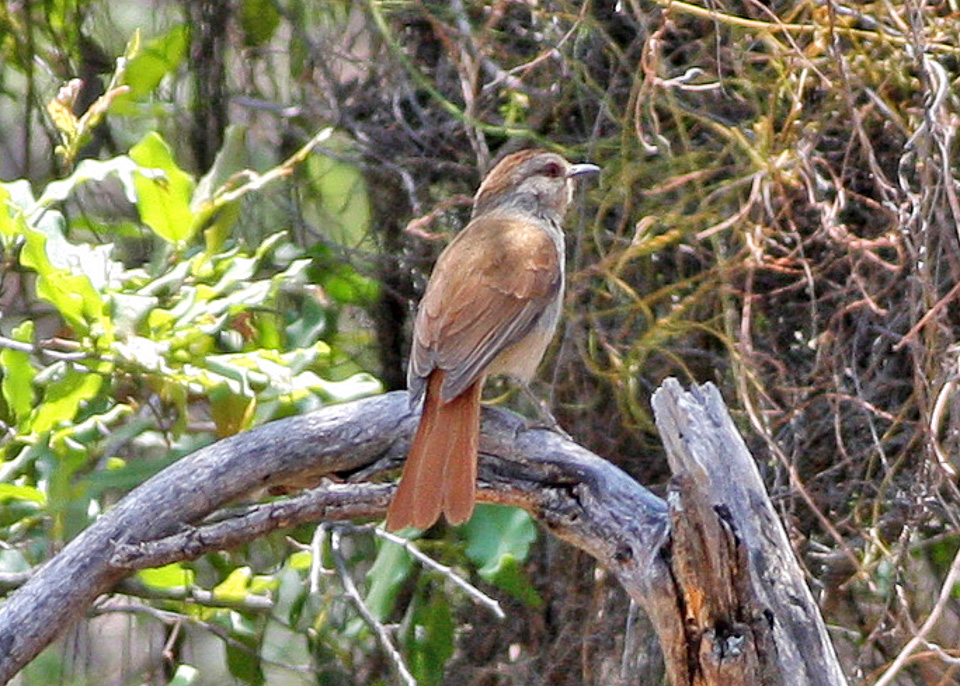
The Rufous-tailed Palm-Thrush (Cichladusa ruficauda) is a songbird of notable charm, inhabiting the subtropical and tropical regions of Africa. Its range spans countries such as Angola, Namibia, and Zambia, where it thrives in palm-rich environments. This bird belongs to the Muscicapidae family, which is known for its diverse array of species that exhibit complex vocalizations and adaptable behaviors. The Rufous-tailed Palm-Thrush plays a critical role in the ecosystem by aiding in insect population control and contributing to the dispersal of seeds due to its varied diet. In Angola, the bird is often found flitting through the branches of Borassus and Hyphaene palm trees, where its distinctive rufous tail and melodious song make it a sought-after sight for birdwatchers. Throughout the year, the Rufous-tailed Palm-Thrush exhibits seasonal behaviors that align with its reproductive and feeding needs. During the breeding season, which takes place primarily in the wetter months, this species is more vocal and territorial. Its song serves not only as a mating call but also as a deterrent to potential competitors. As the dry season approaches, the Rufous-tailed Palm-Thrush may alter its feeding patterns, taking advantage of the seasonal availability of fruits and insects. Despite being a tropical bird, it does not migrate extensively, often remaining within its established range year-round. Its adaptability to various habitats, including urban areas and savannas, underscores its resilience and ecological importance. The Rufous-tailed Palm-Thrush’s presence in both natural and human-altered landscapes highlights its role as a bridge between the wild and human worlds, fostering biodiversity in areas where palm trees are prevalent. As urban expansion continues, the bird's adaptability will be crucial in maintaining its population and the ecological balance of its habitats.
The Rufous-tailed Palm-Thrush belongs to the family Muscicapidae, within the order Passeriformes. These birds typically live 5 years with a maximum recorded of 8 years.
How to Identify a Rufous-tailed Palm-Thrush
The Rufous-tailed Palm-Thrush exhibits a striking appearance with its rufous tail serving as its most distinguishing feature. Adult plumage is characterized by a grayish-brown upper body that contrasts with its vivid russet tail and pale underparts. The eyes are typically dark, accentuating the bird's lively expression. In terms of sexual dimorphism, males and females appear quite similar, making field identification based on plumage alone challenging. Juveniles resemble adults but tend to have slightly duller colors and less defined patterns. In flight, the Rufous-tailed Palm-Thrush displays a distinctive silhouette, with its long tail fanned out and prominent. This feature is particularly noticeable when the bird flits between palm fronds or makes short, rapid flights. When perched, it often holds its tail slightly raised and flicks it frequently, a behavior that further aids in identification. Although it may be confused with other thrushes, the combination of its distinctive tail and specific habitat preferences helps distinguish it from similar species.
Having trouble telling birds apart? Upload a photo to our bird identification tool for an instant species match.
Rufous-tailed Palm-Thrush Habitat and Range
Preferred Habitat
The Rufous-tailed Palm-Thrush thrives in a variety of habitats, predominantly those rich in palms. It is most frequently observed in palm savannas, gallery forests, and along riverine woodlands. These environments, found in regions such as southern Angola and northern Namibia, provide the necessary cover and resources for the species. This bird tends to favor elevations from sea level up to about 1,500 meters, where it can exploit both the arboreal and ground layers for feeding and nesting. Interestingly, the Rufous-tailed Palm-Thrush has adapted to urban areas as well, particularly in towns that incorporate palm trees into landscaping. While it does not exhibit significant seasonal habitat shifts, its presence in both rural and urban settings highlights its adaptability. In urban environments, it often forages in gardens and parks, taking advantage of the modified landscape, which mimics elements of its natural habitat.
Geographic Range
The Rufous-tailed Palm-Thrush is primarily found in the southwestern regions of Africa. Its breeding range encompasses Angola, Namibia, and parts of Zambia, where it is a resident species rather than migratory. Within these countries, the bird is more prevalent in areas where palm trees are abundant, such as the Okavango River region and the Caprivi Strip. While it does not undertake long-distance migrations, the Rufous-tailed Palm-Thrush may make local movements in response to food availability and breeding conditions. Population density tends to be higher in locations where palms are a dominant feature of the landscape, providing both nesting sites and food resources. Despite being localized, the bird is not considered rare, and its populations are stable across its range. However, the distribution is patchy, aligning closely with the distribution of palm-rich habitats.
Want to know which birds visit your area? Browse our backyard birds by location guides for region-specific species lists.
What Does the Rufous-tailed Palm-Thrush Eat?
The diet of the Rufous-tailed Palm-Thrush is diverse, primarily consisting of insects and other small invertebrates. Beetles, ants, and caterpillars form a substantial part of its diet, especially during the breeding season when protein demands are high. Additionally, the bird consumes fruits and seeds, supplementing its diet with these plant materials when they are seasonally abundant. Foraging typically occurs both on the ground and among the branches of trees, where the Rufous-tailed Palm-Thrush uses its keen eyesight to detect prey. The bird's foraging technique is dynamic, involving short, purposeful hops and flights as it searches for food. During the early morning and late afternoon, feeding activity peaks, coinciding with cooler temperatures and increased insect activity. The Rufous-tailed Palm-Thrush's dietary flexibility allows it to adapt to varying environmental conditions and food availability, a factor crucial to its survival in both natural and modified landscapes.
Rufous-tailed Palm-Thrush Behavior and Social Structure
The Rufous-tailed Palm-Thrush exhibits a range of behaviors that reflect its adaptability and social nature. It is generally a solitary or paired bird outside of the breeding season, but during breeding, it becomes more territorial. Males sing vigorously from prominent perches to establish and defend their territory, using their melodious songs to attract mates and ward off rivals. Courtship displays are subtle, often involving mutual preening and synchronized movements between pairs. The Rufous-tailed Palm-Thrush's response to predators is cautious; it relies on its cryptic plumage to blend into its surroundings and may emit sharp alarm calls to alert nearby birds. Daily activity patterns show that it is most active during the morning and late afternoon, with a period of reduced activity during the midday heat. In terms of social interaction, while primarily solitary, the Rufous-tailed Palm-Thrush may join mixed-species foraging flocks, especially when food is abundant.
Rufous-tailed Palm-Thrush Nesting and Reproduction
Nesting for the Rufous-tailed Palm-Thrush typically occurs in the dense foliage of palm trees, where it constructs a cup-shaped nest using grass, leaves, and feathers. These nests are well-hidden among the fronds, providing protection from predators. The female usually lays a clutch of two to three eggs, which are incubated for about 12 to 14 days. Both parents partake in feeding the young, showcasing a cooperative approach to rearing offspring. After hatching, the chicks fledge within 14 to 16 days, although they remain dependent on the parents for some time after leaving the nest. The species may have one to two broods per year, depending on environmental conditions and food availability. Nest predation can affect success rates, with snakes and larger birds posing significant threats.
Rufous-tailed Palm-Thrush Sounds and Vocalizations
The Rufous-tailed Palm-Thrush is renowned for its rich and varied song. The primary song comprises a series of melodious whistles and trills that vary in pitch and tempo, often delivered from a conspicuous perch. These vocalizations serve multiple purposes, from attracting mates to delineating territory. In addition to the song, the bird produces a variety of call notes, including sharp 'chik' sounds used as contact calls between mates. Alarm calls are more abrupt and harsh, intended to alert others of danger. During the dawn chorus, the Rufous-tailed Palm-Thrush is particularly vocal, contributing to the cacophony of sound that marks the early morning hours in its habitat. Its song can be compared to the fluting notes of a thrush, with a unique complexity and rhythm.
Interesting Facts About the Rufous-tailed Palm-Thrush
- 1The Rufous-tailed Palm-Thrush often flicks its tail repeatedly, a behavior thought to be a form of communication.
- 2Despite being a songbird, the Rufous-tailed Palm-Thrush's diet includes a surprising amount of fruit, especially during dry seasons.
- 3This species is known for its adaptability, often found in both rural palm savannas and urban gardens.
- 4The Rufous-tailed Palm-Thrush has a uniquely complex song that can vary significantly between individuals.
- 5Breeding pairs of Rufous-tailed Palm-Thrushes often engage in mutual preening, strengthening pair bonds.
- 6Rufous-tailed Palm-Thrushes are non-migratory, maintaining territories year-round in their subtropical range.
- 7Its nesting preference for palm trees links the Rufous-tailed Palm-Thrush closely to its habitat's health and availability.
Rufous-tailed Palm-Thrush Conservation Status
The Rufous-tailed Palm-Thrush is currently listed as Least Concern by the IUCN, with stable population trends across its range. Its adaptability to various habitats, including urban areas, has contributed to its resilience. However, habitat destruction, specifically the loss of palm-rich environments, poses a potential threat. Conservation efforts focus on preserving these habitats and promoting sustainable land use practices. Historical records indicate that the population has remained relatively stable, but ongoing monitoring is necessary to ensure that environmental changes do not negatively impact its numbers. The Rufous-tailed Palm-Thrush's ability to thrive in human-altered landscapes offers hope for its continued survival amid growing urbanization.
Other Muscicapidae Species


Birds Similar to the Rufous-tailed Palm-Thrush
These species are often confused with the Rufous-tailed Palm-Thrush due to similar appearance or overlapping range.

