Rufous-winged Antwren
Herpsilochmus rufimarginatus
Order: Passeriformes / Family: Thamnophilidae

Wikimedia Commons
About the Rufous-winged Antwren
The Rufous-winged Antwren (Herpsilochmus rufimarginatus) is a small passerine bird belonging to the family Thamnophilidae, native to the Neotropical regions of South America. This species inhabits a range of forested environments, from lowland rainforests to semi-deciduous forests, primarily in Brazil, Paraguay, and Argentina. The bird is well adapted to life in the dense understory, where its discreet plumage allows it to blend seamlessly with its surroundings.
Ecologically, the Rufous-winged Antwren plays a significant role as an insect predator, contributing to the control of arthropod populations within its habitat. This antwren is not just a predator but also a part of the complex food web, as it falls prey to larger birds and animals. Its presence in various forest types highlights its adaptability, although it shows a preference for humid and semi-humid environments.
Seasonally, the Rufous-winged Antwren does not migrate extensively but may exhibit some local movement in response to food availability or habitat changes. During the breeding season, males are particularly vocal and active, engaging in territorial displays to attract mates and ward off competitors. These behaviors emphasize the antwren's vital role in maintaining the ecological balance within its native forests.
The Rufous-winged Antwren belongs to the family Thamnophilidae, within the order Passeriformes. These birds typically live average 5 years with a max recorded of 7 years..
How to Identify a Rufous-winged Antwren
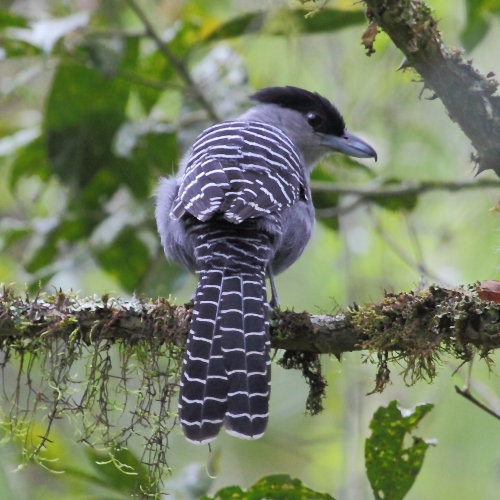
The Rufous-winged Antwren is a small bird, measuring approximately 12 cm in length and weighing around 10-12 grams. Adult males and females are similar in size, but males typically display more vibrant plumage. The most distinctive field mark is the rufous-colored wing panel that contrasts with the otherwise grayish-brown body. The crown is dark with a slight crest, and the underparts are a lighter gray, which may appear white in certain lights.
Juvenile Rufous-winged Antwrens resemble adults but generally have duller plumage, with less pronounced rufous in the wings. This makes them somewhat challenging to identify when not in the company of adults. Males and females can be difficult to differentiate visually, but males often exhibit slightly brighter rufous tones in the wing bars.
The flight of the Rufous-winged Antwren is characterized by short, rapid bursts as it flits through the understory. Its perching posture is typically upright, often seen clinging to vertical branches or vines, which aids in its identification when foraging in its preferred habitat.
Having trouble telling birds apart? Upload a photo to our bird identification tool for an instant species match.
Rufous-winged Antwren Habitat and Range
Preferred Habitat
The Rufous-winged Antwren thrives in a variety of forest habitats, including primary and secondary forests, edge habitats, and even some well-developed plantations where native vegetation is preserved. It is most commonly found in the lowland rainforests of the Amazon Basin and the Atlantic Forest, but also inhabits the Cerrado where forest patches occur.
This species typically resides at elevations up to 1,200 meters, although it is more frequently observed in lowland regions below 800 meters. The Rufous-winged Antwren's habitat preference includes areas with dense understory foliage, where it can forage for insects and other arthropods.
While primarily a forest dweller, the antwren can occasionally be found in rural gardens or urban parks, provided these areas offer sufficient cover and food resources. There are no significant seasonal shifts in habitat preference, though localized movements may occur as the bird seeks optimal foraging conditions.
Geographic Range
The Rufous-winged Antwren's range extends across several countries in South America, with a core population concentrated in Brazil. Its distribution covers the Amazon Basin, stretching into the Atlantic Forest region in southeastern Brazil, and extends into Paraguay and northeastern Argentina.
Within these areas, the bird is predominantly a resident species, with individuals maintaining territories throughout the year. There is minimal evidence of long-distance migration, though some altitudinal movements may occur in response to environmental conditions or food availability.
Population density is highest in well-preserved forested regions, particularly along riverbanks and areas with rich insect life. Although the bird is not considered rare, its presence is closely tied to the health of its forest habitats, making conservation of these areas essential for its continued survival.
Want to know which birds visit your area? Browse our backyard birds by location guides for region-specific species lists.
What Does the Rufous-winged Antwren Eat?
The Rufous-winged Antwren primarily feeds on insects and other small arthropods, making it an important insectivore within its ecosystem. Its diet includes ants, beetles, spiders, and caterpillars, which it gleans from foliage and branches within the dense understory.
Foraging techniques involve active searching, as the antwren hops and flits through vegetation, often hanging upside down to reach prey on the underside of leaves. This behavior not only demonstrates its agility but also allows it to exploit food resources less accessible to other birds.
Seasonal variations in diet are not well-documented, but it is likely that the antwren adjusts its feeding habits based on the abundance of particular prey types, especially during breeding seasons when protein requirements are higher. The bird typically forages during daylight hours, with activity peaking in the early morning and late afternoon when insect activity is also at its highest.
Rufous-winged Antwren Behavior and Social Structure
The Rufous-winged Antwren exhibits a predominantly solitary or pair-based social structure, although small family groups may form during the breeding season. Pairs often maintain and defend territories year-round, using vocalizations and physical displays to ward off intruders.
Courtship involves a variety of displays, with males showcasing their rufous wing bars by flicking their wings and engaging in aerial maneuvers to impress potential mates. These displays underscore the importance of visual signals in the antwren's reproductive behavior.
Flocking is rare, but during non-breeding periods, the antwren may join mixed-species flocks, benefiting from the increased foraging efficiency and protection from predators. When faced with threats, the Rufous-winged Antwren relies on its cryptic plumage and rapid movements to escape detection, often retreating into dense cover.
This antwren is most active during daylight, with peak activity occurring in the cooler hours of the morning and late afternoon. Its daily routine is centered around foraging and territory maintenance, with periods of rest during the hottest part of the day.
Rufous-winged Antwren Nesting and Reproduction
The Rufous-winged Antwren constructs a small, cup-shaped nest using fine twigs, leaves, and other plant fibers. These nests are typically located in the understory, often suspended from the fork of a slender branch, at heights ranging from 1 to 3 meters above the ground.
The typical clutch consists of two eggs, which are incubated by both parents over a period of approximately 14 to 16 days. The eggs are pale with speckled markings, providing camouflage against predators.
Once hatched, the chicks are altricial, requiring significant parental care. Both parents participate in feeding and guarding the young, which fledge about 10 to 12 days post-hatching. Despite the demands of raising a brood, the Rufous-winged Antwren often produces two broods per year, capitalizing on the favorable conditions of its tropical environment.
Parental roles are shared, with both male and female involved in incubation and feeding, highlighting the cooperative nature of the species' reproductive strategy.
Rufous-winged Antwren Sounds and Vocalizations
The Rufous-winged Antwren's primary song consists of a series of sharp, clear notes delivered in rapid succession. The rhythm is steady, resembling a quick 'chip-chip-chip' sequence that increases in tempo towards the end. This song serves as both a territorial call and a mating display.
Call notes are softer and include a variety of chirps and trills used in communication between mates and signaling alarm. When disturbed, the antwren emits a high-pitched, staccato alarm call to warn of potential danger.
During the dawn chorus, the Rufous-winged Antwren's vocalizations can be heard prominently, adding to the symphony of forest sounds. Its calls are more melodious and less harsh compared to some sympatric antbird species, making it a distinctive voice within its habitat.
Interesting Facts About the Rufous-winged Antwren
- 1The Rufous-winged Antwren is known for its rapid, acrobatic foraging movements, which are essential for catching elusive prey.
- 2Despite its name, the Rufous-winged Antwren's rufous coloration is primarily limited to its wing bars, providing a splash of color against its muted body plumage.
- 3Unlike many birds, the Rufous-winged Antwren often participates in mixed-species flocks, enhancing its foraging success and safety.
- 4This species is a resident of some of the world's most biodiverse rainforests, including the Amazon and Atlantic Forests, highlighting its ecological significance.
- 5The Rufous-winged Antwren's call is a distinctive part of the dawn chorus, aiding birders in locating this otherwise elusive species.
- 6Habitat fragmentation remains a concern for the Rufous-winged Antwren, emphasizing the need for continuous conservation efforts.
- 7The bird's cryptic coloring is an effective adaptation for avoiding predators by blending into the dense forest understory.
Rufous-winged Antwren Conservation Status
The Rufous-winged Antwren is currently classified as Least Concern by the IUCN, reflecting its relatively stable population across its range. However, habitat destruction due to deforestation poses a significant threat to its long-term survival, particularly in the Atlantic Forest and Amazon regions. Conservation efforts focus on protecting and restoring forest habitats, with several protected areas established in Brazil that safeguard the bird's environment. Despite these efforts, continued monitoring is essential to ensure that population levels remain stable. Historically, the Rufous-winged Antwren's population has fluctuated in response to habitat changes, but conservation initiatives aim to mitigate these impacts by promoting sustainable land use practices and raising awareness of the species' ecological importance.