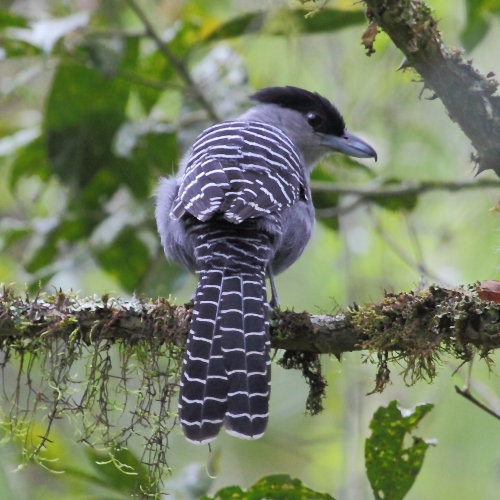
Rusty-backed Antwren
Formicivora rufa
Order: Passeriformes / Family: Thamnophilidae

Wikimedia Commons
About the Rusty-backed Antwren
The Rusty-backed Antwren (Formicivora rufa) is a small, striking member of the Thamnophilidae family, renowned for its vibrant rufous or rusty-colored plumage that provides excellent camouflage in its dense, shrubby habitat. This bird inhabits the lowland forests and scrublands of South America, particularly thriving in Brazil, Bolivia, and Peru. As an understory specialist, the Rusty-backed Antwren plays a critical ecological role as both predator and prey within its ecosystem. It helps control insect populations and, in turn, supports the food web as prey for larger birds and mammals.
The Rusty-backed Antwren shows a remarkable adaptability to various types of forest, including secondary growth and degraded forests, which highlights its resilience in the face of habitat modification. Despite its adaptability, the species faces ongoing pressures from deforestation and habitat fragmentation, particularly in the Amazon basin. Seasonal behaviors include slight altitudinal movements, where individuals may shift to higher elevations during wetter months to follow the abundance of insect prey.
This species contributes significantly to the ecosystem by aiding in seed dispersal through its diet, which includes small seeds and insects. The Rusty-backed Antwren’s presence indicates a healthy, biodiverse habitat, thus serving as a valuable indicator species for environmental monitoring. Its vocalizations, a series of high-pitched trills, play a role in territory establishment and mate attraction, further underscoring its significance in maintaining the ecological balance in its native regions.
The Rusty-backed Antwren belongs to the family Thamnophilidae, within the order Passeriformes. These birds typically live average 5 years, with a maximum recorded of 7 years..
How to Identify a Rusty-backed Antwren
The Rusty-backed Antwren is most easily identified by its distinctive rufous tones, which cover the head, back, and rump, contrasting sharply with its black wings and tail. The underparts are a lighter buff color, providing a subtle but effective camouflage against the forest floor and underbrush. Males and females share similar plumage, though females may display slightly duller tones with less contrast between the rufous and black areas.
Juveniles resemble adults but with feathers that appear more frayed and less vibrant, often with a more muted palette overall. The flight silhouette of the Rusty-backed Antwren is characterized by short, rounded wings and a slightly rounded tail, aiding in agile maneuvering through dense vegetation.
Similar species include other antwrens and antbirds, but the Rusty-backed Antwren can be distinguished by its unique color combination and smaller size. When perched, it maintains an upright posture with a slight lean forward, often flicking its tail as part of its foraging behavior.
Having trouble telling birds apart? Upload a photo to our bird identification tool for an instant species match.
Rusty-backed Antwren Habitat and Range
Preferred Habitat
The Rusty-backed Antwren predominantly inhabits subtropical and tropical moist lowland forests, as well as dry forests and scrublands. It thrives in areas with dense understory vegetation, which provides both cover and abundant feeding opportunities. These habitats are typically found at elevations ranging from sea level to about 1,500 meters.
During the rainy season, some populations may shift slightly in elevation, moving to marginally higher ground where insect prey becomes more plentiful. Although primarily a forest dweller, the Rusty-backed Antwren can sometimes be found in secondary forests and overgrown pastures, demonstrating a level of adaptability to certain forms of habitat alteration.
This species is less common in urban environments, where dense, unfragmented forest patches are scarce. Its presence in rural landscapes, however, can be relatively stable, especially where conservation efforts maintain or restore native vegetation.
Geographic Range
The Rusty-backed Antwren is native to South America, with a range that spans across Brazil, Bolivia, and Peru. It is most frequently observed in the Brazilian states of Amazonas, Acre, and Rondônia, where it occupies extensive tracts of lowland rainforest.
During the breeding season, these birds are primarily sedentary, remaining within their established territories. However, slight altitudinal migrations may occur, particularly in regions with pronounced wet and dry seasons, allowing individuals to exploit varying insect abundances.
Population densities tend to be highest in undisturbed or lightly disturbed forests, with less frequent sightings in heavily logged or urban areas. The Amazon basin represents a significant hotspot for the species, with numerous isolated populations found in suitable habitats across its range.
Want to know which birds visit your area? Browse our backyard birds by location guides for region-specific species lists.
What Does the Rusty-backed Antwren Eat?
The Rusty-backed Antwren primarily feeds on insects, which it gleans from leaves and branches in the understory. Its diet consists largely of ants, beetles, spiders, and other small arthropods, which are abundant in its dense forest habitat.
During the wet season, when insect activity is at its peak, the Rusty-backed Antwren may also consume small seeds and fruits, supplementing its diet with these available resources. Foraging occurs predominantly during the morning and late afternoon, coinciding with periods of lower temperature and higher prey activity.
The bird employs a methodical foraging technique, moving slowly and deliberately through foliage, inspecting leaves and twigs for hidden prey. Its small size allows it to access narrow spaces within the undergrowth, where it uses its sharp bill to extract insects. Prey size typically ranges from 2 to 10 millimeters, with larger insects occasionally taken when available.
Rusty-backed Antwren Behavior and Social Structure
The Rusty-backed Antwren exhibits a largely solitary lifestyle, with pairs forming only during the breeding season. It defends its territory aggressively, using vocalizations and physical displays to deter intruders. Males perform a series of short flights and wing flicks as part of their courtship displays, which are often accompanied by distinctive calls.
During non-breeding periods, individuals may join mixed-species foraging flocks, benefiting from the increased vigilance against predators. The species exhibits a strong territoriality, with territory sizes generally ranging from 1 to 2 hectares, depending on habitat quality.
Daily activity patterns include a peak in foraging activity during the cooler morning and late afternoon hours, with periods of rest and preening during the hottest parts of the day. In response to predators, such as raptors and snakes, the Rusty-backed Antwren employs a series of alarm calls and seeks cover quickly in the dense underbrush.
Rusty-backed Antwren Nesting and Reproduction
The Rusty-backed Antwren builds a cup-shaped nest, meticulously crafted from grass, leaves, and fine roots. These nests are often situated low to the ground, typically between 0.5 and 1.5 meters, well-concealed among dense shrubbery or tangled vines.
A typical clutch consists of two to three eggs, which are incubated by both parents over a period of about 14 days. The eggs are cryptically colored, blending in with the surrounding foliage and nest material to deter predators.
After hatching, nestlings remain in the care of both parents, who share responsibilities for feeding and protection. Fledging occurs approximately 12 to 14 days after hatching, with young birds remaining close to their natal territory for several weeks. The Rusty-backed Antwren typically raises one to two broods per year, depending on environmental conditions and food availability.
Rusty-backed Antwren Sounds and Vocalizations
The Rusty-backed Antwren produces a series of high-pitched trills, serving as both its primary song and a territorial call. These trills are rapid and repetitive, with a slightly metallic quality, making them distinctive among the cacophony of forest sounds.
Its call notes, often used for communication between mates or as warning signals, are sharper and shorter than its song. Alarm calls are more abrupt, serving to alert other birds to potential threats.
During the dawn chorus, the Rusty-backed Antwren's songs contribute to the vibrant acoustic landscape of the forest, often initiating its singing at first light and continuing sporadically throughout the day.
Interesting Facts About the Rusty-backed Antwren
- 1Despite its small size, the Rusty-backed Antwren's territory can span up to 2 hectares, showcasing its need for extensive foraging grounds.
- 2The Rusty-backed Antwren's vocalizations are so distinct that they can be used to identify individual birds within a population.
- 3This antwren is often a key member of mixed-species flocks, benefiting from the safety in numbers while foraging.
- 4The species' adaptability to secondary forests highlights its potential resilience to certain types of habitat disturbance.
- 5The Rusty-backed Antwren's intricate nest construction involves weaving together a variety of plant materials to create a secure environment for its young.
- 6Observations suggest that the Rusty-backed Antwren may occasionally feed on small fruits, supplementing its primarily insectivorous diet.
- 7In its native range, the Rusty-backed Antwren often participates in dawn choruses, contributing to the rich soundscape of the Amazonian forest.
Rusty-backed Antwren Conservation Status
The International Union for Conservation of Nature (IUCN) currently lists the Rusty-backed Antwren as a species of Least Concern, although its population trend is decreasing. The primary threats to this species include habitat loss due to deforestation and agricultural expansion, particularly in the Amazon basin. Conservation efforts focus on habitat preservation and restoration, with numerous protected areas established across its range. Historical population changes suggest a decline in population density in heavily deforested regions, but stable numbers in well-managed conservation areas. Continued monitoring and habitat protection are essential to ensure the long-term survival of this species, particularly as human pressures on tropical forests increase.