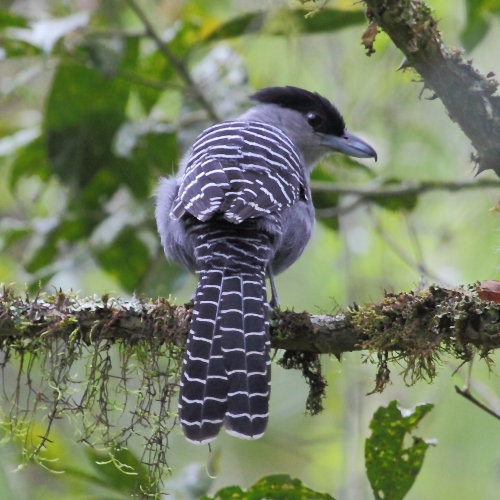
Rusty-winged Antwren
Herpsilochmus frater
Order: Passeriformes / Family: Thamnophilidae

Wikimedia Commons
About the Rusty-winged Antwren
The Rusty-winged Antwren (Herpsilochmus frater) is a small passerine bird belonging to the family Thamnophilidae. This bird is primarily found in the northern regions of South America, notably in Venezuela and Colombia, where it inhabits subtropical or tropical moist lowland forests. Its role in the ecosystem is significant as it acts as both a predator and prey within its environment. By controlling insect populations, the Rusty-winged Antwren contributes to the ecological balance of its habitat. Additionally, it serves as a food source for larger predators, thus maintaining the food chain. During the breeding season, typically from March to July, the Rusty-winged Antwren becomes more vocal and active. Males are known for their distinctive calls, which they use to attract mates and establish territories. These birds are usually monogamous, forming pairs that can last for several breeding seasons. In terms of ecological significance, the Rusty-winged Antwren is an indicator of forest health. Its presence signifies a well-preserved habitat with a rich insect population. As primary consumers, they play a crucial role in transferring energy up the food chain. Their decline or absence can indicate habitat degradation or loss of biodiversity. The Rusty-winged Antwren's reliance on dense forest canopies makes them sensitive to deforestation and habitat fragmentation, which pose significant threats to their population. Conservation efforts aimed at protecting these habitats are crucial for the survival of the species. Seasonal behaviors of the Rusty-winged Antwren include altitudinal migrations in search of food and suitable nesting sites, especially during the wet season when insect activity is at its peak. This bird's adaptability to different forest types, such as secondary growth and gallery forests, highlights its resilience, yet it also underscores the need for conservation measures to ensure that these habitats remain intact.
The Rusty-winged Antwren belongs to the family Thamnophilidae, within the order Passeriformes. These birds typically live average 5 years, with a maximum recorded of 10 years..
How to Identify a Rusty-winged Antwren
The Rusty-winged Antwren is a small bird, measuring approximately 10 to 12 centimeters in length. Its most distinguishing feature is the rusty coloration on its wings, which contrasts with its otherwise gray and white plumage. Adult males and females are similar in appearance, although males tend to have a slightly more vibrant rusty hue on their wings. Juveniles can be identified by their duller color and less defined wing pattern. The Rusty-winged Antwren can be confused with other antwren species, such as the Pygmy Antwren, but key differences include the specific rusty coloring and the distinct vocalizations of the Rusty-winged. In flight, this antwren displays a characteristic fluttering pattern, often darting swiftly between branches in search of insects. When perched, it exhibits an upright posture, frequently flicking its wings and tail. Observing these behaviors, along with the wing color, aids in accurate identification. The bird's small size and agility make it a challenge to spot, but its distinctive call often gives away its presence before it is seen.
Having trouble telling birds apart? Upload a photo to our bird identification tool for an instant species match.
Rusty-winged Antwren Habitat and Range
Preferred Habitat
The Rusty-winged Antwren thrives in tropical and subtropical moist lowland forests, particularly those with dense undergrowth. It is commonly found at elevations ranging from sea level to about 1,200 meters. This bird prefers areas that provide abundant insect prey and dense foliage for nesting and protection. Seasonal variations in habitat occur as the Rusty-winged Antwren may move to slightly higher altitudes during wetter months to follow insect swarms. Unlike more adaptable species, the Rusty-winged Antwren shows limited presence in urban areas, instead favoring remote forested regions. Its reliance on specific forest environments makes it particularly vulnerable to habitat loss and fragmentation. Conservation efforts focus on preserving these critical habitats to ensure the species' ongoing survival.
Geographic Range
The Rusty-winged Antwren's range is primarily within northern South America, with populations concentrated in Venezuela and Colombia. In these countries, it inhabits the lowland tropical forests that stretch across the Orinoco basin and the eastern Andes foothills. The bird does not migrate extensively, but it does undertake local movements in response to seasonal changes in food availability and habitat conditions. These movements are typically altitudinal, allowing the bird to exploit different forest strata during various times of the year. Population densities are highest in regions where forest conditions remain stable and undisturbed. However, deforestation and habitat fragmentation pose ongoing challenges to maintaining these populations. The Rusty-winged Antwren is not known to inhabit areas outside of its current range, making it a species of limited geographical distribution. Conservation efforts in Venezuela and Colombia focus on protecting forest habitats and mitigating the impacts of human activities.
Want to know which birds visit your area? Browse our backyard birds by location guides for region-specific species lists.
What Does the Rusty-winged Antwren Eat?
The Rusty-winged Antwren primarily feeds on insects, with a particular preference for ants and other small arthropods. Its diet shifts slightly with the seasons, as the availability of different insect species fluctuates. During the wet season, the antwren exploits the abundance of caterpillars and beetles, while in drier periods, it relies more heavily on ants and termites. This bird employs a 'gleaning' foraging technique, carefully picking insects off leaves and branches as it moves through the forest canopy. The Rusty-winged Antwren's foraging activity typically occurs during the cooler morning and late afternoon hours, although it may feed sporadically throughout the day. Prey size is generally small, reflecting the bird's delicate bill and agile feeding style. By consuming a variety of insects, the Rusty-winged Antwren plays a vital role in controlling pest populations within its habitat.
Rusty-winged Antwren Behavior and Social Structure
Socially, the Rusty-winged Antwren tends to form monogamous pairs that persist across breeding seasons. These pairs often remain in loose association with other pairs, forming small, loosely organized flocks. Territorial behavior becomes more pronounced during the breeding season, with males vocalizing and displaying aggressively to defend their nesting area and attract mates. Courtship displays include wing flicking and vocal duets between pairs. Flocking behavior outside of the breeding season involves mixed-species flocks, where the antwren partners with other insectivorous birds to increase foraging efficiency and enhance predator detection. In response to predators, the Rusty-winged Antwren engages in alarm calling and performs distraction displays to protect its nest and offspring. Daily activity patterns are crepuscular, with heightened activity during dawn and dusk, although the bird remains active throughout daylight hours under favorable conditions.
Rusty-winged Antwren Nesting and Reproduction
The Rusty-winged Antwren constructs its nest in dense vegetation, often choosing a forked branch or a concealed spot within the forest understory. The nest is cup-shaped and composed of fine plant materials, such as grass, leaves, and spider silk, which provide both structure and camouflage. A typical clutch consists of two eggs, with an incubation period lasting around 14 days. Both parents share incubation duties, taking turns to ensure constant warmth and protection for the developing embryos. After hatching, the chicks remain in the nest for approximately 10 to 12 days before fledging. During this time, both parents actively feed and care for the young, quickly responding to their needs. The Rusty-winged Antwren typically raises one brood per year, although favorable conditions can sometimes lead to a second attempt. Parental roles are well-balanced, with both sexes contributing equally to the rearing of their offspring.
Rusty-winged Antwren Sounds and Vocalizations
The primary song of the Rusty-winged Antwren consists of a series of rapid, high-pitched notes that crescendo into a distinct trill. This song is often described as sharp and metallic, cutting through the dense forest soundscape. In addition to its song, the antwren produces a variety of call notes, including short, sharp chips used for communication between mates. Alarm calls are more urgent and harsh, serving to alert other birds to potential danger. During the dawn chorus, the Rusty-winged Antwren's song contributes to the symphony of sounds that define its habitat. Comparatively, its song shares similarities with those of other antwren species, though the specific pattern and pitch help distinguish it from close relatives.
Interesting Facts About the Rusty-winged Antwren
- 1The Rusty-winged Antwren is named for its distinctive wing coloration, which serves as a key identifying feature among antwrens.
- 2Despite its small size, approximately 10-12 cm, the Rusty-winged Antwren covers extensive ground in its foraging efforts.
- 3Rusty-winged Antwrens often participate in mixed-species flocks, enhancing their foraging success and predator awareness.
- 4The species primarily inhabits lowland forests up to 1,200 meters, demonstrating a preference for dense, humid environments.
- 5Their nests are intricately woven with spider silk, which adds strength and flexibility to the structure.
- 6Rusty-winged Antwrens play a crucial role in insect population control, particularly targeting ant swarms.
- 7The Rusty-winged Antwren's song is a hallmark of its habitat, often heard before the bird is seen due to its elusive nature.
Rusty-winged Antwren Conservation Status
As of the latest assessments, the Rusty-winged Antwren holds a status of Least Concern on the IUCN Red List, although its population is suspected to be in decline due to habitat loss. Deforestation, primarily driven by agricultural expansion and logging, poses the greatest threat to its survival. Conservation efforts focus on habitat protection and restoration, with particular emphasis on preserving the integrity of lowland forest ecosystems. Historical data on population trends remain limited, underscoring the need for continued research and monitoring. Organizations actively working in the region aim to mitigate human impacts and promote sustainable land-use practices to safeguard the Rusty-winged Antwren's future.