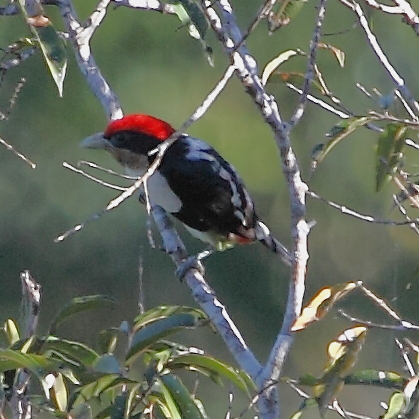
Scarlet-banded Barbet
Capito wallacei
Order: Piciformes / Family: Capitonidae

Wikimedia Commons
About the Scarlet-banded Barbet
The Scarlet-banded Barbet (Capito wallacei) is a striking bird species endemic to a limited range in the Peruvian Andes. Discovered in 1996, this bird is celebrated for its vivid coloration and rarity, capturing the attention of ornithologists and birdwatchers alike. The barbet inhabits montane cloud forests, particularly favoring elevations between 1,200 and 1,700 meters. Its distinct scarlet band across the forehead and contrasting black-and-yellow plumage make it easily recognizable, despite its isolated habitat. This bird plays a significant role in its ecosystem by aiding in seed dispersal and maintaining insect populations. The Scarlet-banded Barbet is an integral part of the biodiversity within its limited range. It is primarily found in the Cordillera Azul region of Peru, where it inhabits forested areas that are rich in moss and epiphytes. Its ecological role includes both seed dispersal, crucial for forest regeneration, and insect control, as it feeds on a variety of fruit and arthropods. The bird's presence in these habitats contributes to the health and balance of the ecosystem. The Scarlet-banded Barbet's behavior changes with the seasons. During the breeding season, this bird becomes more territorial and vocal, establishing and defending its nesting area, which is essential for the survival of its offspring. Its vocalizations become especially prominent in the early morning, marking its territory and communicating with potential mates. Outside the breeding season, it tends to be more solitary, focusing on foraging and maintaining its energy reserves. Despite its limited range, the Scarlet-banded Barbet plays a crucial role in its environment. By dispersing seeds from the fruits it consumes, it helps propagate plant species, contributing to forest regeneration. Additionally, it participates in insect population control, maintaining a balance within its ecosystem. Its presence indicates a healthy, undisturbed forest, underscoring the importance of preserving its habitat.
The Scarlet-banded Barbet belongs to the family Capitonidae, within the order Piciformes. These birds typically live typically 5-7 years, with a maximum recorded of 10 years..
How to Identify a Scarlet-banded Barbet
The Scarlet-banded Barbet is a medium-sized bird, measuring about 19 cm in length. Its most notable feature is the bright scarlet band across its forehead, which sharply contrasts with its black crown. The rest of its face and throat are white, while its back and wings are primarily black. Its underparts are a vibrant yellow, adding to its striking appearance. Juvenile Scarlet-banded Barbets resemble adults but have duller plumage, with less distinct markings. Males and females appear similar, though subtle differences exist, with males typically exhibiting slightly brighter coloration. When observing in the field, the Scarlet-banded Barbet's silhouette is robust, with a stout body and a thick neck. In flight, it shows broad, rounded wings and a short tail. Its perching posture is upright, often seen on prominent branches where it can survey its surroundings. Confusion with other species is unlikely within its restricted range, as the Scarlet-banded Barbet's unique color pattern is distinct among the regional avifauna.
Having trouble telling birds apart? Upload a photo to our bird identification tool for an instant species match.
Scarlet-banded Barbet Habitat and Range
Preferred Habitat
The Scarlet-banded Barbet thrives in montane cloud forests in the Peruvian Andes. These habitats are characterized by dense tree canopies, abundant epiphytes, and a humid, misty environment. The bird prefers elevations between 1,200 and 1,700 meters, where it finds ample food and suitable nesting sites. It is particularly associated with the Cordillera Azul region, where undisturbed forest patches provide the necessary resources for its survival. The Scarlet-banded Barbet does not typically inhabit urban areas, as it requires the complex structure of primary forests to meet its ecological needs. Seasonal habitat shifts are minimal, given its dependency on specific forest conditions and its non-migratory nature.
Geographic Range
The range of the Scarlet-banded Barbet is restricted to the eastern slopes of the Andes in central Peru, specifically within the Cordillera Azul region. This bird's distribution is limited to a few key areas where suitable habitat exists, contributing to its status as a rare and localized species. The Scarlet-banded Barbet does not undertake long migrations, remaining within its montane forest environment year-round. Population densities are highest in areas where forest cover is dense and largely undisturbed. These factors combine to make the Scarlet-banded Barbet a unique and vulnerable species, with its distribution closely tied to the availability of primary montane cloud forest habitat.
Want to know which birds visit your area? Browse our backyard birds by location guides for region-specific species lists.
What Does the Scarlet-banded Barbet Eat?
The Scarlet-banded Barbet has a varied diet that includes both plant and animal matter. Primarily frugivorous, it consumes a wide assortment of fruits and berries, which are abundant in its cloud forest habitat. This diet is supplemented by insects and other small arthropods, which provide essential protein. Seasonal variations in food availability may lead to shifts in dietary composition, with the bird adjusting its foraging strategy accordingly. The Scarlet-banded Barbet typically forages alone or in pairs, using its stout bill to pluck fruits and capture prey. It often employs a methodical approach, moving through the forest canopy to locate food sources. Prey size generally ranges from small insects to medium-sized arthropods, with feeding occurring throughout the day.
Scarlet-banded Barbet Behavior and Social Structure
The Scarlet-banded Barbet exhibits a solitary or paired social structure, rarely forming larger flocks. During the breeding season, it becomes highly territorial, with males actively defending nesting sites through vocalizations and displays. Courtship involves a series of calls and postures designed to attract mates. Once paired, the birds remain in close proximity, working together to raise their young. Daily activity patterns include periods of foraging interspersed with rest and preening. The Scarlet-banded Barbet is vigilant when responding to potential predators, often retreating to dense foliage or higher branches. Territorial behavior is most pronounced during the nesting season, with individuals asserting dominance over their claimed area. Flocking is uncommon, but the bird may occasionally join mixed-species feeding groups in search of food.
Scarlet-banded Barbet Nesting and Reproduction
The Scarlet-banded Barbet nests in tree cavities, often selecting sites that offer protection from predators and harsh weather. These cavities may be natural or excavated by the birds themselves. The nesting site is typically located several meters above the ground, within the dense forest canopy. The clutch size ranges from two to four eggs, with both parents sharing incubation duties. The incubation period lasts approximately 15 to 18 days, after which the chicks hatch. Fledging occurs around four weeks later, with both parents feeding and caring for the young. The Scarlet-banded Barbet generally raises one brood per year, though favorable conditions may allow for a second.
Scarlet-banded Barbet Sounds and Vocalizations
The Scarlet-banded Barbet's primary song is a series of melodious whistles and trills, characterized by a rhythmic and resonant quality. These vocalizations serve to establish territory, attract mates, and communicate with conspecifics. Call notes are varied, including sharp, short calls and softer cooing sounds. Alarm calls are distinct and urgent, alerting others to potential dangers. During dawn, the Scarlet-banded Barbet participates in a chorus where multiple individuals vocalize, creating a rich acoustic tapestry within the forest. These sounds, while unique, can be compared to the clear whistles of other barbet species.
Interesting Facts About the Scarlet-banded Barbet
- 1The Scarlet-banded Barbet was only discovered in 1996, making it a relatively new species to science.
- 2This barbet's striking coloration helps it stand out in its montane cloud forest habitat, making it easier to spot despite its remote range.
- 3Unlike many birds, the Scarlet-banded Barbet does not migrate, remaining within its limited range throughout the year.
- 4The Scarlet-banded Barbet contributes to forest health by dispersing seeds from the fruits it consumes, aiding in plant regeneration.
- 5Despite its vivid colors, the Scarlet-banded Barbet's dense forest habitat provides ample cover, offering protection from predators.
- 6The Scarlet-banded Barbet's discovery in Peru highlighted the rich biodiversity of the region, spurring further conservation efforts.
- 7This species is one of the few endemic birds of Peru, emphasizing the country's unique avian diversity.
Scarlet-banded Barbet Conservation Status
The Scarlet-banded Barbet is currently classified as Near Threatened on the IUCN Red List, with its primary threats being habitat loss due to deforestation and agricultural expansion. The population trend appears to be decreasing, necessitating targeted conservation efforts. Efforts to protect this species include the establishment of protected areas within its range and initiatives to promote sustainable land use practices. Historical population changes have been influenced by human activities, underscoring the importance of preserving the remaining forested regions that support this unique bird.