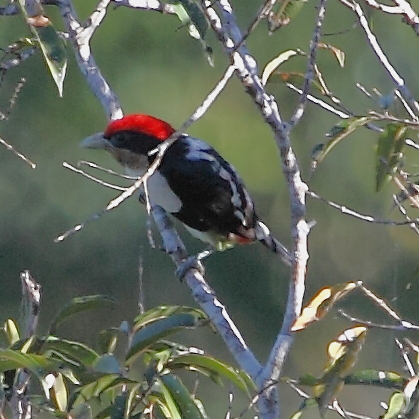
Scarlet-hooded Barbet
Eubucco tucinkae
Order: Piciformes / Family: Capitonidae

Wikimedia Commons
About the Scarlet-hooded Barbet
The Scarlet-hooded Barbet (Eubucco tucinkae), a strikingly vivid bird, belongs to the Capitonidae family. This species inhabits the lowland tropical rainforests of South America, primarily in the Amazon Basin. It is particularly prevalent in regions of southeastern Peru, western Brazil, and northern Bolivia. These barbets are significant to their ecosystems as both pollinators and seed dispersers. Their bright plumage, which includes a scarlet head and a mix of green and yellow on the body, makes them one of the more visually distinctive species in the dense rainforest canopy.
The Scarlet-hooded Barbet plays an important ecological role, aiding in the propagation of plant species through seed dispersal. This interaction not only assists in forest regeneration but also supports the biodiversity of their habitat. As frugivores, they consume a variety of fruits, often ingesting seeds that they later expel, enabling new growth in different areas. Additionally, their foraging habits can influence the distribution and abundance of insects, as they occasionally consume invertebrates, contributing to insect population control.
Seasonally, these barbets demonstrate some changes in behavior, especially during the breeding season, when their vocalizations increase in frequency. They are generally non-migratory, maintaining territories within the forest throughout the year. However, the onset of the wet season may affect their movement patterns slightly, as they adapt to fluctuations in food availability. The Scarlet-hooded Barbet's presence is a testament to the richness and complexity of tropical rainforest ecosystems.
The Scarlet-hooded Barbet belongs to the family Capitonidae, within the order Piciformes. These birds typically live typically 5-7 years in the wild, with some living up to 10 years..
How to Identify a Scarlet-hooded Barbet
The Scarlet-hooded Barbet is easily identified by its vibrant red head, which contrasts sharply with its green back and wings. The underparts are primarily yellow, adding to the bird's striking appearance. Adult males typically display more saturated colors than females, though both sexes share the same basic color pattern. Juveniles exhibit a duller version of the adults' plumage, with less pronounced red and yellow hues.
When observing this species, note the stout bill, characteristic of barbets, which is adapted for fruit consumption. This feature, along with their stocky build, assists in distinguishing them from other birds in their habitat. The Scarlet-hooded Barbet's flight is direct and fast, often appearing as a flash of color amidst the foliage. Unlike some birds in their range, they do not exhibit significant sexual dimorphism, making male and female birds difficult to differentiate in the field without close observation.
In terms of posture, the Scarlet-hooded Barbet often perches upright on branches, sometimes hanging upside down to reach fruit. Their silhouette is compact, with a relatively short tail and rounded wings. While they might be confused with other colorful rainforest birds at a distance, the combination of a bright red head and the specific pattern of green and yellow on their body is quite distinctive.
Having trouble telling birds apart? Upload a photo to our bird identification tool for an instant species match.
Scarlet-hooded Barbet Habitat and Range
Preferred Habitat
The Scarlet-hooded Barbet inhabits lowland tropical rainforests, primarily within the Amazon Basin. They favor areas with dense canopy cover, where fruiting trees are abundant. These birds typically reside at elevations below 1000 meters, where the climate remains consistently warm and humid. Their preference for primary and secondary forests with high biodiversity supports their dietary needs.
Seasonal habitat shifts are minimal for this species since they are non-migratory. However, they may move locally within the forest to exploit seasonal fruiting events. Unlike some birds, they do not commonly inhabit urban or suburban areas, as their ecological niche is closely tied to undisturbed forest environments. Their presence in more remote, forested regions underscores the importance of habitat conservation efforts in maintaining healthy populations.
Geographic Range
The Scarlet-hooded Barbet's range is largely confined to the Amazon Basin, spanning southeastern Peru, western Brazil, and northern Bolivia. Within these countries, they are commonly found in lowland rainforest areas, particularly in regions renowned for their biological diversity, such as Peru's Manu National Park and Brazil's Acre state.
These birds do not undertake long-distance migrations, instead maintaining territories within the rich forest environments they inhabit year-round. There are no significant population density hotspots outside of these primary regions, as their range is quite specific to the Amazonian lowlands.
Population densities can vary, but they are generally higher in areas with abundant fruiting trees. The Scarlet-hooded Barbet is not often observed outside its preferred range, reinforcing the importance of its specialized habitat requirements.
Want to know which birds visit your area? Browse our backyard birds by location guides for region-specific species lists.
What Does the Scarlet-hooded Barbet Eat?
The Scarlet-hooded Barbet primarily feeds on a variety of fruits, making it an important frugivore in its ecosystem. Its diet includes berries, figs, and other small fleshy fruits available in the rainforest canopy. The bird's stout bill allows it to handle and consume its food efficiently, often swallowing fruits whole and later regurgitating seeds, which aids in seed dispersal.
During certain times of the year, the barbet may supplement its diet with insects and other invertebrates, providing a source of protein, particularly during the breeding season when nutritional demands increase. They employ a foraging technique that involves scanning the canopy for fruiting trees and occasionally hanging upside down to reach their food.
Feeding typically occurs during the early morning and late afternoon, with periods of rest and preening in between. This schedule helps them avoid the midday heat, which can be intense in their tropical environment. The Scarlet-hooded Barbet's varied diet reflects its adaptability and role in maintaining the ecological balance of its habitat.
Want to attract Scarlet-hooded Barbets to your yard? See our recommended feeders and seed types for the best results.
Scarlet-hooded Barbet Behavior and Social Structure
The Scarlet-hooded Barbet exhibits a largely solitary lifestyle, though it can occasionally be observed in pairs or small family groups. During the breeding season, males become more vocal, utilizing a series of calls to establish territories and attract mates. These vocalizations serve as an auditory marker of their presence in the dense forest environment.
Territorial behavior includes both vocal displays and physical displays, such as wing-fluttering and short flights to deter intruders. While not overtly aggressive, they defend their chosen areas with persistence. In terms of courtship, males perform a variety of displays to woo females, including offering food and showcasing their plumage.
Though not known for flocking in large numbers, the Scarlet-hooded Barbet may join mixed-species foraging flocks, benefiting from the collective vigilance against predators. Their response to threats typically involves retreating to the canopy's upper levels, where dense foliage offers protection. Daily activities include periods of feeding interspersed with rest, often during the hottest parts of the day.
Scarlet-hooded Barbet Nesting and Reproduction
Scarlet-hooded Barbets nest in tree cavities, often selecting natural hollows or abandoned woodpecker holes. They prefer locations that offer some degree of concealment from potential predators, usually high in the canopy. The nest construction involves minimal material, as they rely on the existing structure of the cavity.
A typical clutch consists of two to four eggs, which the female incubates over a period of about 14-16 days. Both parents participate in feeding the chicks once they hatch, bringing a steady supply of fruit and insects. The fledging period lasts approximately 20-25 days, during which the young remain in the nest under the care of both parents.
Scarlet-hooded Barbets generally produce one brood per year, though if conditions are favorable and food is abundant, a second brood may occur. The involvement of both parents in chick-rearing is crucial for the successful raising of their offspring.
Scarlet-hooded Barbet Sounds and Vocalizations
The primary song of the Scarlet-hooded Barbet consists of a series of repetitive, melodious whistles. These whistles maintain a steady rhythm and moderate pitch, serving as an effective communication tool in their dense forest habitat. The song is often heard during the early morning as part of the dawn chorus, contributing to the forest's vibrant soundscape.
Call notes include sharp, single whistles that can act as contact calls between mates or family members. When alarmed, the barbet emits a rapid, chattering call, alerting others in the vicinity to potential danger. These vocalizations, while not as complex as those of some songbirds, are distinctive and play a vital role in the bird's communication repertoire.
Interesting Facts About the Scarlet-hooded Barbet
- 1The Scarlet-hooded Barbet has a stout bill perfectly adapted for its fruit-heavy diet, enabling it to handle and consume a wide variety of fruits.
- 2Although non-migratory, the Scarlet-hooded Barbet may move locally within the forest to exploit seasonal fruiting events, demonstrating some adaptability.
- 3Scarlet-hooded Barbets are important seed dispersers, playing a role in the propagation of plant species within the Amazon rainforest.
- 4Their vibrant red head and contrasting green and yellow plumage make the Scarlet-hooded Barbet one of the most visually striking birds in its range.
- 5The species is typically found in the lowland rainforests of the Amazon Basin, particularly in southeastern Peru, western Brazil, and northern Bolivia.
- 6Scarlet-hooded Barbets primarily feed on fruits but will also consume insects, especially during the breeding season when nutritional demands are higher.
- 7Despite their bright colors, Scarlet-hooded Barbets can be surprisingly difficult to spot, often remaining high in the dense forest canopy.
Scarlet-hooded Barbet Conservation Status
The Scarlet-hooded Barbet is currently listed as Least Concern by the IUCN, indicating that, at present, it faces no immediate threat of extinction. However, its population trend is subject to pressures from habitat loss due to deforestation and land conversion for agriculture. Conservation efforts focus on preserving large tracts of rainforest within its range, ensuring that these vibrant birds and their habitats remain intact. Protected areas such as national parks and reserves provide safe havens where the barbet can thrive. Monitoring population trends and habitat changes remains crucial in assessing long-term conservation needs. Historically, the population has remained relatively stable, benefiting from the dense and inaccessible nature of its preferred habitat. Nonetheless, continued vigilance and habitat conservation are essential to maintain the stability of the Scarlet-hooded Barbet's population.
Attracting Scarlet-hooded Barbets to Your Feeder
The Scarlet-hooded Barbet is a regular visitor to backyard bird feeders across its range. At the Eye On The Fly feeding station, we observe Scarlet-hooded Barbets regularly and capture footage with our feeder cameras.