Serra Antwren
Formicivora serrana
Order: Passeriformes / Family: Thamnophilidae

Wikimedia Commons
About the Serra Antwren
The Serra Antwren (Formicivora serrana) is a small passerine bird belonging to the Thamnophilidae family, a group widely known for their insectivorous habits and specialized forest habitats. Native to Brazil, this species is primarily confined to the Atlantic Forest, one of the most biodiverse yet threatened ecosystems on the planet. Its distribution is largely restricted to the southeastern regions of Brazil, particularly within the states of Rio de Janeiro, Minas Gerais, and São Paulo. This antwren plays a crucial role in maintaining the ecological balance of its habitat by controlling insect populations, which benefits the forest's health and diversity.
The Serra Antwren is a sentinel of the Atlantic Forest's health. As an insectivore, it helps regulate the abundance of arthropods, impacting the forest's trophic dynamics. This species' presence indicates a relatively intact habitat, as it requires dense understory vegetation typically found in well-preserved forests. Its conservation status is closely tied to the fate of the Atlantic Forest, which has been reduced to a fraction of its original extent due to deforestation and urbanization. Thus, the Serra Antwren is not only significant as a species but also as an indicator of broader environmental conditions.
Behaviorally, the Serra Antwren exhibits a fascinating blend of territoriality and adaptability. It is typically seen in pairs or small family groups, patrolling their territory with a series of calls and songs that reinforce pair bonds and deter intruders. During the breeding season, which aligns with the austral spring and summer (September to February), these birds become more vocal and active. They engage in elaborate courtship displays, which involve fluttering flights and vocal duets. As a resident species, the Serra Antwren does not undertake long migrations but may exhibit altitudinal movements in response to seasonal changes in food availability and habitat conditions.
In summary, the Serra Antwren is an emblematic species of Brazil's Atlantic Forest. Its survival hinges on the conservation of its habitat, which supports a wide array of other flora and fauna. Protecting this bird and its ecosystem offers a broader conservation benefit, preserving the rich biodiversity of one of the world's most important forest regions.
The Serra Antwren belongs to the family Thamnophilidae, within the order Passeriformes. These birds typically live average 5 years, with a maximum recorded of 7 years..
How to Identify a Serra Antwren
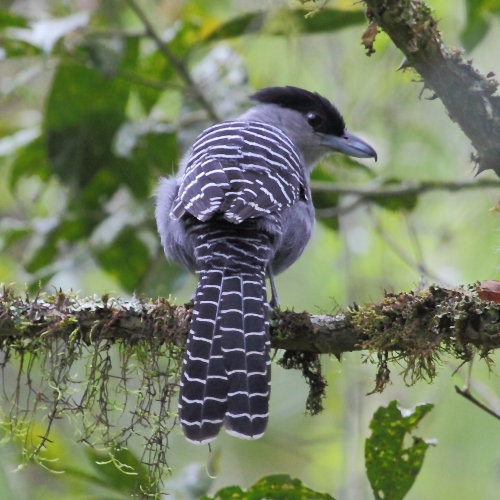
The Serra Antwren is a small bird, measuring about 11 to 12 cm in length with a wingspan of approximately 16 cm. Adult males are strikingly patterned with black upperparts, adorned with bold white wing bars and a white throat and belly. The black extends to the head, giving them a distinctive cap, while the back is a mix of black and gray. Females, on the other hand, feature a more subdued color palette, with brownish upperparts and a pale buffy underpart, lacking the stark contrast seen in males.
Juveniles resemble females but are generally duller, often with a more mottled appearance as they transition into adult plumage. The differences between males and females become more pronounced as juveniles mature. These birds can be confused with other antwrens, such as the Sooty Antwren (Myrmotherula unicolor), but the latter lacks the distinctive white wing bars and has a more uniform coloration.
In flight, the Serra Antwren displays a quick, fluttery flight pattern typical of small passerines. When perching, it often holds a horizontal posture, flitting through the understory in search of insects. Its distinctive black-and-white or brown-and-buff plumage, depending on sex and age, aids in quick identification for seasoned birdwatchers familiar with the region's avifauna.
Having trouble telling birds apart? Upload a photo to our bird identification tool for an instant species match.
Serra Antwren Habitat and Range
Preferred Habitat
The Serra Antwren thrives in the Atlantic Forest, a biome characterized by high humidity and dense, complex vegetation structures. It favors the lowland and montane forest regions, often found at elevations from sea level to about 1500 meters. Within these forests, it occupies the understory and midstory layers, where it forages for insects amidst thick leaf litter and tangled vines.
The bird's preference for such dense habitats makes it sensitive to habitat fragmentation, a significant threat in its range. While primarily a forest denizen, it can occasionally be found in secondary growth or regenerating forest areas, provided there is sufficient cover. Unlike some other species, the Serra Antwren does not typically venture into urban environments and remains closely associated with forested areas.
Seasonal shifts in habitat use are minimal, as the Serra Antwren is a resident species. However, some local movements may occur in response to food availability, particularly during the dry season when insect prey might be less abundant in certain areas.
Geographic Range
The Serra Antwren is endemic to southeastern Brazil, with its range primarily confined to the states of Rio de Janeiro, Minas Gerais, and São Paulo. These areas encompass some of the most critical remnants of the Atlantic Forest, which provides the necessary habitat for the species' survival.
During the breeding season, the Serra Antwren remains within its established territories, often in well-preserved patches of forest. Outside the breeding season, the bird maintains its residency but may exhibit minor altitudinal migrations, moving to slightly different elevations as food sources fluctuate with the seasons.
Although its range is limited geographically, within this range, the Serra Antwren can be locally abundant, particularly in areas where habitat conditions remain favorable. Conservation efforts in these states aim to maintain and expand forest reserves, which are crucial for the continued survival of this and many other endemic species.
Want to know which birds visit your area? Browse our backyard birds by location guides for region-specific species lists.
What Does the Serra Antwren Eat?
The Serra Antwren primarily feeds on insects, with a diet that includes ants, beetles, caterpillars, and other arthropods. It forages actively in the forest understory, using a series of quick, agile movements to glean prey from leaves and branches. This bird employs a mixed foraging strategy, often undertaking short flights to snatch insects from the air or foliage.
Seasonal variations in diet are linked to insect abundance, with a broader range of prey available during the wet season when insects are most prolific. During drier periods, the Serra Antwren may rely more heavily on ants, which remain a consistent food source.
The bird's feeding schedule is largely diurnal, with peak foraging activity occurring in the early morning and late afternoon. This schedule aligns with the periods of greatest insect activity and availability, maximizing foraging success.
Serra Antwren Behavior and Social Structure
The Serra Antwren is a territorial species, usually found in pairs or small family groups. Its territorial behavior includes vocalizations and displays to defend its area from intruders. These birds maintain territories year-round, with increased territorial defense during the breeding season.
Courtship and mating involve a series of displays that strengthen pair bonds. During courtship, males perform fluttering flights and vocal duets with females, a behavior that reinforces their partnership. The Serra Antwren's social structure is relatively simple, with pairs remaining together throughout the year.
In response to predators, the Serra Antwren relies on its cryptic plumage and quick movements to avoid detection. When threatened, it may freeze or slip into dense cover, a behavior common among understory-dwelling birds. Daily activity patterns are characterized by periods of intense foraging interspersed with rest and preening, ensuring the bird maintains its condition and readiness for the next foraging bout.
Serra Antwren Nesting and Reproduction
Serra Antwrens construct cup-shaped nests using fine plant materials such as grass, leaves, and rootlets. These nests are typically situated low in the undergrowth, often less than a meter off the ground, well-concealed within thick foliage.
The female usually lays a clutch of two eggs, which she incubates primarily alone, although the male may assist in brooding and feeding the chicks. The incubation period lasts about 14 to 16 days, followed by a fledging period of around 10 to 12 days.
Both parents participate actively in feeding and caring for the chicks, ensuring a high level of parental investment. The species may produce one to two broods per year, depending on food availability and environmental conditions, which can influence reproductive success.
Serra Antwren Sounds and Vocalizations
The primary song of the Serra Antwren is a series of short, sharp notes delivered in a rapid, rhythmic sequence. This song serves as both a territorial declaration and a communication tool between mates. The pitch is usually high and clear, making it distinguishable amidst the forest sounds.
In addition to its song, the Serra Antwren produces a variety of call notes used in different contexts, including soft contact calls between mates and harsher alarm calls in the presence of predators. During the dawn chorus, its vocalizations become more frequent and energetic, contributing to the forest's symphony as day breaks.
Compared to other antwrens, the Serra Antwren's vocalizations are less varied, but their consistency and rhythm make them a reliable feature for identification in the field.
Interesting Facts About the Serra Antwren
- 1The Serra Antwren's habitat, the Atlantic Forest, is home to over 20,000 plant species, many of which are found nowhere else on Earth.
- 2This bird's vocalizations can carry over surprising distances, allowing it to communicate effectively in dense forest environments.
- 3The Serra Antwren's nesting success is closely tied to the abundance of ants and arthropods, reflecting its dependency on insect populations.
- 4Despite its small size, the Serra Antwren exhibits a robust territorial behavior, often engaging in vocal duets to assert dominance.
- 5The Atlantic Forest, the Serra Antwren's habitat, has more endemic bird species than the entire continent of Europe.
- 6Serra Antwrens are often found in mixed-species flocks, benefiting from the increased vigilance and foraging opportunities provided by such groups.
- 7Due to its restricted range, the Serra Antwren is considered a bioindicator species for the health of the Atlantic Forest ecosystem.
Serra Antwren Conservation Status
The Serra Antwren is currently listed as Near Threatened on the IUCN Red List, primarily due to habitat loss and fragmentation. The Atlantic Forest, its primary habitat, has been dramatically reduced in size, with only about 12% of its original area remaining intact. Deforestation for agriculture, urban development, and logging pose significant threats to the species. Conservation efforts focus on preserving and restoring habitat within the bird's range. Establishing and maintaining protected areas in the Atlantic Forest is crucial for its survival. Habitat corridors are also being developed to connect fragmented forest patches, facilitating movement and genetic exchange between populations. Population trends for the Serra Antwren suggest a decline, but conservation initiatives offer hope for stabilization. Continued efforts to curb habitat destruction and promote sustainable land-use practices are essential to reverse the species' trajectory.