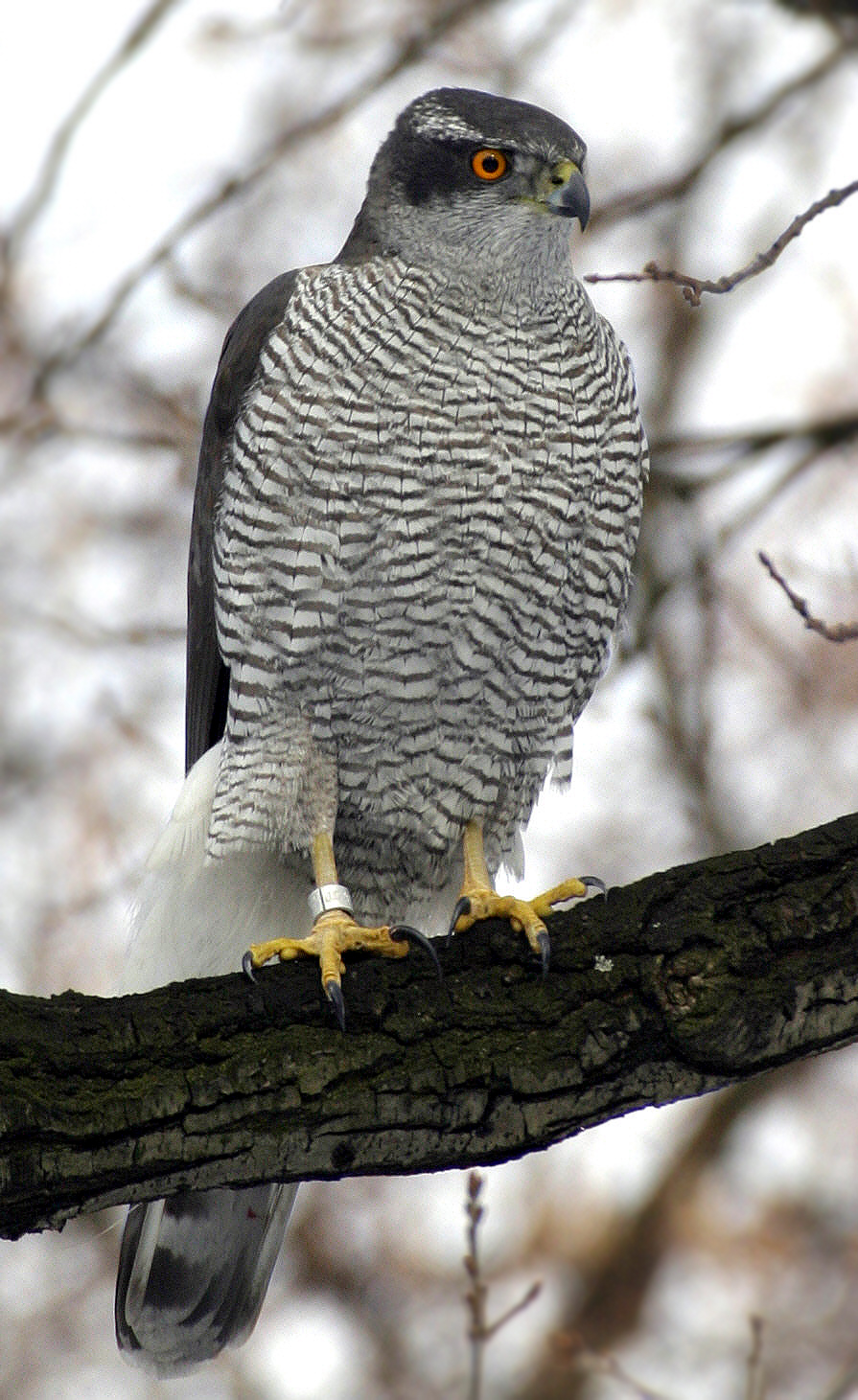
Sharp-shinned Hawk
Accipiter striatus
Order: Accipitriformes / Family: Accipitridae

Wikimedia Commons
About the Sharp-shinned Hawk
The Sharp-shinned Hawk, scientifically known as Accipiter striatus, is the smallest hawk in North America and is a member of the family Accipitridae. This raptor occupies a significant ecological niche as a predator of small birds and mammals. It is most commonly found in dense forests and woodlands across North America, adapting well to both deciduous and coniferous environments. During the breeding season, which occurs primarily in the northern reaches of its range such as Canada and the northern United States, the Sharp-shinned Hawk inhabits dense coniferous forests. In winter, it migrates to warmer regions, extending its range to Central America and northern South America, favoring open woods and forest edges where prey is more abundant. The ecological role of the Sharp-shinned Hawk is vital for maintaining balanced ecosystems. By preying on small birds, rodents, and insects, it helps control the populations of these species, thus contributing to the health of the forest ecosystems. During migration periods, these hawks are often observed in large numbers along established corridors such as the ridges of the Appalachian Mountains, where they take advantage of updrafts. Seasonal behaviors of the Sharp-shinned Hawk are closely tied to the availability of prey. In summer, it primarily hunts in the dense forests of its breeding grounds, while in winter, it becomes a more opportunistic predator, often seen in urban and suburban areas where bird feeders attract its prey. Its adaptability to different environments and its role as a predator make the Sharp-shinned Hawk an essential subject of study for ornithologists and a fascinating bird for nature enthusiasts.
The Sharp-shinned Hawk belongs to the family Accipitridae, within the order Accipitriformes. These birds typically live average lifespan of 3-5 years, with a maximum recorded of 20 years..
How to Identify a Sharp-shinned Hawk
The Sharp-shinned Hawk is recognized by its small size, with adults measuring 24 to 34 centimeters in length and having a wingspan of 53 to 66 centimeters. Adults display a distinctive slate-gray back and wings, with a barred rufous chest and a white underbelly, which aids in camouflage among the forest canopy. Juvenile hawks, however, are brown above with streaked brown and white underparts, which helps them blend into the woodland. Sexual dimorphism is present, with females being notably larger than males, a common trait among raptors. This size difference can be a useful field mark in identifying the sex of the bird when observed in pairs. The Sharp-shinned Hawk can be confused with the Cooper's Hawk, as both share similar plumage and habitats. However, the Sharp-shinned Hawk is smaller and has a more squared tail, as opposed to the rounded tail of the Cooper's Hawk. In flight, the Sharp-shinned Hawk displays a characteristic flap-flap-glide pattern, and its wings are short and rounded, which are adaptations for maneuvering through dense vegetation. When perched, this hawk often appears long-legged and broad-shouldered, contributing to its alert and wary posture.
Having trouble telling birds apart? Upload a photo to our bird identification tool for an instant species match.
Sharp-shinned Hawk Habitat and Range
Preferred Habitat
The Sharp-shinned Hawk thrives in a variety of forested habitats. Its primary habitat includes dense coniferous forests, particularly during the breeding season, found in regions like the boreal forests of Canada and the northern United States. In these areas, the hawk nests and raises its young. During migration and winter months, it can be found in mixed woodlands, forest edges, and even suburban areas where small birds, its main prey, are abundant. The hawk's elevation range varies with its habitat, often breeding at higher elevations in mountainous areas and descending to lower elevations during winter. This bird's presence in urban environments is increasing, particularly in areas with ample tree cover and bird feeders, which attract the small birds that comprise its diet. Despite its preference for forested areas, the Sharp-shinned Hawk's adaptability allows it to exploit various habitats across its range.
Geographic Range
The Sharp-shinned Hawk's breeding range covers most of Canada and extends into the northern United States, favoring dense, mature forests for nesting. In autumn, these hawks embark on long migrations, traveling south through the United States and into Central America. Some individuals even reach northern South America, including Colombia and Venezuela. Migration corridors are well-established, with large numbers of Sharp-shinned Hawks passing through areas such as the Appalachian Mountains and coastal ridges. During winter, the population disperses widely across the southern United States, Mexico, and Central America. The density of Sharp-shinned Hawks varies, with high concentrations in migration hotspots and around winter feeding areas. Populations are relatively sparse in extreme northern regions during winter, where they are replaced by more cold-tolerant species.
Want to know which birds visit your area? Browse our backyard birds by location guides for region-specific species lists.
What Does the Sharp-shinned Hawk Eat?
The Sharp-shinned Hawk's diet primarily consists of small birds, which it hunts with remarkable agility and speed. It preys on species such as sparrows, finches, and warblers, making use of surprise attacks from concealed perches. During the breeding season, its diet may expand to include mammals like small rodents and insects, which are more readily available in its dense forest habitat. In winter, the hawk becomes more opportunistic, often visiting bird feeders in suburban areas to catch small birds drawn to the seeds. The Sharp-shinned Hawk's foraging technique involves stealth and speed. It uses dense cover to approach its prey and executes swift, surprise attacks. Prey size typically ranges from 10 to 50 grams. Feeding occurs primarily during daylight hours, with peak activity during early morning and late afternoon, coinciding with the activity patterns of its prey.
Sharp-shinned Hawk Behavior and Social Structure
The Sharp-shinned Hawk exhibits solitary behavior outside of the breeding season, maintaining a territory to ensure ample food supply. Males and females perform elaborate aerial displays during courtship, involving acrobatic flights and vocalizations to strengthen pair bonds. These hawks are highly territorial and engage in aggressive displays to defend their nesting areas from intruders. Social interactions are minimal, though during migration, they may be seen in loose flocks utilizing the same thermal updrafts. Despite their solitary nature, Sharp-shinned Hawks are highly adaptive and exhibit changes in behavior based on environmental conditions and prey availability. In response to predators, they rely on their agility and speed to evade capture, often retreating into dense foliage. Daily activity patterns align with prey activity, being most active during periods when small birds are feeding, yet they remain alert throughout the day to maximize hunting opportunities.
Sharp-shinned Hawk Nesting and Reproduction
Sharp-shinned Hawks construct their nests high in trees, often selecting coniferous trees for added concealment. The nest is typically a platform of sticks, lined with bark and leaves for insulation and comfort. Preferred locations are well-hidden within dense forest canopy, sometimes as high as 20 meters above the ground. Clutch size ranges from 3 to 8 eggs, with 4 to 5 being most common. The eggs are incubated primarily by the female for about 30 to 35 days, while the male provides food. After hatching, both parents participate in feeding the chicks. The fledging period occurs approximately 24 to 27 days after hatching. Sharp-shinned Hawks generally produce a single brood per year, with the timing of nesting and fledging closely linked to prey availability and seasonal conditions.
Sharp-shinned Hawk Sounds and Vocalizations
The Sharp-shinned Hawk's vocalizations include high-pitched, rapid 'kik-kik-kik' calls, often used during courtship and territorial displays. These calls are sharp and piercing, carrying through dense forest. Alarm calls are similarly high-pitched but more repetitive, serving to alert mates or chicks to potential threats. Unlike songbirds, the Sharp-shinned Hawk does not participate in a dawn chorus, but it remains vocal during active periods. The quality of its calls can be compared to a high-pitched, fast-paced laugh or chatter, which stands out against the background of forest sounds.
Interesting Facts About the Sharp-shinned Hawk
- 1The Sharp-shinned Hawk is the smallest hawk in North America, yet it can take down prey larger than itself by weight.
- 2During migration, Sharp-shinned Hawks can travel over 2,000 miles, often covering 150 miles in a single day.
- 3These hawks have keen eyesight, allowing them to spot prey from considerable distances and strike with precision.
- 4A Sharp-shinned Hawk's heart can beat up to 300 times per minute during flight, supporting its rapid hunts.
- 5Unlike many raptors, the Sharp-shinned Hawk is known to visit backyard bird feeders, drawn by the small birds.
- 6Young Sharp-shinned Hawks develop flight skills rapidly, often mastering hunting techniques within weeks of fledging.
- 7The species name 'striatum' refers to the streaked plumage of juvenile hawks, a key identification feature.
Sharp-shinned Hawk Conservation Status
The Sharp-shinned Hawk is currently listed as Least Concern by the IUCN, with its population trend considered stable. Despite historical declines due to habitat loss and pesticide use, conservation efforts have helped stabilize numbers. Key threats include habitat destruction and urbanization, which reduce available nesting sites and prey. Conservation measures focus on preserving forest habitats and monitoring pesticide use. Population monitoring programs and migration counts contribute to understanding trends and informing policy decisions. Historically, this hawk has shown resilience, adapting to changing environments and maintaining stable numbers across much of its range.
Other Accipitridae Species


Birds Similar to the Sharp-shinned Hawk
These species are often confused with the Sharp-shinned Hawk due to similar appearance or overlapping range.