
Northern Goshawk
Accipiter gentilis
Order: Accipitriformes / Family: Accipitridae
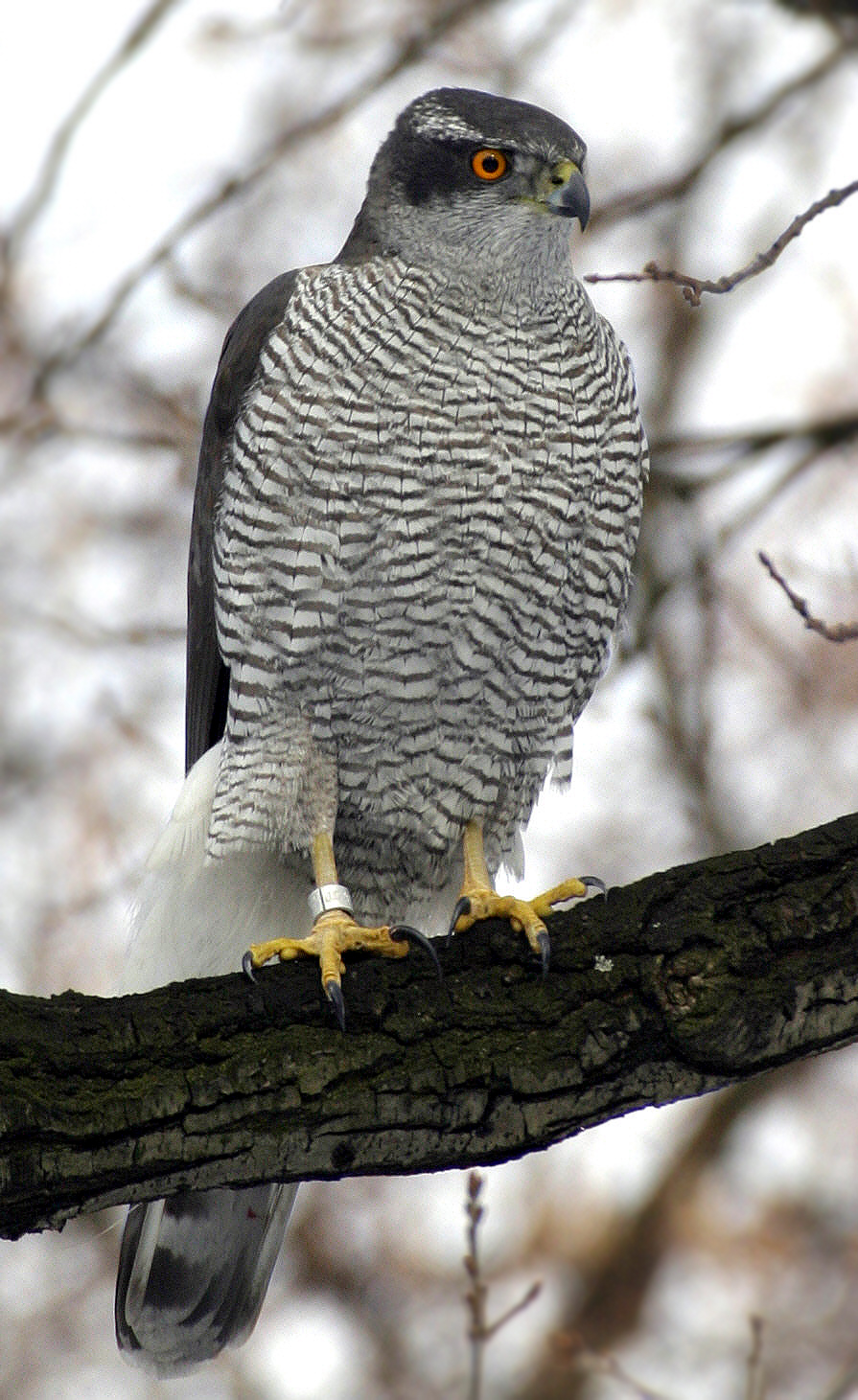
Wikimedia Commons
About the Northern Goshawk
The Northern Goshawk, Accipiter gentilis, stands as a formidable predator in the bird world, adapted to the challenging environments of forests across the Northern Hemisphere. Renowned for its agile flight and swift maneuverability, this raptor plays a crucial role in maintaining the balance of its ecosystem by controlling populations of small to medium-sized mammals and birds. Its presence signifies a healthy forest ecosystem, making it an essential species for biodiversity conservation.
Throughout the year, the Northern Goshawk adjusts its behavior to suit seasonal changes. In the breeding season, which typically occurs in late winter to early spring, these birds become particularly territorial, with both males and females fiercely defending their nesting sites. Outside the breeding season, goshawks may range more widely in search of food, although they generally remain in forested areas.
The Northern Goshawk inhabits a broad geographic area, including North America, Europe, and Asia. In North America, it is found from Alaska to northern Mexico, while in Europe, its range extends from Scandinavia to the Mediterranean. Across these regions, the goshawk prefers mature forests, which provide the necessary cover and prey abundance. Despite its adaptability, habitat destruction and human encroachment pose significant threats, highlighting the importance of forest conservation for this species.
The Northern Goshawk belongs to the family Accipitridae, within the order Accipitriformes. These birds typically live average lifespan is about 11 years, with a maximum recorded of 19 years..
How to Identify a Northern Goshawk
The Northern Goshawk is a large raptor with a robust build, possessing broad wings and a long tail that aid in its agile flight through dense forests. Adults display a striking plumage with a slate-gray back and a lighter, finely barred underpart. Their eyes are a piercing red, adding to their fierce appearance. Juveniles, however, differ significantly, having a brown plumage with streaked underparts, which gradually change as they mature.
Males and females have similar coloration, but females are noticeably larger, a common trait among raptors. This size difference can aid in sex identification in the field. When comparing the goshawk to similar species, observers often confuse it with the Cooper's Hawk or Sharp-shinned Hawk. However, the goshawk's larger size and more powerful build, along with its distinctive white supercilium, help differentiate it from these smaller accipiters.
In flight, the Northern Goshawk exhibits a unique silhouette, with its broad, rounded wings and long tail. When perched, it maintains an upright posture, often found in a watchful position on tree branches or snags within its forested habitat.
Having trouble telling birds apart? Upload a photo to our bird identification tool for an instant species match.
Northern Goshawk Habitat and Range
Preferred Habitat
The Northern Goshawk thrives in mature, mixed, and coniferous forests, where its hunting skills are best utilized among dense trees. It prefers remote areas with minimal human disturbance, often found at elevations ranging from sea level to mountainous regions, depending on geographic location. In North America, it frequents forests of the Appalachian Mountains and the western Rockies. In Europe, it inhabits the vast forests of Scandinavia and the Alps. Seasonal habitat shifts are minimal, as goshawks tend to remain in or near their breeding territories year-round, although they may descend to lower elevations in harsh winters.
While primarily forest dwellers, Northern Goshawks can occasionally be spotted at the edges of urban areas, particularly where forest patches intersect with human developments. However, they are less common in heavily urbanized environments, preferring the solitude and cover provided by expansive forested landscapes.
Geographic Range
The breeding range of the Northern Goshawk spans a wide area across the Northern Hemisphere. In North America, it breeds from Alaska and Canada down to the northern United States, including the Great Lakes region and the Appalachian Mountains. In Europe, its range extends from the British Isles and Scandinavia to the Mediterranean, and in Asia, it is found from Siberia to Japan and northern China.
During the winter, some goshawks may move to slightly lower elevations or more southerly areas of their range, but they are generally considered resident birds, remaining near their breeding territories. Migration corridors are less defined for these birds compared to more migratory raptors.
Population densities tend to be higher in regions with extensive, continuous forest cover. In North America, the Pacific Northwest and parts of the northeastern U.S. are notable for their goshawk populations, while in Europe, Scandinavia and the Alps serve as population hotspots.
Want to know which birds visit your area? Browse our backyard birds by location guides for region-specific species lists.
What Does the Northern Goshawk Eat?
The Northern Goshawk primarily preys on birds and mammals, with a diet that varies based on regional availability. Common avian prey includes medium-sized species such as grouse, crows, and woodpeckers. Among mammals, it frequently targets rabbits, hares, and squirrels, with occasional predation on larger rodents.
Seasonal diet changes are influenced by prey abundance and accessibility. During the breeding season, when demands are higher, goshawks may hunt larger prey to provide for their young. Their foraging technique involves surprise attacks, using their speed and agility to pursue prey through dense forest cover. Prey size can range from small songbirds to larger mammals weighing up to several kilograms.
Goshawks typically hunt during daylight, though they are most active in the early morning and late afternoon. Their feeding schedule is opportunistic, often dictated by prey movement and availability within their territory.
Northern Goshawk Behavior and Social Structure
Northern Goshawks exhibit solitary and territorial behavior, especially during the breeding season. They are known for their fierce defense of nesting sites, often engaging in aerial displays to deter intruders. Courtship involves impressive flight displays, with the male performing acrobatics and sky-dancing to attract a mate.
Outside the breeding season, goshawks maintain their territories but may become less aggressive. They do not typically flock, preferring solitude except when nesting. In response to predators or threats, they make use of their speed and agility to evade danger, sometimes engaging in aggressive defense if necessary.
Daily activity patterns show a preference for dawn and dusk, aligning with peak periods of prey activity. During these times, goshawks patrol their territories, alternating between perching and active hunting flights. Their keen eyesight allows them to detect prey with remarkable precision, even through dense foliage.
Northern Goshawk Nesting and Reproduction
Northern Goshawks build large stick nests, typically located high in mature trees. They often choose conifers or tall deciduous trees, depending on regional availability. The nest is a substantial structure, composed of sticks, lined with bark and greenery.
A typical clutch consists of 2 to 4 eggs, which the female incubates for about 32 to 37 days. During this time, the male provides food for the female. Once hatched, the fledglings remain in the nest for another 35 to 42 days before attempting their first flights. Both parents play active roles in feeding and protecting the young.
Goshawks generally produce one brood per year, although in areas with abundant resources, a second brood is possible. Parental roles are well defined, with the male primarily responsible for hunting while the female tends to nest duties. As the young mature, they gradually become independent, eventually dispersing to establish their territories.
Northern Goshawk Sounds and Vocalizations
The Northern Goshawk's vocalizations include a series of sharp, loud calls that serve various purposes. Its primary call, often described as a 'kak-kak-kak,' is used for territory defense and communication between mates. This call is loud and penetrating, easily heard through dense forests.
Alarm calls are harsher and more rapid, used in response to threats or disturbances near the nest. These sounds can alert both mate and young to potential dangers.
During courtship, the goshawk may emit softer, more melodious calls, although these are less common. Unlike many songbirds, the Northern Goshawk does not participate in a dawn chorus, but its calls are most frequent during the early morning and late afternoon, coinciding with its peak activity times.
Interesting Facts About the Northern Goshawk
- 1The Northern Goshawk can reach speeds of up to 40 mph when pursuing prey through the forest.
- 2Goshawks have been used in falconry for centuries, prized for their hunting prowess and trainability.
- 3A Northern Goshawk's nest can be reused for multiple years, often expanding in size with each use.
- 4These raptors have been known to hunt prey as large as a snowshoe hare, showcasing their strength.
- 5The species name 'gentilis' refers to the goshawk's historical association with nobility in falconry.
- 6Northern Goshawks are capable of flying silently, an adaptation that aids in their stealthy hunting.
- 7Juvenile Northern Goshawks have yellow eyes, which gradually turn red as they mature.
Northern Goshawk Conservation Status
The Northern Goshawk currently holds a status of Least Concern according to the IUCN, although local populations face various challenges. Habitat loss due to logging and land conversion is a primary threat, reducing available nesting and hunting grounds. In some regions, goshawks have suffered from persecution and illegal hunting, although these practices have decreased in recent years. Conservation efforts focus on habitat preservation, particularly in maintaining large tracts of mature forests. Some countries have implemented protective legislation to safeguard these vital areas. Historical population changes have seen fluctuations, largely in response to habitat alterations and human activities. Continued monitoring and conservation initiatives are crucial to ensure the long-term stability of goshawk populations across their range.
Other Accipitridae Species


Birds Similar to the Northern Goshawk
These species are often confused with the Northern Goshawk due to similar appearance or overlapping range.


