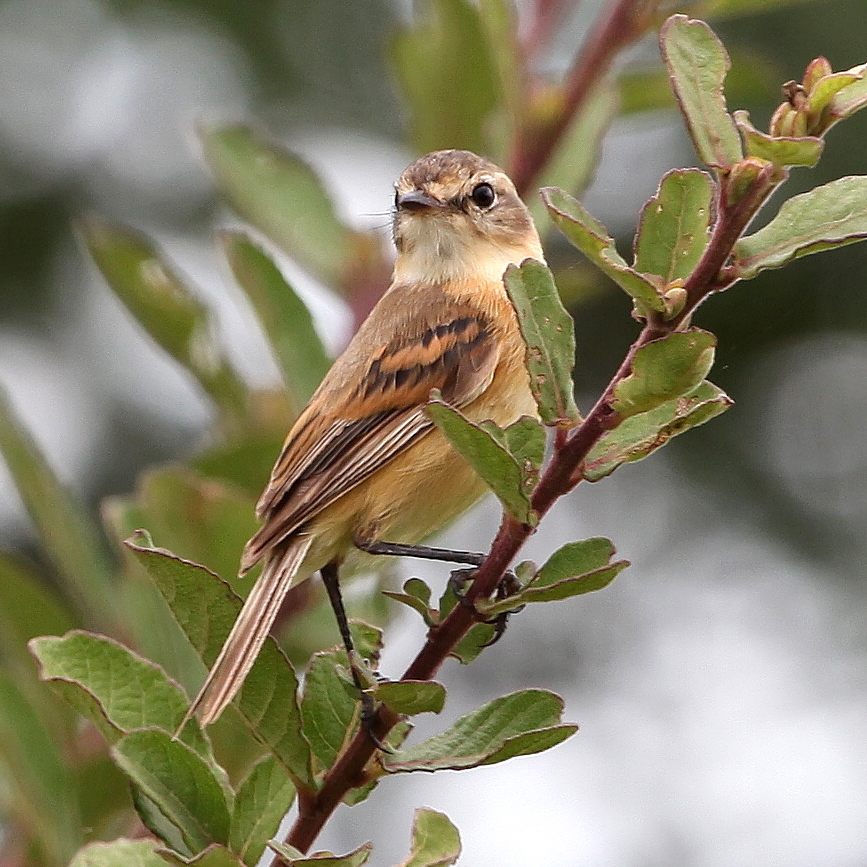
Sharp-tailed Tyrant
Culicivora caudacuta
Order: Passeriformes / Family: Tyrannidae

Wikimedia Commons
About the Sharp-tailed Tyrant
The Sharp-tailed Tyrant (Culicivora caudacuta) is a small passerine bird found primarily in the grasslands of South America, particularly in Brazil, Paraguay, and parts of Argentina. This species plays a significant role in its ecosystem as an insectivore, helping to control insect populations. Its presence is indicative of healthy grassland ecosystems, which are often under threat from agricultural expansion and climate change.
The Sharp-tailed Tyrant is notable for its preference for open habitats such as campos and cerrado in Brazil, where it can be seen flitting among tall grasses. These habitats are characterized by a mix of grassland and scattered shrubs, providing the perfect environment for this bird's foraging behavior. During the breeding season, which coincides with the southern hemisphere's spring and summer months, the Sharp-tailed Tyrant becomes more vocal and territorial.
This bird is an important species for bird watchers and ornithologists due to its specialized habitat requirements and its role as a bioindicator. The conservation of the Sharp-tailed Tyrant aids in the preservation of the diverse grassland ecosystems it inhabits. Observations suggest that this species may face challenges due to habitat fragmentation, making conservation efforts crucial for its survival.
The Sharp-tailed Tyrant belongs to the family Tyrannidae, within the order Passeriformes. These birds typically live average 3 years, with a maximum recorded of 5 years..
How to Identify a Sharp-tailed Tyrant
The Sharp-tailed Tyrant is a small bird, measuring about 10-12 cm in length. It is identified by its long, narrow tail, which is sharply pointed and contributes to its name. The plumage of the adult Sharp-tailed Tyrant is predominantly olive-brown on the back with a lighter, buff-colored underside, providing excellent camouflage in its grassland habitat.
Males and females exhibit similar plumage, though males may have a slightly longer tail, a trait that can assist in identification during field observations. Juveniles resemble adults but tend to have duller coloring and shorter tails. The sharp tail is a distinguishing feature that sets this species apart from other similar-sized grassland birds.
In flight, the Sharp-tailed Tyrant showcases an agile and erratic flight pattern, often staying low to the ground. When perched, it typically sits upright on grass stalks or shrubs, using its tail for balance. This posture, combined with its slender body and long tail, makes it recognizable even from a distance.
Having trouble telling birds apart? Upload a photo to our bird identification tool for an instant species match.
Sharp-tailed Tyrant Habitat and Range
Preferred Habitat
The Sharp-tailed Tyrant is primarily associated with grassland habitats, including the Brazilian cerrado, open campos, and grassy savannas. These areas feature a mix of tall grasses and scattered bushes, which offer both foraging opportunities and protection from predators. The bird is typically found at elevations ranging from sea level up to about 1,000 meters.
While the Sharp-tailed Tyrant thrives in rural and natural grassland settings, its presence in urban areas is rare due to its specific habitat needs. Seasonal shifts in habitat are minimal, as this bird tends to remain in regions with consistent grassland coverage throughout the year.
Geographic Range
The breeding range of the Sharp-tailed Tyrant spans across southern Brazil, eastern Paraguay, and parts of northeastern Argentina. Within these areas, it is most commonly found in the expansive grasslands of the Brazilian cerrado and the Paraguayan campos.
Unlike many migratory birds, the Sharp-tailed Tyrant does not undertake long-distance migrations. Instead, it remains within its breeding range year-round, taking advantage of the stable climate and resources available in these regions. Population densities are highest in areas with extensive, undisturbed grassland habitats, but the bird can also be found in smaller, isolated patches where suitable conditions persist.
Want to know which birds visit your area? Browse our backyard birds by location guides for region-specific species lists.
What Does the Sharp-tailed Tyrant Eat?
The diet of the Sharp-tailed Tyrant consists primarily of insects, making it an important insectivore in its ecosystem. It feeds on a wide variety of arthropods, including beetles, grasshoppers, and caterpillars. Seasonal diet changes are minimal, as insect availability in its habitat remains relatively constant throughout the year.
Foraging techniques include sallying from perches to catch insects in flight and gleaning prey from grass stalks and foliage. The bird often forages alone or in pairs, focusing on smaller prey that is easily handled and consumed. Feeding occurs throughout the day, with peak activity during the cooler morning and late afternoon hours.
Sharp-tailed Tyrant Behavior and Social Structure
Sharp-tailed Tyrants are generally solitary or found in pairs, especially during the breeding season when they establish and defend territories. Territorial behavior includes vocal displays and aerial chases to deter intruders. Males often perform flight displays to attract females, showcasing their agility and tail feathers.
These birds exhibit a daily routine that involves active foraging during early morning and late afternoon, avoiding the heat of midday. Their response to predators involves swift flight into dense grass or shrub cover, utilizing their cryptic plumage for concealment. Flocking is uncommon, though outside of breeding season, small groups may form in areas with abundant food resources.
Sharp-tailed Tyrant Nesting and Reproduction
The Sharp-tailed Tyrant constructs cup-shaped nests made from grasses and plant fibers, typically located low in dense grass or shrubs. These nests are well-hidden to protect from predators and environmental elements.
A typical clutch consists of two to three eggs, which are incubated by the female for about 14 days. Both parents participate in feeding the hatchlings. The fledging period lasts approximately two weeks, after which young birds leave the nest but remain under parental care for some time. The species usually produces one brood per year, although favorable conditions may lead to a second.
Sharp-tailed Tyrant Sounds and Vocalizations
The primary song of the Sharp-tailed Tyrant is a series of short, high-pitched notes delivered in rapid succession. This song is often described as a 'tick-tick-tick' sound, similar to the ticking of a small clock.
Alarm calls are sharp and staccato, serving to alert mates of potential threats. During the dawn chorus, their vocalizations are more frequent and can be heard over long distances, making them more conspicuous to both mates and rivals.
Interesting Facts About the Sharp-tailed Tyrant
- 1The Sharp-tailed Tyrant can cover over 50 meters in a single flight when chasing insects.
- 2Despite its small size, it plays a significant role in controlling grasshopper populations.
- 3The species' tail length is about one-third its total body length, aiding in its identification.
- 4Sharp-tailed Tyrants are known to be monogamous, forming long-term pair bonds.
- 5Their nests are often camouflaged with surrounding vegetation, making them hard to spot.
- 6The bird's vocalizations are often used as a key indicator of its presence in dense grasslands.
- 7Conservationists use the presence of the Sharp-tailed Tyrant as a measure of grassland health.
Sharp-tailed Tyrant Conservation Status
The Sharp-tailed Tyrant is currently listed as 'Near Threatened' on the IUCN Red List. Its population trend is decreasing, primarily due to habitat loss from agricultural expansion and land conversion. Conservation efforts focus on preserving and restoring grassland habitats. Historically, the bird's range has contracted in some areas due to these threats. Local conservation initiatives aim to protect critical habitats and raise awareness of the species' ecological importance.
Other Tyrannidae Species


Birds Similar to the Sharp-tailed Tyrant
These species are often confused with the Sharp-tailed Tyrant due to similar appearance or overlapping range.