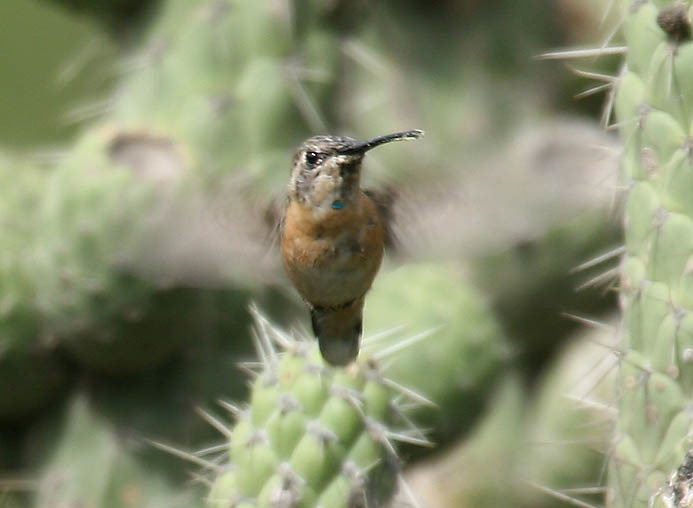
Short-tailed Woodstar
Myrmia micrura
Order: Apodiformes / Family: Trochilidae

Wikimedia Commons
About the Short-tailed Woodstar
The Short-tailed Woodstar (Myrmia micrura) is a captivating member of the hummingbird family, Trochilidae. This small bird is renowned for its distinctively short tail and vibrant plumage, which makes it a favorite among birders and ornithologists. Primarily found in the tropical regions of South America, particularly in Ecuador and northern Peru, the Short-tailed Woodstar inhabits areas ranging from lowland deciduous forests to scrubby areas at higher elevations. Its presence is often marked by its rapid and agile flight, a necessary adaptation for navigating the dense foliage and accessing food sources like nectar and small insects. The ecological role of the Short-tailed Woodstar is significant, as it acts as a pollinator for various plant species. By transferring pollen as it feeds, the bird facilitates plant reproduction, contributing to the biodiversity of its habitat. During the breeding season, which usually spans from October to March, this species becomes particularly active, with males engaging in elaborate aerial displays to attract females. Outside the breeding season, the Short-tailed Woodstar is a solitary creature, displaying territorial behavior around feeding sites to ensure an adequate supply of nectar. The bird's adaptability allows it to exploit a range of ecological niches, from forest edges to gardens. However, habitat destruction poses a challenge to its survival, making conservation efforts crucial. Despite these threats, the Short-tailed Woodstar remains relatively resilient, maintaining stable population numbers across its range. Observing this bird in its natural habitat, one can appreciate its role within the ecosystem as both a pollinator and a prey species, contributing to the intricate web of life in tropical environments.
The Short-tailed Woodstar belongs to the family Trochilidae, within the order Apodiformes. These birds typically live average 4 years with a maximum recorded of 6 years.
How to Identify a Short-tailed Woodstar
The Short-tailed Woodstar is characterized by its iridescent plumage, with the males exhibiting a brilliant green body and a vibrant violet-blue throat patch known as a gorget. Females, on the other hand, display a more subdued coloration, with a green back and a white underbelly, alongside a hint of rufous on their flanks. Juvenile birds resemble females but lack the fully developed gorget seen in adult males. This species is easily distinguished from other hummingbirds by its notably short tail, which is less than half the length of its body. In flight, the Short-tailed Woodstar presents a compact silhouette, with rapid wing beats that create a characteristic buzzing sound. When perched, the bird holds a straight posture, often on exposed branches, from which it can survey its surroundings. Although there is some potential for confusion with similar species like the Peruvian Sheartail, the Short-tailed Woodstar's significantly shorter tail and distinct throat coloration help birders with accurate identification.
Having trouble telling birds apart? Upload a photo to our bird identification tool for an instant species match.
Short-tailed Woodstar Habitat and Range
Preferred Habitat
The Short-tailed Woodstar thrives in a variety of habitats, primarily within tropical and subtropical zones. It frequents deciduous and semi-deciduous forests, scrublands, and open areas, often at elevations ranging from sea level up to 2,500 meters. During the breeding season, it may also venture into more densely forested regions, where it finds suitable nesting sites and abundant food sources. The bird can adapt to gardens and parklands, especially where flowering plants are plentiful. While it prefers rural settings, some individuals have been observed in urban areas, provided there is adequate vegetation to support its dietary needs.
Geographic Range
The Short-tailed Woodstar is predominantly found in western South America, with its range extending throughout Ecuador and into northern Peru. It inhabits areas west of the Andes, favoring regions that offer a mix of open spaces and forested patches. While it does not undertake long-distance migrations, the species may exhibit altitudinal movements in response to changes in food availability and climatic conditions. During the breeding season, its population density increases in areas where flowers are abundant, creating hotspots for observation.
Want to know which birds visit your area? Browse our backyard birds by location guides for region-specific species lists.
What Does the Short-tailed Woodstar Eat?
The diet of the Short-tailed Woodstar consists mainly of nectar from a variety of flowering plants. It plays a vital role in pollination as it forages, moving from flower to flower in search of sustenance. In addition to nectar, it supplements its diet with small insects and arachnids, which provide essential proteins and nutrients. The bird employs a hovering technique while feeding, allowing it to access nectar without perching. Its feeding schedule typically aligns with the availability of flowers, with peak activity occurring during the early morning and late afternoon when blooms are most active.
Short-tailed Woodstar Behavior and Social Structure
Short-tailed Woodstars exhibit a solitary lifestyle, especially outside the breeding season. Males establish territories around rich feeding sites, displaying aggression towards intruders to protect their resources. During courtship, males perform impressive aerial displays, characterized by rapid dives and intricate flight patterns to captivate females. The bird remains active throughout the day, with feeding and territorial defense being its primary activities. When faced with predators, the Short-tailed Woodstar relies on its agility to evade capture, often retreating to dense foliage for safety.
Short-tailed Woodstar Nesting and Reproduction
The Short-tailed Woodstar constructs a cup-shaped nest, typically using plant fibers, moss, and spider silk to bind the materials together. Nests are often situated on horizontal branches or in sheltered locations to protect against the elements. The female is solely responsible for incubating the clutch, which usually consists of two eggs, and she cares for the young until they fledge. Incubation lasts approximately 15-17 days, and the fledgling period extends another 20-22 days. The species typically raises one brood per year, although favorable conditions may lead to a second.
Short-tailed Woodstar Sounds and Vocalizations
The vocalizations of the Short-tailed Woodstar are characterized by a series of high-pitched, rapid notes that may be described as metallic or tinkling. These sounds serve as communication signals during territorial disputes or courtship. The bird's call notes are softer and less frequent, often serving as contact calls between individuals. Alarm calls are sharper and more insistent, alerting others to potential threats. Unlike some other birds, it does not engage in a dawn chorus, but its calls are consistently audible throughout the day.
Interesting Facts About the Short-tailed Woodstar
- 1The Short-tailed Woodstar's wings beat up to 70 times per second, allowing it to hover effortlessly.
- 2This species can consume up to twice its body weight in nectar each day, showcasing its high-energy needs.
- 3Despite its small size, the Short-tailed Woodstar can travel at speeds exceeding 30 miles per hour in flight.
- 4Males perform a unique courtship display known as a 'J-dive,' where they rapidly ascend and then plummet toward the ground.
- 5The Short-tailed Woodstar's heart beats at a rate of 1,200 beats per minute during intense activity.
- 6Its iridescent plumage results from microscopic platelets that refract light rather than pigments.
- 7The Short-tailed Woodstar is one of the few hummingbirds that can be found in both rural and urban settings, provided there are ample flowers.
Short-tailed Woodstar Conservation Status
The Short-tailed Woodstar currently holds a status of Least Concern according to the IUCN. Its population numbers remain stable, although habitat destruction poses a long-term threat. Conservation efforts focus on preserving its natural habitats and ensuring the availability of flowering plants. Historical records indicate that the species has maintained a relatively consistent presence in its range, though ongoing deforestation and land conversion could impact future populations.
Other Trochilidae Species


Birds Similar to the Short-tailed Woodstar
These species are often confused with the Short-tailed Woodstar due to similar appearance or overlapping range.