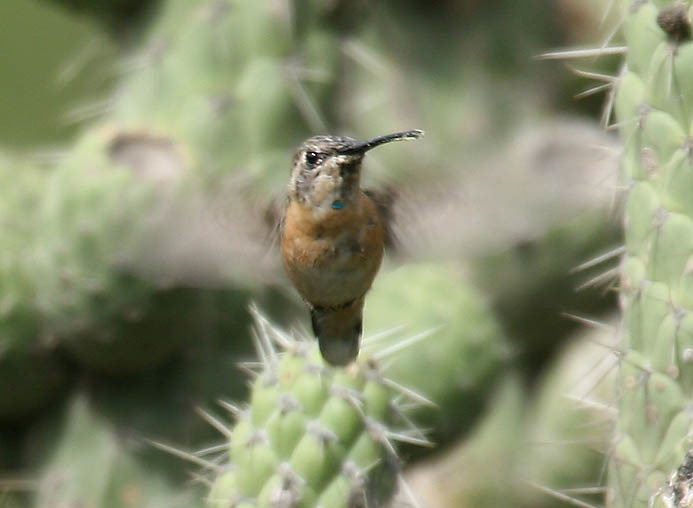
Slender-tailed Woodstar
Microstilbon burmeisteri
Order: Apodiformes / Family: Trochilidae

Wikimedia Commons
About the Slender-tailed Woodstar
The Slender-tailed Woodstar (Microstilbon burmeisteri) is a captivating member of the hummingbird family, known for its diminutive size and striking appearance. This species is primarily found in South America, particularly in the Andes mountain range, spanning countries such as Colombia, Ecuador, and Peru. The Slender-tailed Woodstar occupies a crucial ecological niche as a pollinator, frequenting a variety of flowering plants in montane and subtropical forests. It plays an indispensable role in the maintenance of these ecosystems, aiding in plant reproduction and genetic diversity. During the breeding season, the Slender-tailed Woodstar is more active, often seen flitting from flower to flower in search of nectar. The bird's seasonal behaviors include altitudinal migration, where it moves to different elevations in response to climatic conditions and food availability. In lower elevations and during the non-breeding months, the woodstar is less conspicuous, blending into the diverse avian community of the region. The significance of the Slender-tailed Woodstar extends beyond its role as a pollinator; it also serves as an indicator species for the health of its habitat. Changes in its population can reflect broader environmental changes, making it a valuable subject for ecological studies and conservation efforts.
The Slender-tailed Woodstar belongs to the family Trochilidae, within the order Apodiformes. These birds typically live average 5 years with a maximum recorded of 7 years.
How to Identify a Slender-tailed Woodstar
The Slender-tailed Woodstar is a small hummingbird, measuring around 8 to 9 centimeters in length, with a slender, elongated tail that gives the bird its name. Adult males boast a glittering green back and crown, with a striking magenta gorget that catches the light, while the underparts are predominantly white. Females and juveniles differ slightly, displaying a more subdued color palette with greenish upperparts and buffy underparts. Males and females can be differentiated by the presence of the vibrant gorget in males, absent in females, who have a more rounded tail. When observing these birds in the field, note their rapid wing beats and agile flight, which can make them challenging to follow. Despite their small size, the woodstar's iridescence makes them stand out against the foliage. The flight silhouette of the Slender-tailed Woodstar is characterized by its long tail and rapid wing movements, often creating a blur as it hovers near flowers. When perched, the bird's tail appears notably long relative to its body, a distinguishing feature among hummingbirds. Confusion with other similar species such as the Purple-crowned Fairy is possible, but careful observation of the tail length and plumage details can aid in correct identification.
Having trouble telling birds apart? Upload a photo to our bird identification tool for an instant species match.
Slender-tailed Woodstar Habitat and Range
Preferred Habitat
The Slender-tailed Woodstar inhabits montane and subtropical forests within the Andes, typically at elevations ranging from 1,500 to 2,800 meters. These regions are rich in biodiversity, providing ample flowering plants for the woodstar's nectar diet. During the breeding season, the bird may venture into more open areas within these forests to capitalize on abundant floral resources. Seasonal habitat shifts occur as the bird moves to lower elevations during colder months, seeking warmer climates and sustaining its energy needs. While it primarily resides in natural forested areas, the Slender-tailed Woodstar can occasionally be found in rural gardens where suitable flowers are present. Unlike some hummingbird species, it tends to avoid highly urbanized environments, preferring the tranquility and resources of undisturbed habitats.
Geographic Range
The Slender-tailed Woodstar's range is confined to the Andean regions of South America, with notable populations in countries such as Colombia, Ecuador, and Peru. Within these areas, the bird exhibits localized movement patterns, often influenced by altitudinal migration. During the breeding season, the woodstar is predominantly found at higher elevations, where it takes advantage of specific flowering plants that thrive in these conditions. In contrast, during the non-breeding season, it descends to lower elevations, ensuring a consistent supply of nectar and avoiding the harsher climate of higher altitudes. The bird's distribution is not uniform, with population density hotspots occurring in regions where floral resources are abundant and diverse. Unlike many migratory birds, the Slender-tailed Woodstar does not engage in long-distance migration, instead exhibiting more localized, seasonal movements that optimize its survival and reproductive success.
Want to know which birds visit your area? Browse our backyard birds by location guides for region-specific species lists.
What Does the Slender-tailed Woodstar Eat?
The primary diet of the Slender-tailed Woodstar consists of nectar from a variety of flowering plants, making it a crucial pollinator in its ecosystem. It favors tubular flowers, which are rich in nectar and accessible with the bird's specialized bill. During the breeding season, the woodstar's diet is heavily reliant on abundant floral resources to meet the high energy demands of breeding and raising young. In addition to nectar, the bird occasionally consumes small insects and spiders, providing a supplementary protein source essential for growth and development. Foraging techniques include hovering in front of flowers, using rapid wing beats to maintain position while extracting nectar with its long, specialized tongue. The Slender-tailed Woodstar is most active during the early morning and late afternoon, times when flowers tend to produce the most nectar. In seasons when floral abundance decreases, the bird adapts by expanding its diet to include a wider range of available plants, showing remarkable flexibility in its foraging habits.
Want to attract Slender-tailed Woodstars to your yard? See our recommended feeders and seed types for the best results.
Slender-tailed Woodstar Behavior and Social Structure
The Slender-tailed Woodstar is a solitary bird, generally avoiding close contact with conspecifics outside of the breeding season. Territorial behavior is prominent, with males aggressively defending feeding areas from intruders to ensure access to precious nectar resources. Courtship displays are elaborate, involving rapid flight maneuvers and vocalizations to attract potential mates. The male's vibrant plumage plays a significant role in these displays, reflecting light in a way that highlights the magenta gorget. In response to predators, the woodstar relies on its agility and small size to evade capture, often retreating into dense foliage. Daily activity patterns reveal a preference for early morning and late afternoon feeding, coinciding with peak nectar availability. Unlike some hummingbirds that form flocks, the Slender-tailed Woodstar remains solitary, maintaining its territory and safeguarding its food sources. This behavior is especially pronounced during the breeding season when the drive to secure resources for offspring is heightened.
Slender-tailed Woodstar Nesting and Reproduction
The Slender-tailed Woodstar constructs its nest using fine plant fibers, spider silk, and lichens, creating a small, cup-shaped structure that blends seamlessly with its surroundings. These nests are typically located on a slender branch or within dense foliage, providing concealment from predators. The female is solely responsible for nest building and incubation, laying a clutch of two tiny white eggs. The incubation period lasts approximately 14 to 16 days, during which the female remains vigilant, leaving the nest only briefly to forage. Once hatched, the nestlings are fed a diet of regurgitated nectar and insects, growing rapidly under the female's care. Fledging occurs around 20 to 23 days post-hatching, after which the young birds begin to explore their environment, gradually becoming independent. The Slender-tailed Woodstar may produce two broods per year, depending on environmental conditions and food availability.
Slender-tailed Woodstar Sounds and Vocalizations
The primary song of the Slender-tailed Woodstar is a series of high-pitched, rapid trills and chirps, often delivered from a prominent perch. These vocalizations serve both to establish territory and attract mates during the breeding season. Call notes are shorter and sharper, used for communication between individuals and as alarm calls when predators are near. The dawn chorus features the woodstar's song as part of the broader symphony of avian sounds, blending with the calls of other hummingbirds and forest birds. When compared to familiar sounds, the woodstar's song is reminiscent of a delicate wind chime, with a musical quality that can be both captivating and elusive to the human ear.
Interesting Facts About the Slender-tailed Woodstar
- 1The Slender-tailed Woodstar can beat its wings up to 70 times per second, allowing it to hover with precision while feeding.
- 2Despite its small size, the Slender-tailed Woodstar covers large territories while foraging for nectar.
- 3The Slender-tailed Woodstar's heart rate can reach up to 1,260 beats per minute during flight, one of the highest among birds.
- 4The bird's iridescent plumage results from microscopic platelets in the feathers, not pigments, creating vibrant colors.
- 5The Slender-tailed Woodstar is named not only for its tail but also for its streamlined body adapted for high-speed flight.
- 6In addition to nectar, the Slender-tailed Woodstar consumes small insects, which provide essential proteins and nutrients.
- 7The Slender-tailed Woodstar's nests are expertly camouflaged, often appearing as part of the surrounding foliage.
Slender-tailed Woodstar Conservation Status
According to the IUCN, the Slender-tailed Woodstar is currently listed as Least Concern, with stable population trends. Despite this status, the bird faces threats from habitat destruction due to deforestation and agricultural expansion in the Andes. Conservation efforts focus on protecting critical habitats and promoting sustainable land use practices that benefit both the woodstar and local biodiversity. Historical population changes are not well-documented, but recent studies emphasize the importance of continued monitoring to prevent future declines. In areas where conservation measures have been implemented, the Slender-tailed Woodstar has shown resilience, underscoring the effectiveness of habitat preservation initiatives.
Attracting Slender-tailed Woodstars to Your Feeder
The Slender-tailed Woodstar is a regular visitor to backyard bird feeders across its range. At the Eye On The Fly feeding station, we observe Slender-tailed Woodstars regularly and capture footage with our feeder cameras.
Other Trochilidae Species


Birds Similar to the Slender-tailed Woodstar
These species are often confused with the Slender-tailed Woodstar due to similar appearance or overlapping range.