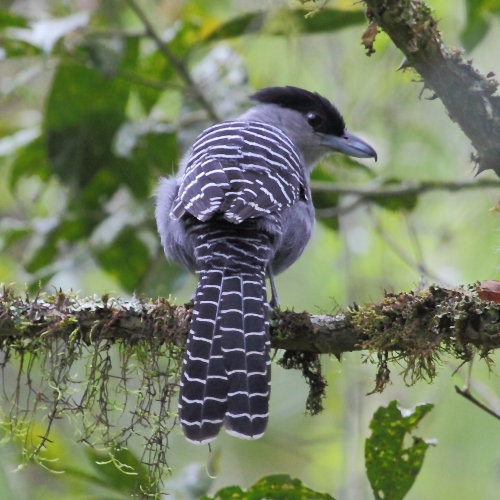
Silvery-cheeked Antshrike
Sakesphorus cristatus
Order: Passeriformes / Family: Thamnophilidae

Wikimedia Commons
About the Silvery-cheeked Antshrike
The Silvery-cheeked Antshrike (Sakesphorus cristatus) is an enchanting bird native to the vast tropical landscapes of South America, where it plays a significant role in the ecosystem. This species can be found predominantly in the Atlantic Forest regions of eastern Brazil, extending its presence into parts of Paraguay and northeastern Argentina. As a member of the Thamnophilidae family, the Silvery-cheeked Antshrike is an important insectivore, contributing to the control of insect populations and promoting the health of forest ecosystems.
This bird's ecological significance cannot be understated; through its feeding habits, it helps maintain a balance in the forest's food web. By preying on various insects, the Silvery-cheeked Antshrike indirectly supports plant growth by controlling herbivorous insect populations. Its presence in these rich habitats indicates a healthy ecosystem, as it requires a well-structured environment to thrive. The bird's reliance on dense canopy cover underscores the importance of preserving its natural habitats, which are increasingly threatened by deforestation and habitat fragmentation.
Seasonal behaviors of the Silvery-cheeked Antshrike include subtle shifts within its habitat rather than long migrations. While not migratory, it may move vertically within forest strata in response to climatic changes or resource availability, ensuring it remains in areas that provide adequate food and protection. Understanding the behavior and ecological role of Sakesphorus cristatus is crucial for conservation efforts, as it is indicative of broader environmental health. Its success in varied forest environments highlights the adaptability of this species, yet underscores the fragility of its existence amidst growing environmental pressures.
The Silvery-cheeked Antshrike belongs to the family Thamnophilidae, within the order Passeriformes. These birds typically live average 3-5 years, with some living up to 7 years..
How to Identify a Silvery-cheeked Antshrike
The Silvery-cheeked Antshrike is a medium-sized bird with a distinctive appearance that makes it relatively easy to identify in the field. Adult males possess striking silvery-white cheek patches, a trait from which they derive their common name, contrasting with their predominantly dark plumage. Their bodies are covered in black feathers with a slightly iridescent sheen, giving them a glossy appearance when caught in sunlight. Females exhibit a more subdued coloration, with brownish tones replacing the males' darker plumage, and their cheek patches are less pronounced. This sexual dimorphism aids in distinguishing between the sexes.
Juveniles resemble females but are slightly duller, with less pronounced cheek patches and a more uniform brownish coloration, which offers them camouflage during their vulnerable early life stages. Observers should note that the Silvery-cheeked Antshrike can be confused with the similar Spot-backed Antshrike (Hypoedaleus guttatus), especially in overlapping ranges. However, the latter lacks the silvery cheek patches and features more extensive spotting on its back.
In flight, the Silvery-cheeked Antshrike presents a compact silhouette with broad wings and a short tail, typical of forest-dwelling antshrikes. When perching, it often adopts an upright posture, making it easier to spot among the dense foliage. The bird's behavior of frequently flicking its tail adds to its distinguishable field marks, helping birders and naturalists alike to confirm its identity in its natural habitat.
Having trouble telling birds apart? Upload a photo to our bird identification tool for an instant species match.
Silvery-cheeked Antshrike Habitat and Range
Preferred Habitat
The Silvery-cheeked Antshrike thrives in dense tropical and subtropical forests, particularly favoring the Atlantic Forest biome of South America. This rich, biodiverse habitat provides the dense canopy and undergrowth that the species requires for feeding and nesting. These forests, located in eastern Brazil, Paraguay, and northeastern Argentina, offer the ideal environment for the antshrike, with a complex structure of trees, shrubs, and lianas.
This bird typically resides at elevations ranging from sea level to about 1200 meters, though it is most abundant in lowland and montane forests where the vegetation is thickest. During different seasons, while the antshrike does not migrate, it may shift location within its habitat to follow food availability and optimal conditions, moving vertically within the forest strata to exploit different ecological niches.
While the Silvery-cheeked Antshrike generally avoids urban areas, it can occasionally be found in secondary growth forests and forest edges, where human activity has altered the landscape but not completely removed the necessary structural complexity. Its presence in these modified habitats highlights a degree of adaptability, although it continues to rely heavily on primary forest ecosystems for survival.
Geographic Range
The Silvery-cheeked Antshrike's range is primarily concentrated in the Atlantic Forest region of eastern South America. Its breeding range extends throughout southeastern Brazil, from Bahia to Rio Grande do Sul, and into eastern Paraguay and the Misiones province of northeastern Argentina. This distribution reflects the bird's preference for the humid Atlantic Forest biome, which offers the resources necessary for its survival.
Throughout its range, the Silvery-cheeked Antshrike is a year-round resident, showing limited movement beyond its established territories. It does not undertake long migrations, instead relying on the consistent climate and resources provided by its habitat. Some localized movements may occur in response to food availability or climatic conditions, but these are typically within the same general area rather than long-distance migrations.
Population densities of the Silvery-cheeked Antshrike vary across its range, with hotspots often found in undisturbed forest areas where human impact is minimal. Conservation efforts in regions like the Serra do Mar and Serra Geral ranges are vital for maintaining these population centers, as these areas contain some of the largest remaining tracts of Atlantic Forest, essential for the bird's continued viability.
Want to know which birds visit your area? Browse our backyard birds by location guides for region-specific species lists.
What Does the Silvery-cheeked Antshrike Eat?
The diet of the Silvery-cheeked Antshrike primarily consists of insects and other small arthropods, making it an important insectivore within its ecosystem. It forages mostly in the mid to upper canopy layers of the forest, using its sharp eyesight and quick reflexes to snatch prey from leaves and branches. Beetles, ants, and various larvae constitute the bulk of its diet, but the bird is opportunistic and will consume a wide variety of available insects.
During the rainy season, when insect activity is at its peak, the Silvery-cheeked Antshrike increases its feeding activity, taking advantage of the abundance of food. In contrast, during the drier months, it may expand its diet to include small fruits and seeds, although this is less common. The bird employs a methodical foraging technique, moving deliberately through the foliage while searching for prey.
Prey size is typically small to medium, with the antshrike favoring insects that can be easily handled and swallowed whole. Its feeding schedule is largely diurnal, with foraging activity peaking in the early morning and late afternoon, coinciding with periods of increased insect activity. This daily rhythm ensures the bird maximizes its energy intake while minimizing exposure to predators.
Silvery-cheeked Antshrike Behavior and Social Structure
The Silvery-cheeked Antshrike exhibits a social structure centered around monogamous pairs, which maintain and defend territories within their forest habitat. These territories, established through vocalizations and displays, are essential for breeding and feeding. Courtship displays are subtle, often involving mutual preening and the presentation of food items by the male to the female.
Although primarily solitary or found in pairs, the Silvery-cheeked Antshrike occasionally joins mixed-species flocks, particularly outside the breeding season. These associations provide increased foraging opportunities and protection from predators through collective vigilance.
The species displays a strong territorial behavior, with both males and females engaging in vocal duets to establish and reaffirm their presence in the area. When confronted by predators, the antshrike employs a combination of alarm calls and evasive flight maneuvers to avoid detection and capture. Daily activity patterns are largely dictated by environmental conditions, with peak activity occurring during the cooler hours of the morning and late afternoon, when the bird is most actively foraging and defending its territory.
Silvery-cheeked Antshrike Nesting and Reproduction
Nesting for the Silvery-cheeked Antshrike involves constructing a cup-shaped nest, typically placed in the dense understory of its forest habitat. The nest is made from a combination of plant fibers, leaves, and twigs, carefully woven together to provide a secure environment for the eggs. This location choice helps protect the nest from predators and environmental elements.
The typical clutch size consists of two to three eggs, which are incubated primarily by the female, though the male may assist occasionally. The incubation period lasts about 14 to 16 days, during which the parents alternate between incubating and foraging for food. Once the chicks hatch, both parents participate in feeding and caring for the young, ensuring a steady supply of insects to support their rapid growth.
Fledging occurs approximately 12 to 14 days after hatching, with the young birds remaining under parental care for several additional weeks as they learn essential survival skills. Generally, the Silvery-cheeked Antshrike produces one to two broods per year, depending on environmental conditions and resource availability. The cooperative breeding strategy and shared parental responsibilities increase the chances of survival for the offspring.
Silvery-cheeked Antshrike Sounds and Vocalizations
The vocalizations of the Silvery-cheeked Antshrike are a key aspect of its behavior and a primary method of communication. Its primary song is a series of clear, melodious whistles that carry well through the dense forest, often delivered as a rapid sequence of notes that rise and fall in pitch. This song serves to establish territory and attract mates, and it is typically more pronounced during the breeding season.
Call notes are varied, consisting of sharp clicks and soft chirps used for communication between mates and signaling alarm. When threatened, the bird emits a distinctive, harsh call to alert nearby individuals of potential danger. During the dawn chorus, the Silvery-cheeked Antshrike is among the first to vocalize, its song adding to the symphony of sounds that marks the beginning of the day in tropical forests.
Its vocalizations are reminiscent of other antshrikes but can be distinguished by their distinctive rhythm and tonal quality. These sounds are essential for researchers and birders to identify the presence of the Silvery-cheeked Antshrike in its dense forest habitat.
Interesting Facts About the Silvery-cheeked Antshrike
- 1The Silvery-cheeked Antshrike's silvery facial feathers are a unique feature among antbirds.
- 2Despite its name, the Silvery-cheeked Antshrike primarily eats insects, not ants.
- 3This bird is most vocal during the early morning, contributing to the forest's dawn chorus.
- 4The Silvery-cheeked Antshrike is known for its territorial duets, where pairs sing in harmony.
- 5Its reliance on dense forests makes it an indicator species for ecosystem health.
- 6The Atlantic Forest, home to the antshrike, is one of the world's richest and most endangered habitats.
- 7The species rarely migrates, instead shifting locally to adapt to food availability.
Silvery-cheeked Antshrike Conservation Status
The Silvery-cheeked Antshrike is currently classified as a species of Least Concern by the IUCN, but its population trend is decreasing due to ongoing habitat loss. The primary threat to this species is deforestation, driven by agricultural expansion, logging, and urban development in the Atlantic Forest region. These activities fragment and degrade the vital habitats that the antshrike and many other species depend on. Conservation efforts focus on habitat protection and restoration, with several protected areas established within the bird's range, such as the Serra do Mar State Park and the Iguaçu National Park. These initiatives aim to preserve the remaining tracts of Atlantic Forest, promoting reforestation and sustainable land use practices to mitigate further habitat loss. Historically, the Silvery-cheeked Antshrike's population remained stable, but recent environmental pressures have highlighted the need for continued conservation efforts. By raising awareness and supporting local conservation programs, stakeholders can help ensure the long-term survival of this and other species that rely on the Atlantic Forest.